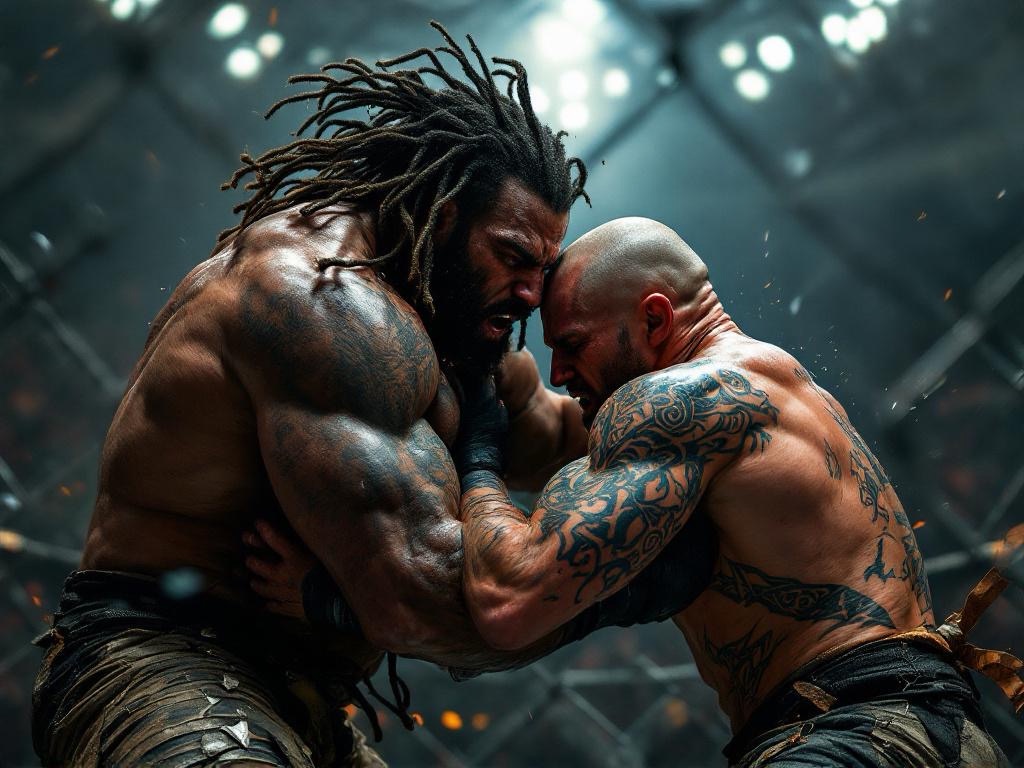
When Randy Orton stepped into the Hell in a Cell with Mark Henry on October 2, 2011, the match was not framed as a clash of equals. It was designed as a test of whether structure, experience, and resilience could withstand overwhelming force applied with intent.
This was not a spectacle-driven Cell match. It was an experiment in containment.
Why This Match Existed
The catalyst was straightforward. At Night of Champions 2011, Mark Henry defeated Orton to capture the World Heavyweight Championship, the culmination of a 15-year career repositioned almost overnight.
What mattered more than the title change was how it was framed.
Henry was not presented as opportunistic. He was presented as inevitable.
SmackDown General Manager Theodore Long escalated the rematch into Hell in a Cell not to enhance drama, but to contain damage. The structure, at the time an expanded five-ton, 20-foot enclosure, was framed as a necessary control mechanism rather than a spectacle device.
That framing dictated everything that followed.
The “Hall of Pain” as a System, Not a Gimmick
By late 2011, the “Hall of Pain” was less a catchphrase and more a repeatable pattern.
Henry’s character operated on three principles:
- Target the legs
- End matches through incapacitation, not pinfall drama
- Accumulate victims to validate threat
The list was deliberate. The Big Show, Kane, The Great Khali. Each represented size, legacy, or durability. Each was removed methodically.
This run worked because it was restrained. Henry did not chase crowd reaction. He reduced opponents to problems to be solved physically.
Against Orton, the system faced its most resistant variable.
Orton’s Role: Experience as Defensive Structure
Orton entered as champion in waiting, not underdog. His advantage was not power but familiarity.
By 2011, Orton had extensive Hell in a Cell experience. After all, he had been main event material alongside Triple H for many years by this point. He understood the structure as terrain. Early in the match, he attempted to weaponise that knowledge by dragging Henry into the steel, scraping his face against the mesh, and testing whether the monster would react emotionally.
Henry did not.
Instead, he inverted the dynamic. Rather than chasing Orton into the cell, he drove Orton into it. Back-first. Repeatedly. The message was immediate: the structure would not be used creatively. It would be used bluntly.
This established the match’s tone. No momentum swings. No escalation. Just pressure.
Match Architecture: Heavyweight Logic
The match ran 15 minutes and 54 seconds, and its pacing reflected intent rather than limitation.
There were no high-risk sequences. No aerial ambition. The emphasis was on:
- Positional dominance
- Damage accumulation
- Visual confirmation of force
The steel steps spot encapsulated this approach. Henry dismantled the ring steps and threw the upper half across the ring at Orton. It was not dramatic in motion, but it was conclusive in meaning. Objects were not tools. They were extensions of Henry’s physical authority.
Orton’s counters were reactive rather than proactive. His DDT onto the steps functioned as a pressure release, not a momentum shift. It bought time. It did not threaten outcome.
The One-Count: Purposeful Shock
The most discussed moment of the match remains Orton’s RKO and Henry’s kick-out at one.
The one-count was not there to elevate Orton. It was there to redefine the ceiling of Henry’s damage tolerance. The audience reaction was strong because the moment recalibrated expectations mid-match. If the RKO was insufficient, escalation pathways narrowed.
From that point forward, Orton’s options reduced to one.
The Finish: Closure Without Ambiguity
Orton attempted the Punt Kick, historically his most definitive weapon. Henry catching it mid-motion and converting directly into the World’s Strongest Slam was not a reversal. It was a refusal.
The pinfall was clean. No assistance. No structural interference. No controversy.
This mattered.
Hell in a Cell matches often obscure outcomes behind chaos. This one clarified them. Henry was champion not because the cell allowed him to be, but because nothing inside it could stop him.
Post-Match Behavior: Character Continuity
Henry’s attempted induction of Orton into the Hall of Pain reinforced consistency. He was not satisfied with victory. He sought permanence.
Orton’s escape and chair retaliation did not undermine Henry. It re-established Orton as resilient rather than dominant. The visual language remained intact.
The following SmackDown pivoted logically. The Big Show returned as the next physical test. Orton redirected into a personal feud with Cody Rhodes, aligning character trajectories without overlap.
Reception and Legacy
Dave Meltzer’s 2.5-star rating reflected structural limitations rather than narrative failure. With multiple Cell matches on the card, novelty diluted impact. But internally, the match succeeded.
The 182,000 PPV buys, down year-on-year, contextualise the era rather than the execution.
More importantly, the World Heavyweight Championship emerged stronger. It was defended, not survived.
Final Assessment
This was not a classic. It was not designed to be. Unlike the upcoming Royal Rumble…
Randy Orton vs Mark Henry at Hell in a Cell 2011 functioned as character confirmation through constraint. The cell did not escalate violence. It framed inevitability.
Mark Henry’s 2011 run worked because it respected structure. He did not sprint. He compressed. He did not chase reactions. He closed exits.
 doragon sports