On the face of it, this looks simple. Hosts, favourites, history on their side versus debutants, underdogs, writing a story just by being here. But AFCON rarely behaves like a straight line, and Africa Cup of Nations knockouts almost never do.
On Sunday evening in Rabat, Morocco national football team and Tanzania national football team meet in a Round of 16 that carries far more emotional weight than the fixture list suggests. This is about pressure, belief, and what happens when expectation turns the volume all the way up.
For Morocco, this is another step in a long, restless march toward ending a 50-year wait for continental glory. For Tanzania’s Taifa Stars, it is already history made, and perhaps something more if the night bends just enough in their direction.
A knockout that feels bigger than the bracket
The basics first. This is the TotalEnergies AFCON 2025 Round of 16, played on January 4 at the Prince Moulay Abdellah Stadium, a 69,500-seat arena that can feel less like a stadium and more like a living organism when Morocco play. Kick-off comes at 17:00 local time, with the entire country effectively leaning forward in unison.
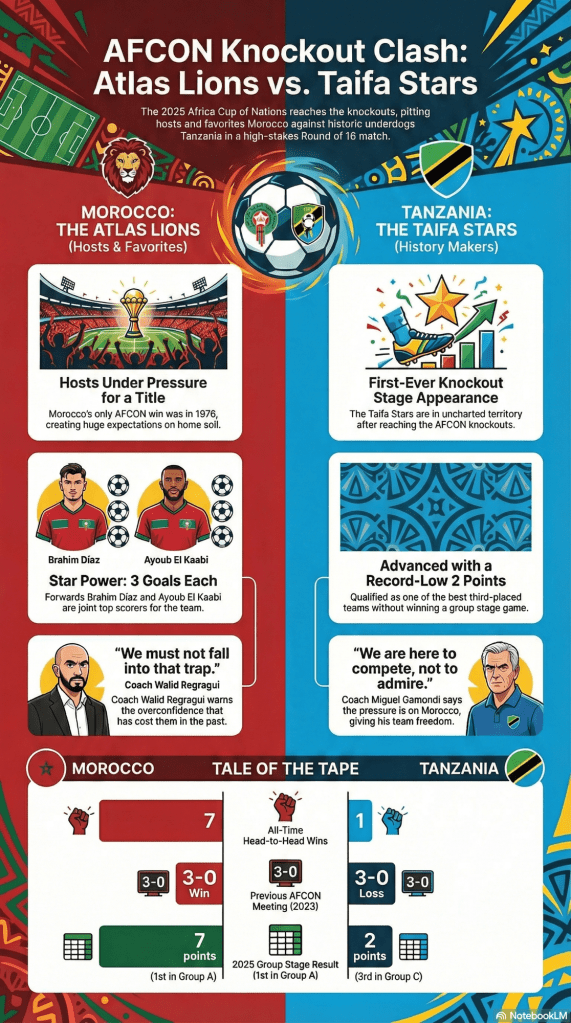
The stakes are unmissable. Morocco are hosts, favourites, and openly chasing a first AFCON title since 1976. That drought is old enough to carry its own mythology. It has survived golden generations, European stars, and even that magical World Cup run that changed how the world views African football.
Tanzania, meanwhile, have never been here before. This is their first knockout appearance in 45 years of tournament history. They scraped through the group stage with two points, the lowest tally ever to advance in the 24-team format, and somehow that only sharpens the romance of it. They are still standing. They are still playing. They are still together.
If you’re searching for a clean football prediction, this match resists it. If you’re searching for a human story, it overflows.
Morocco’s weight of history, Tanzania’s freedom
Morocco’s relationship with the Round of 16 is complicated. Since 2004, they have only passed this stage once. In each of their last three Round of 16 exits, they conceded first, a small but stubborn pattern that hangs in the air. At home, with a title-hungry crowd, that pressure multiplies rather than fades.
Head coach Walid Regragui knows this better than anyone. His public messaging throughout the tournament has been about humility, intensity, and refusing to believe that talent alone is enough. Morocco, he insists, have failed before because they assumed the story would write itself.
Tanzania arrive carrying none of that baggage. Under head coach Miguel Gamondi, appointed just weeks before the tournament, the Taifa Stars have leaned into a simple psychological truth: all the pressure lives on the other side.
Gamondi knows Morocco well. He has lived and worked there, understands the noise, the scrutiny, the expectation. He has spoken openly about how that pressure can tighten muscles as much as it sharpens focus. Tanzania’s task is to stay compact, stay patient, and wait for the moment when the jeweller’s hand trembles.
Brahim Díaz and the face of a new Morocco
If Morocco’s campaign has had a human headline, it has been Brahim Díaz. Scoring in every group-stage match, the Real Madrid attacker has moved from curiosity to cornerstone in a matter of weeks. He floats into half-spaces, drags defenders with him, and gives Morocco a creative axis that feels modern, European, and unapologetically ambitious.
There is history within reach here. A goal would make Díaz the first Moroccan to score in four consecutive AFCON matches. Records matter in tournaments like this. They give fans something to cling to when nerves creep in.
Alongside him, Ayoub El Kaabi brings a story that resonates far beyond tactics boards. El Kaabi once left school at 15 to work as a carpenter, playing amateur football in Casablanca’s streets before signing his first professional contract at 21. Now he leads the Golden Boot race, known globally for spectacular bicycle kicks and locally for a relentless hunger to score.
Morocco’s attack is rich, layered, and dangerous. But AFCON has taught us repeatedly that none of that guarantees serenity.
Tanzania’s stars, known and emerging
For Tanzania, the emotional anchor remains Ally Samatta. The captain, and the first Tanzanian to play in the Premier League, has not had a prolific tournament by his own standards. Yet his presence alone reshapes how opponents defend. He draws attention, creates space, and carries the symbolic weight of a footballing nation still defining itself on this stage.
Just one goal away from becoming Tanzania’s all-time leading scorer is Simon Msuva, whose career has quietly bridged domestic and international worlds. Meanwhile, Feisal Salum, affectionately known as Fei Toto, has already written his own line into AFCON history by becoming the first domestically based Tanzanian to score at the tournament since 1980.
These are not household names globally. They are, however, deeply rooted symbols of representation, possibility, and belief for Tanzanian fans watching at home.
Where the game may turn
Tactically, this is a familiar AFCON picture with fascinating details. Morocco are likely to morph between a 4-3-3 and a 3-2-5 in possession, with Sofyan Amrabat dropping deep to allow the full-backs to push high. That fluidity has helped them dominate possession, attempt more passes than any other team in the tournament, and camp in opposition halves.
Tanzania will almost certainly sit deep in a 5-4-1 or 3-4-1-2, compressing space and daring Morocco to force the issue. Their efficiency has been striking: three goals from just 15 shots on target. When chances arrive, they tend to matter.
One matchup worth circling is Noussair Mazraoui versus Novatus Miroshi. Mazraoui has thrived in Achraf Hakimi’s injury absence, while Miroshi has quietly provided two assists and real outlet on the counter. That flank could become a pressure valve or a fault line.
Statistically, the gap is wide. Morocco’s xG dwarfs Tanzania’s, and they arrive unbeaten in 23 matches. But they have also failed to keep a clean sheet in their last five AFCON knockout games. Patterns don’t decide matches, but they do whisper.
Atmosphere, culture, and the unseen layers
The Prince Moulay Abdellah Stadium will roar. Morocco’s fans are relentless, knowledgeable, and deeply invested in this moment. They are also impatient. If an early goal does not arrive, encouragement can curdle into anxiety, and anxiety can turn into noise of a different kind.
Hovering over it all is the tournament mascot, Assad the Barbary lion, a neat symbol for a team nicknamed the Atlas Lions. Strength, pride, dominance. All expected. All demanded.
Tanzania’s cultural thread is different, but no less powerful. Their campaign has leaned heavily on the idea of Pamoja, togetherness. Reaching the Round of 16 has already been rewarded back home, a tangible reminder that this journey matters beyond the pitch.
There is also a quieter backdrop. Morocco has hosted amid social tension, with younger generations questioning the cost and priorities of large-scale sporting investment. Football does not exist in a vacuum, and nights like this inevitably absorb more meaning than the scoreline alone.
So, what does it all mean?
This match is not just taifa stars vs morocco. It is experience versus emergence, expectation versus freedom, control versus resistance. It is the équipe du Maroc de football trying to impose its rhythm under unforgiving lights, and a Tanzanian side discovering how far collective belief can carry them.
In terms of a football prediction, logic favours Morocco. The depth, the talent, the structure, the numbers all lean red. But AFCON knockouts have a habit of punishing assumption. One set-piece. One counter. One moment of hesitation.
Think of it like this: Morocco are a master jeweller, tasked with cutting a flawless stone under thousands of expectant eyes. Tanzania are the blacksmith, patient, watchful, waiting for the smallest crack in the tool. If it comes, the whole display can shatter.
Whatever happens, this fixture adds another chapter to the evolving classement championnat d’Afrique des nations de football, and another entry to the growing story of the Taifa Stars fixtures list that Tanzanian fans will remember for decades.
It’s not over yet. And that, as AFCON so often reminds us, is the whole point.
 doragon sports