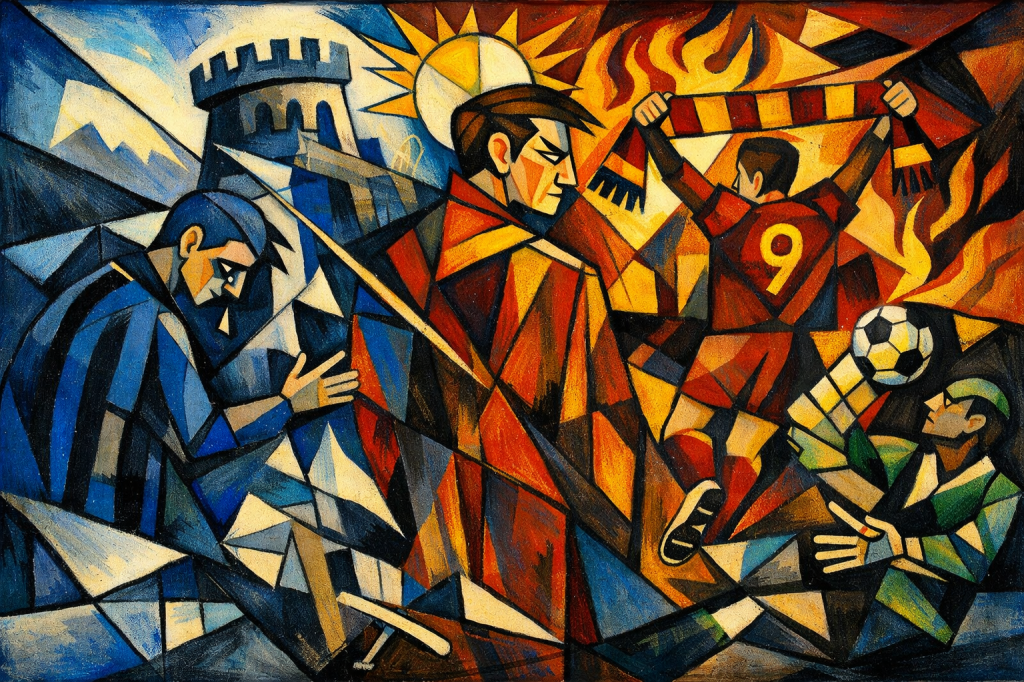
On the face of it, this is just another Saturday night fixture. Serie A Matchday 18, 20:45, Bergamo. Scroll past it on your phone and it sits neatly among the SERIE A results today ticker and the churn of mid-season Serie A news. But that framing is lazy, and football has always relied on laziness to soften uncomfortable truths.
This match is about ownership of ideas. About who gets credit, who gets discarded, and who gets to rebrand a philosophy once it starts making serious money.
On January 3, 2026, Atalanta BC host AS Roma at the New Balance Arena, and for the first time since the breakup, Gian Piero Gasperini returns not as a guardian but as a challenger. Not to reminisce. To measure what survived him, and what didn’t.
Let’s rewind.
The league table tells one story. Power tells another.
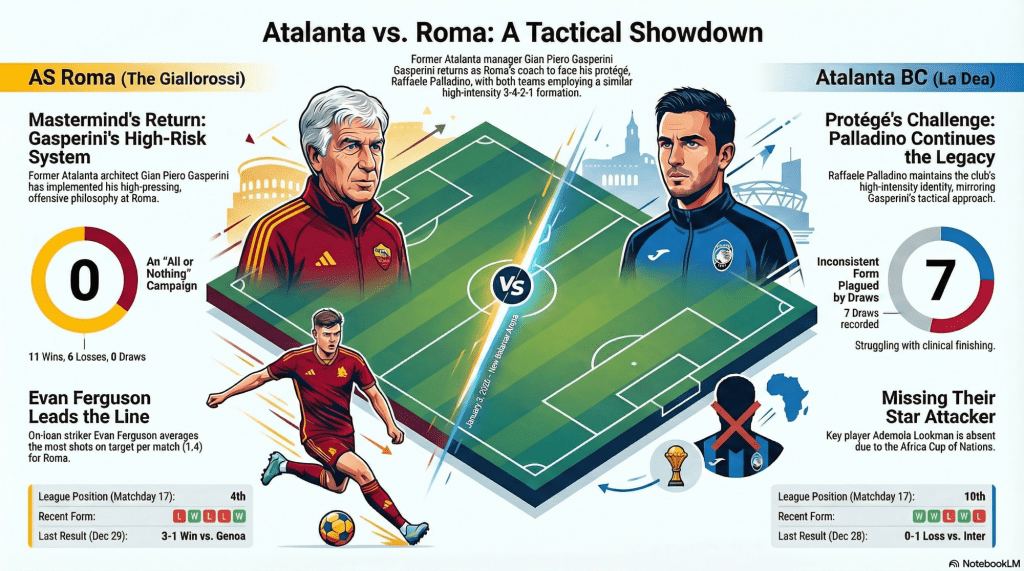
Roma arrive fourth, 33 points, Scudetto-adjacent and structurally confident. Their position is the clean version of the narrative. The AS Roma score lines up neatly with ambition. Win here and Juventus are suddenly in the rear-view mirror.
Atalanta, meanwhile, sit tenth. Atalanta standings that feel wrong if you’ve internalised the last decade. This was meant to be the sustainable model. The proof that you could punch up without selling your soul. Instead, it’s become a warning label.
The numbers matter. Roma have no draws in their first 16 league games. None. That is not volatility by accident. That’s a system designed to burn or soar. Gasperini’s Roma is football stripped of compromise, and when it works, it feels like destiny. When it fails, it’s merciless.
Atalanta’s season reads differently. Shot volume remains elite. Defensive duels are still among the highest in the league. The infrastructure is intact. But the connective tissue is frayed. And when Ivan Jurić was dismissed after a six-game winless run, it wasn’t just a sacking. It was an admission that the club no longer knew how to be itself without the man who taught it how.
That’s the quiet violence of football’s so-called progress.
Gasperini built a house. Others tried to rent it out.
There’s a tendency to sanitise legacies once they become profitable. Gasperini’s Atalanta years are now packaged as an aesthetic. High pressing. Man-to-man. Verticality. But at the time, it was political. It was refusal. A rejection of hierarchy in a league addicted to surnames and balance sheets.
Atalanta weren’t meant to win a European trophy. They weren’t meant to turn Bergamo into a destination rather than a footnote. And yet they did, culminating in the 2024 Europa League and a civic pride that went well beyond football.
That context matters. Especially in Bergamo, a city that used football as communal therapy after the devastation of 2020. This wasn’t branding. It was survival.
So when Gasperini left and the club attempted continuity without authorship, the cracks were inevitable. Raffaele Palladino has inherited not just a squad, but a moral expectation. To press, yes. To attack, yes. But also to mean something.
You may ask why this matters now.
Because Roma are monetising the very chaos Atalanta once weaponised.
Roma’s rise is disciplined chaos, funded properly
Roma’s project works because it’s resourced. Gasperini’s methods at Trigoria are no longer revolutionary. They are optimised. Sports science. Squad depth. Controlled rotation. The violence of the press cushioned by financial planning.
That’s not a criticism. It’s a diagnosis.
Players like Bryan Cristante are central to this evolution. Once a free-scoring midfielder under Gasperini in Bergamo, now Roma’s captain and defensive organiser. The system bends around him. The chaos has a spine.
Then there’s Paulo Dybala, drifting between lines like a luxury Roma can now afford. He isn’t asked to save the system. He’s asked to decorate it.
This is what structural advantage looks like. Same philosophy. Different safety net.
And it’s why Roma can survive nights when the plan misfires. Atalanta, increasingly, cannot.
Zalewski, Ferguson, and the economics of patience
Football loves a redemption arc, but it rarely funds one.
Nicola Zalewski is the human subplot that cuts closest to the bone. A Roma academy product moved on without ceremony, his development outsourced, his resale value quietly maximised. Atalanta paid €17 million for belief Roma no longer had the patience to offer.
That’s not cruelty. It’s modern football.
Across the pitch, Evan Ferguson represents a different gamble. Gasperini’s public scepticism has been blunt, bordering on transactional. He isn’t convinced. And in this system, conviction is currency.
This is where ideology meets reality. Youth development sounds noble until points are on the line. Until sponsors are watching. Until the margin for error disappears.
Atalanta once thrived in that uncertainty. Roma now manage it.
Tactically, this is a mirror. Emotionally, it’s a collision.
Both sides will line up in a 3-4-2-1. Both will press man-to-man. Both will dare the other to blink first.
But the similarity is deceptive.
Roma press with the assurance of recovery options. Atalanta press with urgency. One mistake at the back and the stadium tightens. The newly rebuilt Curva Sud was designed to induce anxiety, and in January cold, it will succeed.
Players like Marten de Roon embody Atalanta’s resistance. Relentless. Uncompromising. Less marketable than his Roma counterparts, but no less essential. His duel with Dybala is less about flair than control. Who dictates the emotional temperature of the match.
In goal, Roma’s hierarchy is clear. Mile Svilar starts. Pierluigi Gollini watches. For Atalanta fans, Gollini’s presence in Roma colours is a reminder of how easily cult heroes become assets.
Fans feel this stuff, even when institutions don’t
For Roma supporters travelling north, the match is framed as momentum. Another step toward relevance. Another reason to lift the AS Roma scarf and believe this season is different.
For Atalanta, it’s heavier. This is about validation. About proving the idea wasn’t portable. About reminding the league that Bergamo wasn’t a temporary laboratory.
There’s a wider conversation to be had here about football’s extractive habits. About how innovation is celebrated until it can be bought, copied, and insured against failure. Atalanta lived the risk. Roma now reap the refinement.
That doesn’t make Roma villains. It makes them beneficiaries.
What happens next is the verdict
If Roma win, the narrative will harden. Gasperini as master. Atalanta as former muse. Another data point in the Serie A news cycle about resurgence and inevitability.
If Atalanta win, it becomes resistance. Proof that identity can survive its architect. That the house still stands, even if the locks were changed.
Football loves to pretend it’s neutral. It isn’t. It reflects who has leverage, who gets time, and who is asked to prove themselves again and again.
On Saturday night in Bergamo, this match stops being about form, fixtures, or even points. It becomes a question.
Who owns an idea once it starts making money?
And who pays when it moves on?
 doragon sports