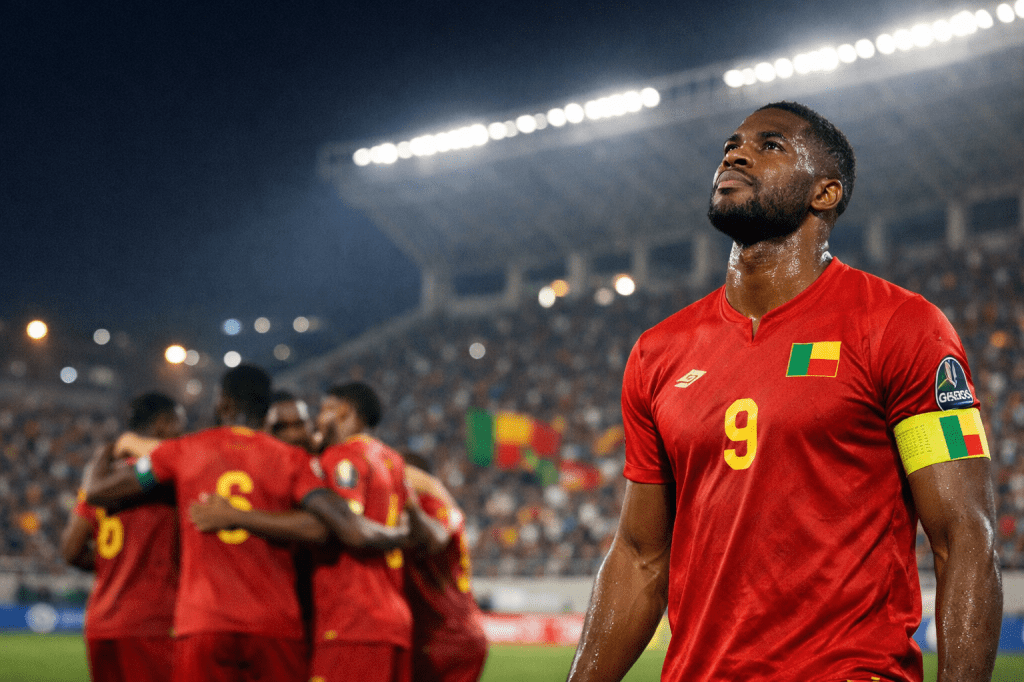
Benin’s Africa Cup of Nations story has often been told in pauses rather than paragraphs. Long waits. Near misses. Quiet exits. For decades, progress came in inches, not strides. At AFCON 2025 in Morocco, that rhythm has finally shifted. Not with noise or spectacle, but with something more durable: composure, clarity, and a sense of direction.
On December 27, Benin defeated Botswana 1–0 in Tangier. It was their first ever AFCON victory achieved in regulation time. A single goal, a narrow margin, and yet a moment that subtly redefined the country’s football narrative. For the first time, the Cheetahs are not chasing history from behind. They are holding it in their hands.
As Group D reaches its final matchday, Benin sit third on three points. In most tournaments, that would feel precarious. At AFCON 2025, it is quietly powerful. With the four best third placed teams advancing, Benin currently occupy the strongest of those positions. Their final group match against Senegal will determine whether this campaign becomes a respectable footnote or something more lasting.
A win that changed the air
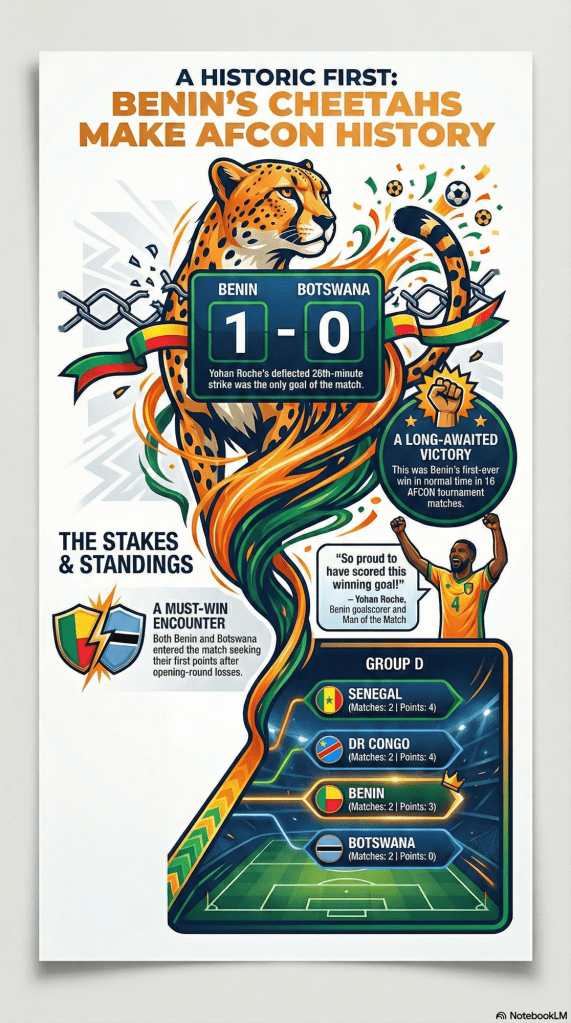
The Botswana match did not unfold like a fairytale. It unfolded like a team that understood the moment. Benin scored in the 28th minute through Yohan Roche, a defender stepping into space to complete a sharp one two with captain Steve Mounié. The finish was deflected, decisive, and symbolic. Benin did not wait for fortune. They moved toward it.
From there, the match took on a familiar AFCON shape: pressure, set pieces, moments of tension. Botswana struck the crossbar from a free kick. The final minutes stretched. Benin’s back line narrowed, cleared, and reorganised. There was no panic, only focus. When the final whistle came, it did not release joy so much as confirmation. This team had learned how to protect something valuable.
That result did more than deliver three points. It lifted a psychological ceiling. Benin had arrived at previous tournaments hoping not to lose. In Tangier, they learned how to win.
The shape of progress
The opening match against DR Congo had already hinted at this shift. Benin lost 1–0 to an early goal, but the performance was measured and competitive. They controlled spells of possession, moved the ball with patience, and pressed selectively. Coach Gernot Rohr later noted his side’s composure and their frustration at a late handball decision that went unpunished.
The result did not flatter Benin, but it did not diminish them either. The defeat felt contextual, not terminal. That distinction mattered.
Under Rohr, Benin have slowly refined their tactical identity. The federation’s decision to rebrand the team from the Squirrels to the Cheetahs was more than cosmetic. It reflected an internal reset. This Benin side is compact without being passive, direct without being rushed. They defend in layers, value territory, and rely on collective discipline rather than individual stardom.
Across two matches, their defensive distances have tightened, their midfield spacing improved, and their transitions sharpened. This is not a team discovering itself mid tournament. It is one executing a plan.
Leadership and responsibility
At the centre of that plan is Mounié. The captain’s role extends beyond goals and assists. He sets the tempo of Benin’s attacks, holds defenders in place, and communicates constantly. His assist against Botswana was understated but intelligent, releasing Roche into a channel with perfect timing. Moments later, he was dropping deep to relieve pressure.
Mounié’s career has taken him through demanding European environments. At AFCON 2025, that experience shows in small decisions: when to slow the game, when to contest a second ball, when to speak and when to gesture. Leadership here is not theatrical. It is functional.
Behind him, Roche has emerged as an unlikely figurehead. His Man of the Match performance against Botswana was built on anticipation and positional discipline as much as the goal itself. Benin’s defenders are not tasked with carrying the ball long distances or breaking lines. They are asked to read danger early and respond together. Roche has embodied that brief.
In goal, stability has been equally important. Saturnin Allagbé provided assurance in the opener, while Marcel Dandjinou returned against Botswana to manage the match with calm authority. Distribution was conservative, time management effective. There were no unnecessary risks.
Out wide, Junior Olaïtan has added movement and unpredictability. His return to the starting lineup stretched Botswana’s defensive shape and gave Benin an outlet when under pressure. He represents the next phase of this project: players who can operate comfortably between structure and expression.
The Senegal test
If Benin’s journey has been about control, Senegal’s presence introduces scale. The reigning champions are tournament favourites again, carrying depth, physical power, and attacking threat. They lead Group D with four points and have already shown their capacity to recover within matches.
Sadio Mané remains their emotional and technical reference point, scoring a crucial equaliser against DR Congo. Nicolas Jackson offers directness and pace, capable of unsettling any defensive line.
Yet Senegal are not untouchable. They conceded in their last outing. Their rhythm can be disrupted. For Benin, the task is not to outplay Senegal, but to remain present within the match long enough for opportunities to appear.
The venue, Tangier Grand Stadium, has already felt welcoming to Benin. The atmosphere has been balanced, the pitch forgiving. Familiarity matters at this stage of tournaments. It calms margins.
Memory and meaning
History frames this moment gently but firmly. Benin’s run to the quarter finals in 2019 remains their benchmark, achieved without winning a match in normal time. AFCON 2025 has already surpassed that achievement in substance, if not yet in distance.
This campaign has been built on presence rather than momentum. Each performance has been contained, deliberate, and human. Rohr, now at his fourth AFCON finals, has spoken about character more than tactics. He has emphasised preparation, patience, and belief. Those are not slogans. They are observable traits in this team.
For supporters following the classement équipe du bénin de football, this tournament has offered something new: reliability. Benin have not relied on chaos or fortune. They have relied on structure. For audiences engaging through platforms like Benin web tv, the shift has been visible. Matches are no longer endured. They are followed with expectation.
Even beyond football, the symbolism has travelled. In Porto Novo, conversations drift between results and everyday life, between kick off times and routines, between the match schedule and a search for a pharmacie de garde Porto Novo late in the evening. Football has reentered daily rhythm not as distraction, but as shared reference.
A calm edge of possibility
Benin approach their final group match without urgency, but not without ambition. A draw may be enough. A win would be transformative. Defeat would not erase what has already been built.
They are no longer running simply to keep pace. They are choosing their moments to accelerate.
In tournaments like AFCON, history often turns not on grand gestures, but on accumulation. One solid defensive block. One clear decision. One shared understanding of space and time. Benin have assembled those elements quietly.
Against Senegal, they will test them.
Whatever the outcome, this campaign has already reshaped perception. The Cheetahs are no longer defined by what they have not done. They are defined by how they now behave on the pitch.
That, in itself, is progress dressed in composure
 doragon sports