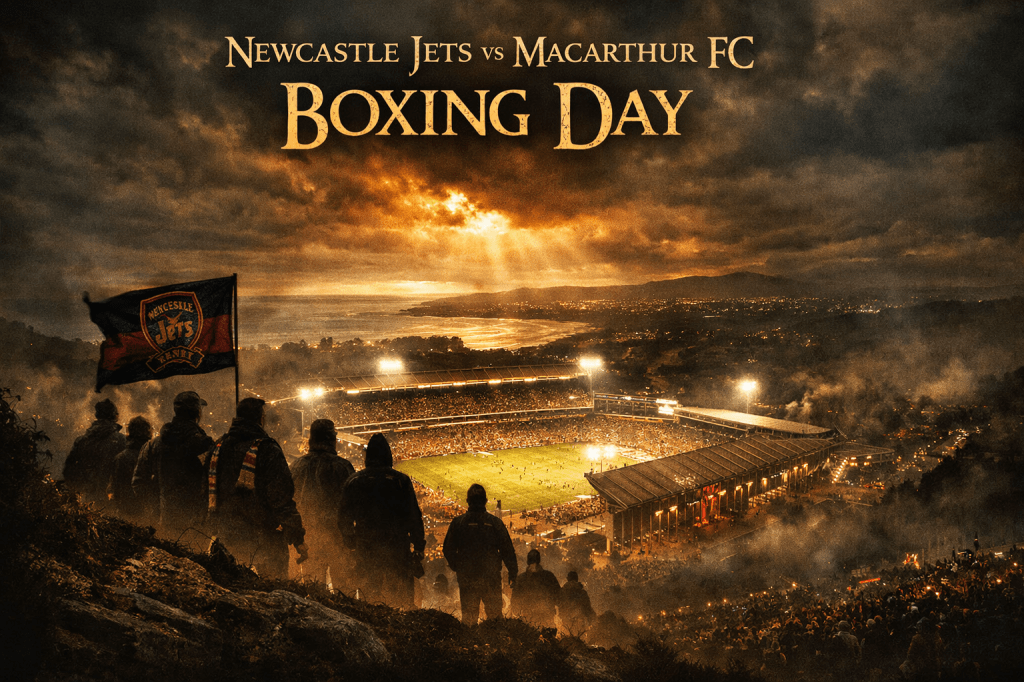
Boxing Day football: but make it political. Make it human. Make it a reckoning.
On the face of it, this is a neat little mid-table Christmas fixture. Sixth versus seventh. Twelve points apiece. A Boxing Day crowd in Newcastle, kids still sticky with chocolate, adults clinging to beer and hope. A-League Men doing what it always does best in December: offering chaos as a public service.
But scratch the surface and the Round 10 meeting between Newcastle Jets and Macarthur FC is less festive filler and more stress test. For models. For managers. For clubs trying to convince their fans and their owners that this season is going somewhere meaningful rather than circling the same precarious drain.
This game matters because it has to.
The traffic jam nobody escapes by accident
Let’s rewind.
The Isuzu UTE A-League Men has spent years marketing parity as virtue. Competitive balance. Anyone can beat anyone. A league without oil states or super clubs. The rhetoric is tidy. The reality is messier.
When everyone sits on similar points deep into December, what you actually have is not equality but fragility. One win buys oxygen. One loss drags you into the undertow of narrative collapse. Twelve points feels fine until it doesn’t.
That is the context at McDonald Jones Stadium on Friday night. Newcastle sixth. Macarthur seventh. Goal difference doing the separating. The top six still framed as a promised land even though the league has never fully resolved whether that threshold is aspirational or arbitrary.
Win and you can sell momentum. Lose and you are suddenly “under pressure”, a phrase that in A-League terms often precedes budget tightening, fan disengagement, or January panic.
There’s a wider conversation to be had here about what success actually looks like in a competition still structurally addicted to short-termism. But Boxing Day doesn’t wait for governance reform.
Memory is a weapon, and Newcastle are holding it
Newcastle arrive with something dangerously intoxicating: precedent.
Earlier this season they dismantled Macarthur 3–0 in the Australia Cup quarter-finals. Comprehensive. Ruthless. The kind of result that lives rent-free in dressing rooms and supporter forums alike. It whispers certainty. It lies.
Because the head-to-head record remains dead level. Five wins each. Five draws. This rivalry has no natural hierarchy, only moments of dominance that expire quickly.
Still, psychology matters. Especially in a league where margins are thin and confidence often substitutes for control.
Macarthur know this. They also know they are arriving battered.
A midweek trip to Melbourne. Heavy legs. Sixteen yellow cards across their last five matches. This wasn’t discipline; it was desperation. A team reaching for fouls as tactical brake pads, trying to slow games they don’t fully trust themselves to manage.
That approach has a cost. Boxing Day crowds smell fatigue like blood in water.
The managers, and what they represent
You may ask why this fixture feels heavier than its table position suggests. Start on the touchlines.
Mark Milligan is a first-year professional head coach, which in Australian football still feels like a radical act. His influences are telling. Ange Postecoglou. Bert van Marwijk. Coaches who, for very different reasons, insist that players own their performances rather than hide inside systems.
Milligan talks about accountability and ownership not as slogans but as daily habits. He treats the season “one day at a time”, which sounds banal until you realise how few clubs in this league are actually afforded that luxury. Most are managing weeks, not years.
Across from him is Mile Sterjovski, whose Macarthur side reflects the economic logic of the club itself. Sit deep. Absorb. Wait. Strike when the moment arrives. It’s football as risk management.
After a brutal 2022–23, Sterjovski has pivoted toward speed and structure. Less romance. More survival. It’s not pretty, but it is legible.
The clash here is philosophical. Youthful expansion versus compact resistance. A precision-tuned engine meeting a reinforced wall.
The question is not which is better. It’s which breaks first.
The returning son and the economics of affection
There is always one subplot the league leans on harder than any broadcast deal. The return narrative.
Lachlan Rose made 98 appearances for Macarthur. Player of the Year. Fan favourite. Especially with younger supporters. He returns now in Newcastle colours, healthy again after early-season frustration.
His words about the move were professional. Excited. Ready to work. But fan reactions were raw. Disappointment. A sense of loss that doesn’t show up in spreadsheets.
This is the quiet truth of Australian football. Clubs sell community figures as assets, then act surprised when fans feel hollowed out. Loyalty is marketed. Mobility is enforced.
Rose’s presence on Boxing Day is not just personal. It’s symbolic of a league that still hasn’t reconciled player development with supporter attachment.
Football asks fans to care deeply. The system rarely returns the favour.
Redemption arcs in a league that forgets quickly
The A-League is ruthless with memory. Injuries erase players. Time accelerates. Absence is interpreted as failure.
Kristian Popovic knows this well. A twelve-month injury layoff. A quiet return. A goal in ACL2 that mattered more emotionally than commercially. His gratitude feels genuine because survival does.
So does Rose’s own frustration. Sitting out while the season moves without you is its own violence. Players talk about “killing you a little” because football identities are not built for patience.
This league offers few safety nets. Come back sharp or vanish quietly.
That is the pressure underpinning Friday night.
Where the game will actually be decided
Strip away the narratives and this match hinges on two duels.
First, Eli Adams, Newcastle’s designated Bull Hunter. Four goals in four appearances against Macarthur. Sizzling form. A winger thriving in a system that finally gives him space rather than instruction manuals.
Newcastle push their full-backs high. They overload wide areas. They score early. Six goals in the opening fifteen minutes this season. That is not coincidence. It is intent.
Macarthur know this. Which is why their defensive discipline will be tested immediately.
Second, the opposite pole: Harry Sawyer. Six-foot-five. Six goals across competitions. A human metronome around which Macarthur’s attack is calibrated.
The task of neutralising him falls to Max Cooper, eighteen years old, local, still learning where his ceiling sits. This is how leagues grow or fail. By throwing teenagers into responsibility and seeing whether the structure catches them if they stumble.
Add in Will Dobson, the hometown kid scoring at home, and Rafael Durán, a striker auditioning for relevance before January, and you have a match humming with personal stakes that no tactics board can fully contain.
Fatigue, force, and the cost of stopping momentum
There’s a physical warning flashing over Macarthur right now. Sixteen yellows in five matches. That is not just aggression; it is systemic strain.
They arrive after a midweek draw in Melbourne. Newcastle arrive rested after a sharp win over Sydney FC. In a league without deep squads or rotation budgets, this matters.
Fatigue erodes discipline. Discipline erodes shape. Shape erodes belief.
Boxing Day crowds amplify every crack. Especially in Newcastle, where Novovastrian pride is not branding but lived identity. Local kids behind the goal. Noise that feels earned rather than piped in. A sense that the club belongs to the place rather than the other way around.
That connection is fragile. But when it clicks, it lifts teams beyond spreadsheets.
The tyranny of distance, revisited
The Macarthur name is historically tied to the tyranny of distance. Wool. Transport. Isolation. Australian capitalism forged through logistics and endurance.a
On Friday, that tyranny returns in a modern form. Travel fatigue. Compressed schedules. A league that still struggles to reconcile geography with sustainability.
The Jets will try to blow the doors off early. The Bulls will try to hold. One side chasing oxygen. The other clinging to structure.
This is not just a football match. It’s a referendum on approach.
Because if Newcastle win, they sell a vision. Youth. Width. Community energy. If Macarthur survive and strike, they validate pragmatism in a league that often punishes idealism.
Neither outcome fixes the league’s deeper problems. But both will feel like truth in the moment.
And sometimes, in Australian football, that is enough to keep the lights on for another week.
Boxing Day doesn’t resolve seasons. It exposes them
 doragon sports