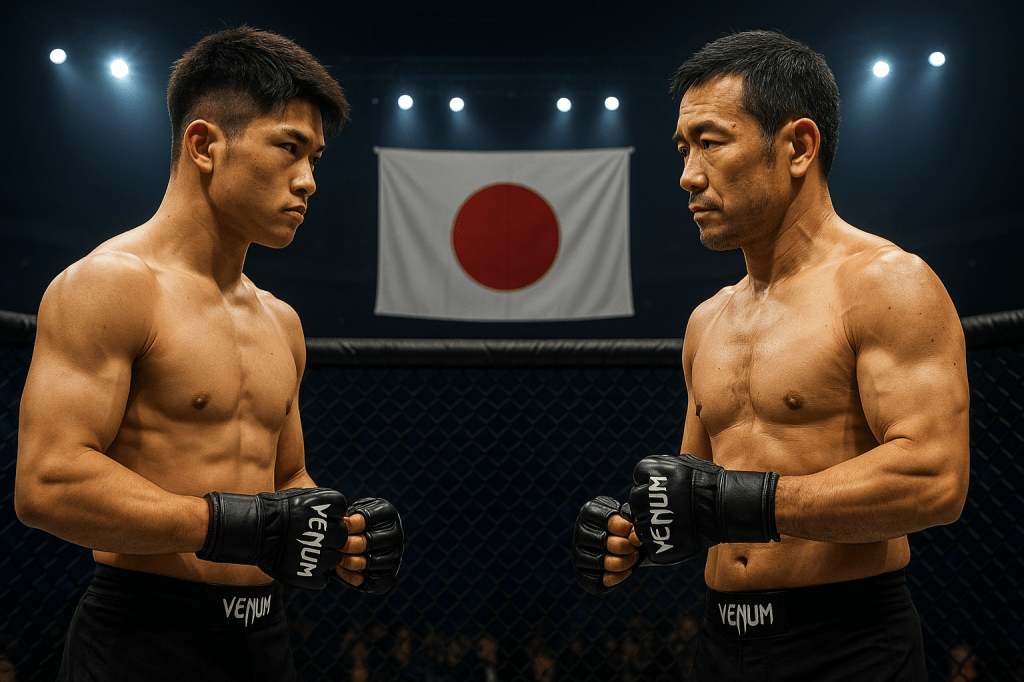
When DEEP booked Haruo Ochi’s latest title defence for December 14 at New Pier Hall, the match-up was framed not simply as a main event but as a checkpoint for the organisation’s long-term vision of the strawweight division. It is unusual for a promotion to place a 2-0 fighter in a championship bout. It is even less common for that fighter to be twenty years old, stepping into only his third professional contest.
Yet Sora Sugiyama’s accelerated pathway reflects a strategic moment for DEEP: a willingness to test the structural limits of the division, introduce new talent quickly, and study how the championship ecosystem responds when a veteran is pitted against a developmental outlier.
Ochi, 41, enters this fight in a markedly different phase of his career. A six-fight win streak, a unified belt, and a global #2 ranking at strawweight tell the story of a champion who has consolidated power in a weight class often associated with volatility. His project is one of stability and legacy-building; he has spent two years shaping the division through consistent returns, intelligent management of his career stage, and a broader commitment to regional martial arts. Sugiyama, meanwhile, represents the opposite energy: a prospect with very little professional data attached to him but a decade-long base across kickboxing and wrestling, coupled with a camp that sees no ceiling on his development curve.
In many ways, this main event functions as an audit of DEEP’s pathway structure. It asks whether a fighter forged in traditional circuits (kickboxing titles, youth wrestling, controlled progression) can be accelerated into elite MMA faster than usual without compromising the integrity of the title picture.
The Context and Stakes Behind the Match-Up
New Pier Hall offers a compact, pressure-heavy environment. Every strike and movement is amplified, and with this event completely sold out — including standing tickets — the setting will feel like a testing chamber for both fighters’ underlying projects.
From an organisational standpoint, DEEP leans into two structural narratives here:
- A champion whose long-term goal is the institutional growth of the strawweight class, both domestically and in RIZIN.
- A rookie whose career model is built around international mobility, openly speaking about a future in the UFC.
That divide enhances the significance of the bout. Ochi has made clear that his role is not just to defend a belt but to strengthen visibility for a division that has historically struggled for mainstream traction. He relocated to Ehime in 2023, opened Little Giant Gym, and framed his next chapter around representing local fighters and advocating for strawweights to have permanent places on major cards. For him, this fight sits inside a multi-year project aimed at legitimacy and infrastructure, not just personal success.
Sugiyama’s pathway is markedly more individualised. The Black Belt Japan operates as a high-performance hub for lighter-weight men, and the training environment is built around elite acceleration. His camp’s philosophy, as seen in his quotes, prioritises decisive victories and rapid advancement toward global recognition. There is a clear alignment between fighter and camp: they believe that high-level striking mechanics plus wrestling fundamentals create a candidate for fast-tracking.
The fight becomes a case study in two competing development models: the late-phase stabiliser vs. the early-phase disruptor.
Voices and Underlying Philosophies
Even without explicit managerial clashes, the difference in tone from both camps indicates two philosophies about what success looks like.
Ochi’s interviews remain consistent with his current project. There is an emphasis on experience, community connection, and reinforcing the strawweight identity within Japanese MMA. He refers to his guillotine choke as a “specialty technique” — a product of years refining the same mechanical detail until it becomes part of his sporting identity. His post-fight ritual of singing “Ultra Soul” adds a cultural layer that helps fans feel invested in the man as well as the athlete.
The challenger’s framing is more forward-looking. Sugiyama speaks as someone who treats each fight as a stepping stone to a global circuit. He acknowledges Ochi’s guillotine as a risk, but his wider focus is squarely on impact, marketability, and progression. His quote, “I don’t intend to fight three rounds, and I will win in a flashy, spectacular way,” captures both his personal ambition and the technical boldness of his camp.
DEEP therefore stages not just a fight but a comparison of two development philosophies. One is retention and refinement. The other is expansion and projection.
Operational Detail: Styles, Training Loads, and Key Matchups
From a practical standpoint, this main event offers a clear structural puzzle.
Ochi will likely take the centre early, close distance, and attempt to draw Sugiyama into grappling exchanges. His history of securing guillotine chokes when opponents shoot low places the burden on Sugiyama to avoid instinctive entries. The veteran thrives when opponents scramble or force transitions. He has repeatedly turned defensive moments into submission wins, and his recent performances show an ability to turn late rounds in his favour.
At Little Giant Gym, Ochi coaches across all levels, which shapes his own training rhythm. Despite the varied environment, his preparation remains grounded in familiar patterns: grappling volume, clinch transitions, and choke setups. There is an internal consistency that benefits older athletes; repetition, not reinvention, has carried him into this late-career success.
Sugiyama, by contrast, enters with a training model that emphasises pace and technical sharpness. The Black Belt Japan incorporates multi-disciplinary sessions, and their internal competition is known for being high. Sugiyama’s experience in wrestling ensures he can defend takedowns more cleanly than most strikers with kickboxing backgrounds. His elbows, used effectively in Muay Thai, may become decisive tools if Ochi pressures into the clinch.
His longest professional MMA fight has lasted under four minutes, which leaves his stamina profile unclear. This is a structural uncertainty that DEEP, and the wider strawweight division, will be watching closely.
Tactical Duels That Shape the Event
- Guillotine vs. Entry Distance
Sugiyama cannot attempt low takedowns without risking the choke. His path will rely heavily on lateral movement and punishing elbows when Ochi steps in. - Elbow Accuracy vs. Championship Durability
Ochi was cut over the eye against Tago, and Sugiyama has the accuracy to reopen such wounds. A cut could quickly change the pace and scoring of the fight. - Experience Base vs. Compressed Career
Ochi has fought 41 professional bouts. Sugiyama has fought two. The contrast offers neither a predictive model nor a reliable analogue — it simply highlights the structural gamble DEEP is taking.
Zoom Out: What This Means for DEEP and the Strawweight Ecosystem
Regardless of the outcome, this fight will shape the next 12 to 24 months of DEEP’s strawweight planning.
If Ochi retains, the division remains anchored by a veteran who has proven he can manage both elite challengers and the organisational role of standard-bearer. His goal of strengthening the strawweight presence in RIZIN gains further momentum. A successful defence would give DEEP time to build additional contenders more gradually, protecting the stability that Ochi’s tenure has created.
If Sugiyama wins, DEEP enters a generational transition. A 20-year-old champion with a 3-0 record would instantly raise questions about matchmaking structures, pacing, and the sustainability of accelerating prospects. It would also draw significant external attention — both from international fans and promotions — to DEEP’s developmental output. The organisation would effectively be signalling that the division is ready for a faster, more aggressive talent pipeline.
In either case, New Pier Hall will witness a match with implications that extend beyond Sunday afternoon. This title fight does not just determine who holds the belt; it will influence how DEEP constructs its strawweight identity and how Japanese lighter-weight MMA positions itself relative to global trends.
For Ochi, this could be another step in a legacy that stretches back more than a decade. For Sugiyama, it is the first real measurement of how his long-term project translates under pressure.
Years from now, people may look back on this event — not as the moment the belt changed hands, but as the moment DEEP clarified what kind of division it wants to build.
 doragon sports