
The women’s Derby della Madonnina arrives early on a cold December morning, detached from spectacle in timing but never in meaning. AC Milan and Inter Milan enter Matchday 9 separated by a single point, both rebuilding, both searching for consistency, and both conscious of how narrow the margins have become in a league now shaped by fine details rather than broad gestures. This fixture has never needed hype; it lives on proximity, accumulated memory, and the knowledge that neither side can afford the cost of losing ground.
For Milan, recently lifted by two straight wins, the match offers another chance to consolidate their position in the upper half of the standings and protect the foothold they have carved out in the Champions League conversation. Inter travel with their own urgency, aware that a win would take them above their rivals and into a more respectable path after a season of fluctuating form. The numbers reinforce the feeling: eleven Milan victories to six for Inter across twenty meetings, with three draws, yet little that resembles predictability. The reality is that both sides know momentum in this rivalry rarely lasts longer than a week.
This is the Derby della Madonnina, watched over symbolically by the statue on the cathedral but shaped more directly by tactical honesty and the ability to withstand emotional pressure.
Milan’s Returners and Inter’s Recalibration
Milan’s recent improvement has roots that extend beyond results. The return of Christy Grimshaw provides a level of midfield stability that had been missing since her injury troubles began. Her goal against Napoli was significant not simply because of its timing, but because it reaffirmed her importance as the team’s organising force. Milan are a stronger side when Grimshaw dictates rhythm and shields transitions, and her presence alongside Valentina Cernoia offers structure in possession that reduces the volatility Milan have shown in tighter games.
Cernoia’s form matters here. Her two assists against Sassuolo showed how valuable her delivery remains, especially in a side that does not create a high volume of chances but converts efficiently when they arrive. Milan lead the league with a 15 percent conversion rate, a reminder that they do not need to dominate shot totals to win matches. They need clarity in the final third, and Cernoia still provides it.
At the other end of the experience spectrum, Karen Appiah Amoakoah continues to emerge from the margins into genuine relevance. Her stoppage-time goal against Napoli felt like a moment that could influence team selection and the squad’s internal hierarchy. Young forwards breaking through in fixtures of consequence often accelerate tactical shifts. If Milan want more directness and willingness to disrupt established patterns, she becomes a natural option.
Inter arrive with different questions to answer. Their 5–0 victory over Genoa last weekend was comprehensive, built on control, pressure, and renewed collective confidence. The performance aligned closely with the message coach Piovani has been repeating for months: consistency, ruthlessness, and better management of leads. It is notable that he referenced preparation and feeling as much as execution. Inter have spent long phases of the season appearing disconnected from their own potential. The win against Genoa suggests a correction.
Elisa Bartoli remains emblematic of that shift. Her influence is rooted in reliability and leadership, qualities Inter have lacked at various points this year. She scored in a historic San Siro derby twelve months ago and still represents their clearest internal compass: do the basics, win your duels, take responsibility in decisive moments. When the derby becomes congested, Bartoli tends to rise above the noise.
A Tale of Two Coaches: Identity Versus Proof
Suzanne Bakker’s Milan is built on personality and cohesion. She has spoken repeatedly about the need for “unique individuals” who commit fully to the tactical and mental demands of her system. That philosophy was shaken earlier in the year by Nadia Nadim’s explosive exit. Her assertion that training sessions in refugee camps were better than Milan’s was not simply criticism; it was an indictment of the culture Bakker was attempting to create. For a squad trying to stabilise after transitional seasons, the public challenge mattered.
The smaller Doragon spark flickers here: this match becomes a measure of whether Bakker has regained control of the narrative inside her own walls. Grimshaw’s return helps. A growing youth presence helps. But derbies test leadership more aggressively than most fixtures.
Piovani approaches the game from the opposite direction. His Inter are not searching for identity; they are searching for proof that their potential can translate into a reliable top-five trajectory. He is pragmatic and rarely theatrical. His recent comments about preparation and clean sheets show a coach trying to normalise high-level standards rather than chase emotion. Inter’s best performances this season have followed this pattern: disciplined structure, heavy repetition in training, and clear lines of responsibility across the back three and midfield four.
Both coaches know the stakes. Milan can remain in the Champions League conversation with a win. Inter can overtake their rivals and reset the tone of their season. The derby becomes the hinge between aspiration and credibility.
Key Duels: Where the Match Tilts
Wullaert Versus the Milan Defence
Inter have a clear advantage in Tessa Wullaert, the league’s leading scorer with seven goals. Her movement in the box continues to expose defensive lines that hesitate even briefly. Milan have conceded in every home match so far, averaging 1.75 goals against. That statistic becomes the match’s sharpest warning sign.
Wullaert’s history in this derby is extensive and damaging: a brace in April’s 4–1 win, consistent pressure in transitions, and an ability to create her own tempo inside the penalty area. Milan’s centre-back pairing must reduce gaps between lines and deny her the freedom to drift unchecked. If they fail to do so, Milan will spend long spells reacting rather than initiating.
Ijeh Versus Ivana Andrés Sanz
Evelyn Ijeh remains Milan’s central focal point. Her four goals this season have come in moments Milan desperately needed stabilisation. Andrés Sanz has the defensive acumen to limit her influence, but this duel extends beyond direct marking. It is about Milan’s ability to bring Ijeh into phases of play early rather than asking her to chase erratic long balls. If Milan control midfield through Grimshaw and Cernoia, Ijeh becomes decisive. If not, she becomes isolated.
Giuliani Versus Rúnarsdóttir: The Quiet Battle
Goalkeepers rarely dominate derby headlines, but this fixture makes an exception. Inter’s Cecilía Rúnarsdóttir leads the league with seven clean sheets, supported by the defensive structure in front of her but elevated by her own reflexes. Milan captain Laura Giuliani comes in with renewed steadiness after securing her side’s first clean sheet of the season last week.
Both will see volume. Derby matches between these teams average almost four goals. Both teams concede regularly. The match may hinge on who handles the second wave of pressure, the kind that emerges after deflections, loose touches, and half-cleared crosses.
The Detruyer Variable
Marie Detruyer is the tactical wrinkle Piovani can introduce when tempo slows. Her capacity to enter a match and immediately alter the rhythm is well documented. She did it in April with two assists. She can do it again if Milan tire or leave spaces between midfield and defence.
The Tactical Landscape
Formation contrasts define much of the early expectation. Milan will likely operate in a 4-3-3, using width to stretch Inter’s back three and relying on quick combinations between the attacking midfielders and wide forwards. Inter’s 3-4-2-1 depends on compact spacing, doubling in wide areas, and switching the point of attack through midfield to release Wullaert or Detruyer.
The data offers a clearer picture:
Milan score reliably at home (2.25 goals per match) but concede even more reliably. Inter struggle away from home, scoring only one goal per match and winning just a quarter of their away fixtures. Inter hold the higher xG across the season, suggesting they create more consistent chances. Milan’s league-best conversion rate implies they need fewer opportunities to do damage. Milan commit significantly more fouls. In a derby, this trend raises the risk of broken momentum and dangerous free-kick positions.
This all points toward a match decided by control of the middle third. Whoever dictates tempo between Grimshaw, Cernoia, and Inter’s interior pairing will shape the game’s flow.
The Wider Picture and the Culture Around It
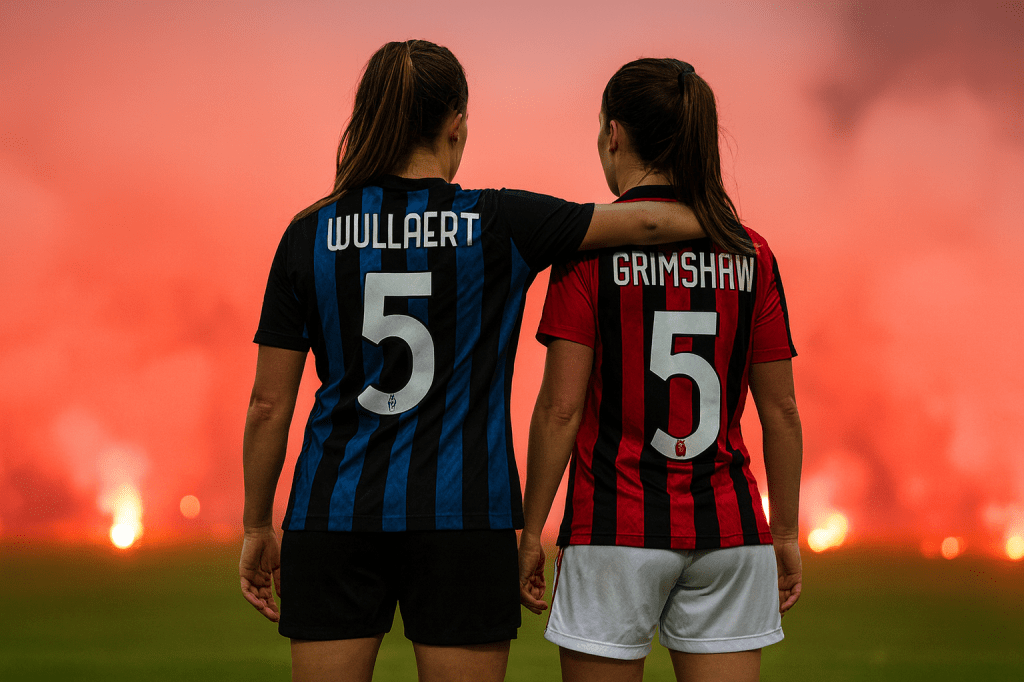
The Madonnina derby is more than a match. It reflects a city’s football identity, shaped by history and grounded in contrasts that have softened but not vanished. The class divide associated with the men’s game, where Inter symbolised bourgeois modernity and Milan embodied industrial grit, still echoes faintly around the fixture. The women’s teams have inherited the rivalry without the weight of outdated stereotypes, yet the emotional charge remains.
The 2024 derby at San Siro marked a turning point: 2,500 supporters in a stadium that symbolised national footballing heritage. It suggested that growth in women’s football is no longer hypothetical. The derby is an event that earns its place because it belongs to the fabric of the city.
The Sion voice returns here: at its core, this match offers a test of development rather than spectacle. Milan’s project under Bakker requires visible progress. Inter’s rebuild under Piovani needs continuity. Evidence has to appear in matches like this.
The smaller Doragon pulse adds the rest: a derby is never neutral. It is a study in pressure, identity, and the slight, almost imperceptible cracks that decide whether a season gathers momentum or falls into doubt.
Conclusion: A Meeting Point in a Narrow League
The women’s Serie A table tightens quickly. One result can shift ambition or expose fragility. Milan and Inter arrive with contrasting questions but equal incentive. Milan want consolidation. Inter want validation. Both want to prove they belong in the league’s competitive upper zone.
The match will not be defined by narrative alone. It will be shaped by Wullaert’s positioning, Grimshaw’s rhythm, Cernoia’s accuracy, Piovani’s structure, and Giuliani’s judgement. It will unfold steadily, shaped by evidence, habits, and small margins.
That is the reality of the Derby della Madonnina. It rarely delivers certainty. It always delivers consequence.
 doragon sports