
There are pay-per-views you remember fondly.
There are matches you remember vividly.
And then there are nights like Armageddon 2000, where WWE didn’t just book chaos — it challenged gravity, logic, and its own future plans… all inside a steel structure that was never meant to hold that much star power.
Twenty-five years on, the Six-Man Hell in a Cell remains a beautiful, brutal mistake. A one-time experiment so intense that WWE immediately decided: never again.
This wasn’t just a main event.
It was the Attitude Era tripping over itself at full speed.
The Context: WWE at Absolute Peak Saturation
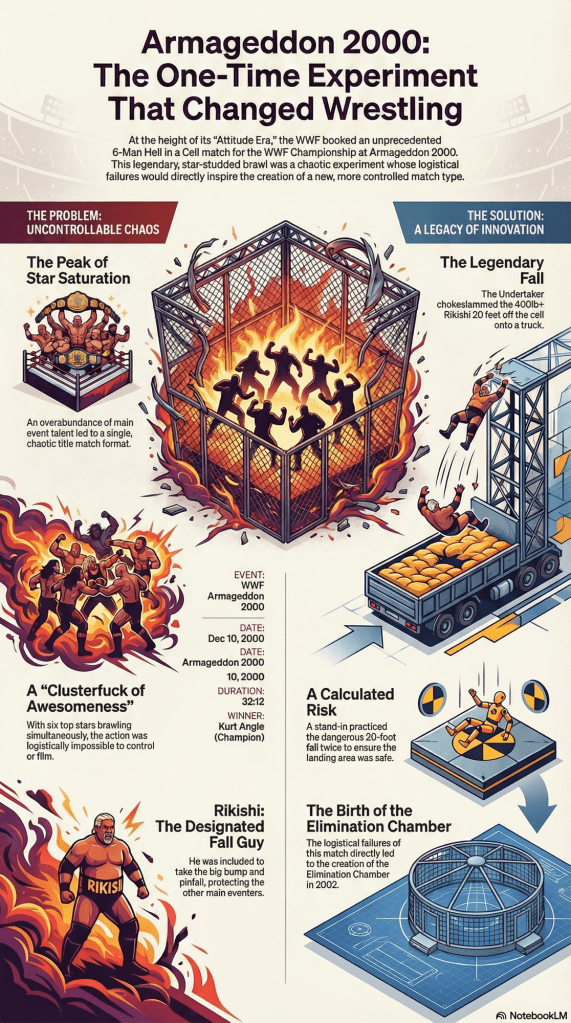
December 10, 2000. Birmingham, Alabama.
Attendance: 14,920.
Buy rate: 465,000 — still the highest December PPV number WWE has ever posted.
This was WWE at its commercial and creative zenith. The roster was obscenely stacked. Too many stars. Too many egos. Too many active main-event arcs.
So WWE did the only Attitude Era thing imaginable:
shove them all in a Cell and hope for the best.
Kurt Angle (WWF Champion) ,The Rock Stone Cold Steve Austin ,Triple H ,The Undertaker (American Badass) and Rikishi.
Read that list again. That’s not a match — that’s a Mount Rushmore argument waiting to happen.
A Match Built on Desperation, Not Logic
This was openly treated as a “one-match show.” Everything else existed in its shadow. And internally, everyone knew it.
Mick Foley — the man who made Hell in a Cell famous — announced the bout with a grim caveat:
If anyone suffered serious injury, he would resign as Commissioner.
Vince McMahon, meanwhile, spent weeks trying to kill the idea entirely — calling it a “lousy investment.” Too much risk. Too many stars. Too much money at stake.
And yet… they rolled the Cell down the ramp anyway.
Because that’s what the Attitude Era did.
Six Men, One Cell, Zero Control
From the opening bell, this thing was less “match” and more riot with a referee.
Five of the six men bladed. Blood was inevitable. Camera angles struggled. Commentary scrambled to keep up. Wrestlers disappeared, reappeared, brawled on the roof, vanished again.
This wasn’t elegant.
It wasn’t clean.
But it was unforgettable.
And crucially — this chaos was intentional. WWE needed to:
Protect Austin Protect Rock Protect Triple H Protect Undertaker …and keep the title on Kurt Angle heading into WrestleMania season.
That’s why Rikishi mattered.
Rikishi: The Necessary Outlier
Let’s be honest. Rikishi didn’t belong here in star power terms — and WWE knew it.
He was included for one reason: asset protection.
By positioning Rikishi as the fall guy — tied to the infamous “I did it for The Rock” storyline — WWE created a pressure valve. Someone Angle could beat without weakening anyone who actually mattered for WrestleMania X-7.
And Rikishi paid for it.
The Spot That Froze Time
You already know the image.
The Undertaker.
The roof of the Cell.
Rikishi.
A 20-foot drop.
The chokeslam off the Cell is still one of the most jaw-dropping visuals in wrestling history — not because it was pretty, but because it looked catastrophic.
Rikishi has since admitted he thought he might die. Before taking the bump, he reportedly told Undertaker to tell his family he loved them. Shane McMahon took the fall twice during rehearsals just to prove it was survivable.
This wasn’t reckless for shock value. It was calculated risk — and one that WWE never attempted again at this scale.
In 2025 terms, this is Dark Side of the Ring fodder waiting to happen.
The Ending: Survival, Not Victory
The finish was deliberately messy.
Triple H blocked Austin from capitalizing on a Stunner.
Angle crawled.
Angle stole it.
Angle retained.
No dominant champion. No clean win. Just survival.
Booking-wise, it was cynical.
Strategically, it was perfect
Why WWE Never Did This Again
Despite earning 4.5 stars, WWE quietly acknowledged the truth afterward:
Six men inside a traditional Hell in a Cell does not work.
The sightlines were awful. The pacing incoherent. The production team couldn’t capture everything happening simultaneously. It was thrilling — but unsustainable.
And so, from this chaos, WWE learned its lesson.
Two years later, the Elimination Chamber was born:
Controlled entries Structured eliminations Designed for television
Armageddon 2000 didn’t just close a year.
It quietly rewrote WWE’s future.
The Final Verdict, 25 Years On
This match isn’t perfect. It’s messy. Overstuffed. Occasionally incoherent.
But that’s exactly why it endures.
It represents the Attitude Era at full velocity — when WWE had more stars than it knew what to do with, and the confidence to bet everything on spectacle.
You can track modern WWE’s risk aversion directly back to this night.
Armageddon 2000 is the sound of WWE slamming the door on one era…
and locking it forever.
A beautiful disaster.
A one-time experiment.
And a reminder that sometimes, wrestling history is made by pushing things too far.
 doragon sports