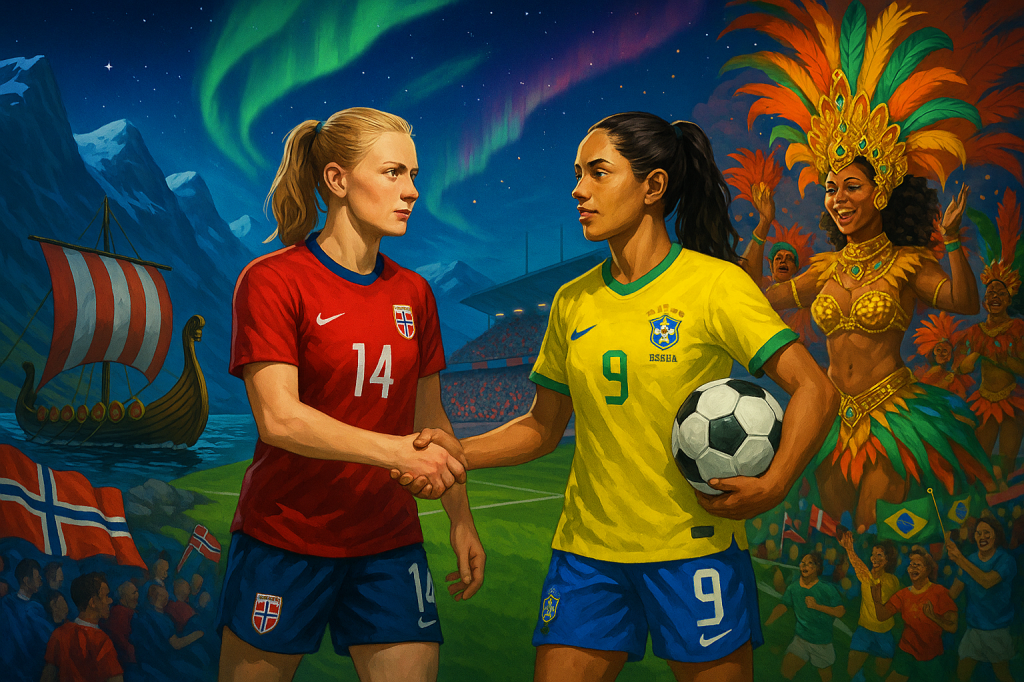
There is a certain kind of match that feels less like preparation and more like confession. A game where two nations meet in a place that neither calls home, under a sky that does not know their anthem, and yet something inside them insists on speaking anyway.
On November 28, 2025, as the saffron light of the Andalusian evening slips over the edge of La Línea de la Concepción, Norway and Brazil will walk out into a stadium that has recently held as few as thirty spectators—thirty souls breathing into a vast, echoing bowl of concrete.
But there are nights where silence allows truth to ring louder.
And this friendly—this quiet thing lodged between cycles and continents—has the weight of unspoken futures.
Brazil come carrying the heat of their rise. Norway come carrying the chill of their doubt. And somewhere between those two temperatures, a story waits.
A Game That Wants to Mean More Than “Friendly”
This is technically just an international friendly. A final match of the year, tucked into the last FIFA window. A neutral venue chosen for its weather, not its poetry.
But football never cares about the limits of its assigned importance. Players don’t run less passionately because someone labelled the event “a warm-up.”
Brazil have spent the autumn collecting moments of emotional magnitude—beating the European champions, England, even with ten players for 70 minutes, then following it with a crisp, composed win over Italy. They arrive here with enorme moral, as Brazilian commentator Jorge Iggoy whispered into his microphone, describing the momentum tugging them forward into a home World Cup cycle.
Norway, meanwhile, arrive with their mythology trailing them like a cloak—World Champions of 1995, Olympic gold in 2000, a trophy cabinet creaking with the ghosts of old glory. And yet, like many teams touched by history, they have felt more haunted than guided by it. Euro 2022’s 8–0 devastation. Euro 2025’s quarter-final collapse. A generation of brilliance that refuses to fuse.
Both nations know that this game matters because it is a mirror, not a milestone.
A reflection of who they are becoming—and who they fear they might remain.
Brazil’s New Heartbeat
Sometimes a national team resembles an entire poem in motion. Brazil have always been that for women’s football: rhythm, insistence, rebellion. Their history is stitched with resistance—decades where the women’s game was marginalised, suffocated, told to wait its turn. And yet from that soil grew players who refused to dim.
Now, as Marta’s international era drifts gently toward its epilogue, a new cast step forward—Luany, Dudinha, Amanda Gutierres, Bia Zaneratto, the captain Angelina—each carrying a different strand of the legacy.
Their recent performance against England, playing most of the match with ten players after Angelina’s early red card, revealed something almost mythic. As commentator Thiago Silva described:
“A cobrança de cada jogadora foi pura poesia em campo.”
The effort of every player was pure poetry on the field.
You could feel Brazil’s stubborn heart beating through the screen—unafraid, unbroken, unwilling to bend to the narrative of European superiority.
This is the essence Arthur Elias has sharpened since taking over:
Intensity. Rotation. Willingness to be uncomfortable.
His 65% win rate is not built on comfort—it is built on confrontation. Seven changes between England and Italy. Endless insistence on facing hard European opponents. A team being sculpted through friction.
Luany is the symbol of it all. Young, fast, fearless. Three goals in the Copa América group stage. The match-winner against Italy. A player whose talent feels less like a skillset and more like sunlight—bright, immediate, impossible to ignore.
And somewhere behind them all, unseen but felt, is Marta—her legacy, her softness, her fierce loyalty to the game. Even in absence, she breathes inside every pass they make.
Norway and the Weight of Expectation
Norway’s beauty is quieter. Northern. Frostbitten.
But beneath that calmness lies a restlessness that no one wants to discuss too openly.
They have everything a top team should have: Ada Hegerberg, Caroline Graham Hansen, Frida Maanum, Ingrid Engen. They have technical talent shimmering through their midfield. They have physicality, intelligence, experience. And yet, in tournaments, this brilliant constellation dims.
Too many stars. Not enough sky.
Hegerberg herself is a story within a story. After leaving the national team for five years in protest—returning only in 2022—she has carried the tone of a warrior who has been burned before. Her quotes stay etched into Norway’s footballing psyche:
“I’m coming back to reconquer my position in football.”
“I can’t wait to inspire some new kick-ass kids.”
She speaks like someone who knows greatness can be both a gift and a sentence.
Caroline Graham Hansen, arguably one of the best wingers in the world, has often played like a violinist waiting for the orchestra to tune. Her brilliance is consistent—52 goals in 119 caps—but the system has not always been worthy of her.
And then there is Signe Gaupset, the new comet.
Two goals and two assists against Iceland at Euro 2025. Two goals against Japan last month.
A player whose movement seems to rewrite gravity.
Norway’s challenge has never been talent.
It has been translation: how to turn talent into coherence.
Gemma Grainger, their English coach, knows this intimately. She encourages grassroots growth, speaks about “raising voices,” tries to build something cultural, not just tactical.
But football is impatient.
And Norway are overdue.
The Match Itself: Where Styles Collide
There is a gorgeous contrast to this fixture if you trace it through the air.
Norway will want structure. They feel safe inside a 4-3-3 or 4-4-2 that lets them dictate rhythm through Maanum, Engen, Graham Hansen. They want the match to breathe at their pace.
Brazil want wind.
They want the world to tilt.
They want Luany running diagonals that tear open space. Bia Zaneratto drifting into half-channels. Dudinha cutting inside. Transitions that burn like struck matches.
Look at the numbers from Brazil’s win over England:
England: 461 passes.
Brazil: 192.
Not a flaw—an identity.
Efficiency. Precision. Counterattack as art form.
Norway, meanwhile, live in the middle third. Their danger blooms when they can paint passing triangles and feed Hegerberg in motion. But their weakness is familiar: defensive frailty, especially against direct runners.
This match becomes a philosophical argument:
European control vs South American release.
Cold steel vs warm fire.
Valkyries vs Canarinhas.
Atmosphere of a Place That Isn’t Home
La Línea de la Concepción is a ghost-like setting for all this drama. An 18,500-seat stadium that recently hosted a match with an attendance of thirty. A place where the wind from the Strait of Gibraltar whistles through the concrete ribs of the stands. A place almost too quiet for a match carrying so much unresolved desire.
Here, without noise, without flags, without scripted ceremony, players are forced to listen to themselves.
The Brazilians will hear the roar of a country that is waiting for 2027 to crown them queens on home soil. A nation rediscovering its love for the women’s game after years of fight.
The Norwegians will hear the echo of history—the breath of legends, the reminders of what they used to be, the ache of what they have not yet become.
Sometimes the most revealing football is the one played far from home, watched by almost no one.
What This Means to the People Watching From Afar
Brazil
For Brazil’s supporters, this team is becoming a symbol of something long overdue: respect. The 2025 Copa América title, the Olympic silver in 2024, the victories over European giants—they feel like decades of resistance finally turning into momentum.
The fans call them Guerreiras—warriors.
Not as a compliment to strength, but as recognition of endurance.
This friendly is another step on the path toward 2027, the home World Cup that Brazil want not just to host, but to own.
Norway
For Norway, this is a chance to whisper to themselves:
We can still be mighty.
Their football federation dreams of quadrupling attendance by 2030, of relighting the fire that once made Norway one of the most feared nations in the world.
This match won’t define that ambition.
But it can nourish it.
A Soft Prophecy
Matches like this tend to unfold in the quiet hinge points of the pitch. In the half-second after a midfield turnover. In the breath before a cross. In the hesitation between choosing the safe pass and the courageous one.
Brazil will look to Luany to break those hinges open.
Norway will look to Hegerberg to punish any crack in concentration.
Between them, Caroline Graham Hansen may hold the brush that paints the night.
And somewhere beneath it all, the Andalusian twilight will watch without judgment.
On November 28, the Canary and the Valkyrie will meet in the stillness of La Línea.
 doragon sports