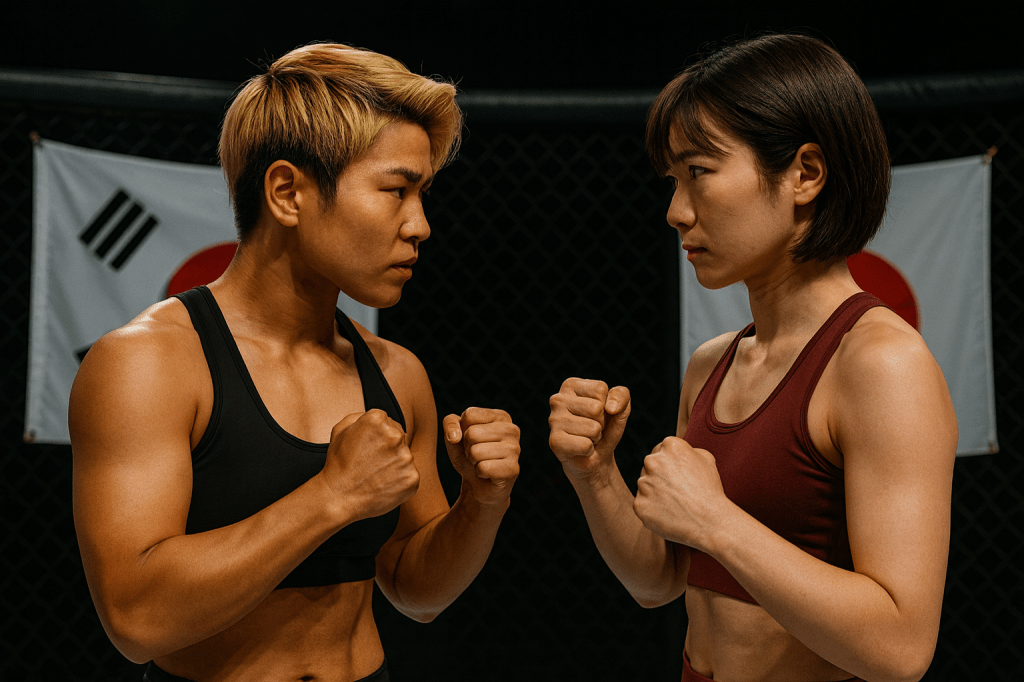
The canvas is the same.
New Pier Hall. Tokyo Bay breathing just beyond the doors.
But for Si Woo Park, everything has changed.
On September 7, 2025, she walked into DEEP JEWELS 50 as the undisputed Strawweight champion, the Korean Queen Bee who had climbed up a weight class and finally wrapped a real belt around a body that started this sport late, at twenty-six, and clawed for every inch. The title had been vacated by Seika Izawa; Park had been elevated from interim to undisputed, and this was supposed to be the night she validated that promotion with violence.
Instead, she walked out beltless, staring at the scoreboard of a split decision she could feel slipping away as the final scores were read. Machi Fukuda, the 21-year-old chasing redemption, got the nod. The crown rolled off Park’s head and straight into a younger pair of hands.
Now, on November 23, 2025, she returns to that same building for DEEP JEWELS 51, dropping back down to 49kg Atomweight in the co-main event against Saki Kitamura. Above her on the poster sits Ayaka Hamasaki vs Ye Ji Lee in the super-atomweight main event; below, a card full of women trying to prove they are more than just consumable products in a crowded fight economy.
For Park, this is more than a comeback.
This is a reckoning with everything that happened at 50.
Split Decision Shadows
To understand DEEP JEWELS 51, you have to go back 187 days to the first time Park and Machi Fukuda stared each other down as rivals instead of just names on a bracket.
They met at DEEP JEWELS 45 for the interim Strawweight title. Park was moving up from her natural Atomweight home at 48kg to test herself at 52kg; Fukuda was the young storm trying to carve her name into the division. Their first fight was razor-thin, a split decision that tilted towards Park and gave her the interim belt.
For Park, that win mattered more than any ranking: it was her first professional title, a crown she had chased since her late start in MMA. For Fukuda, it was a wound. She spoke openly about wanting to “make up for the disappointment of the 1-2 decision loss” and targeted the rematch as a personal trial — the kind of loss that eats at you in quiet moments until you rewrite it with your own hands.
DEEP JEWELS 50 offered exactly that.
Vacant belt. Undisputed status. Milestone card.
Park came in as the newly formalised champion. Fukuda came in as the woman who believed the story wasn’t finished. Over three rounds of high-tempo, high-stress strawweight violence, they wrote one of the tightest fights of the year. The judges’ cards read like a tug of war: two for Park, three for Fukuda. The belt switched waistlines by the width of a single scorecard.
For Park, that wasn’t just a defeat.
It was a verdict on an entire experiment: the jump to Strawweight, the weight of being “undisputed,” the attempt to prove that her precision and decision-heavy style could carry the day against bigger women.
That loss is the shadow walking into DEEP JEWELS 51 beside her.
Si Woo Park at a Crossroads
Strip away the belt and you still have an elite fighter.
Park’s résumé is brutally honest:
12 wins, 6 losses, with 10 of those wins coming by decision. She is a specialist in control and survival, someone who extends fights into deep water and trusts her cardio and tactics to keep her head above the surface while others drown.
She’s not just another grinder, though.
She’s a decorated striker, with a kickboxing background that includes WAKO Asia honours and an Asian Games gold medal. Her game has always been built around distance management, angle-cutting, and the quiet cruelty of cumulative damage.
But her philosophy — and the philosophy of the staff around her — runs deeper than technical bullet points.
In the build-up to these title runs, conditioning coaches talk about “simulating pain”, driving the body to extremes so that when the cage door closes, nothing feels unfamiliar. Pain becomes a rehearsal; effort becomes identity.
The biggest preparation, they say, is a weapon and a commodity, shaped by hours of brutality that nobody applauds, sculpted into something that must be both fearsome in combat and palatable in the promotional photos. That is the paradox of Japanese WMMA — the fighter is a heroine, a warrior, and a consumable product all at once.
And Si Woo Park has lived inside that contradiction for years.
But now, at DEEP JEWELS 51, she re-enters New Pier Hall stripped of everything except truth.
No belt.
No higher weight class experiment.
No ambiguity about her identity.
She is back at 49kg Super Atomweight, the division she actually belongs to.
Back in a body that breathes cleanly.
Back in a place where she moves like flowing ink rather than a woman carrying stones in her pockets.
This is not a demotion.
This is a return to her sharpest self.
And Saki Kitamura may not understand what kind of storm is coming.
The Co-Main Event: Park vs Kitamura — A Rebirth Meets a Rising Blade
Saki Kitamura is exactly the sort of fighter DEEP JEWELS likes to push into the light:
Young. Hungry. A clean 4–4 record against decent competition. A striker with enough aggression to make a veteran uncomfortable if she’s given the space and the rhythm to build.
She enters this fight with nothing to lose and everything to gain — an unspoken audition for future title plans.
But this fight is not about Kitamura.
It is about who Si Woo Park becomes next.
Kitamura is the test.
Park is the story.
Park’s last five fights tell the tale: two battles with Fukuda (one win, one loss), a violent TKO of Princess The Rocket, a measured performance over Namiko Kawabata, and the razor loss to Seika Izawa before all of this began. Every line of that ledger is a reminder of how thin the margins are at the edges of world-class WMMA.
Park has been walking that tightrope for three years straight.
But at Atomweight, she doesn’t walk it.
She dances.
Why This Fight Matters for Park — And for DEEP JEWELS
DEEP JEWELS is a strange and beautiful ecosystem.
It asks its fighters to be killers,
then asks them to smile beautifully on the poster.
It demands excellence
while expecting its athletes to endure the commodification of their own bodies —
lean enough, feminine enough, visible enough.
It is a promotion built on rebellion wrapped in ribbons.
Si Woo Park has always been one of its purest contradictions: a world-class athlete shaped for consumption, yet intent on proving she is more than what any camera can capture. She is the Queen Bee because she embodies the ruination and resurrection of every fighter forced to fight in multiple roles: warrior, entertainer, symbol.
At DEEP JEWELS 50, she lost the belt.
At DEEP JEWELS 51, she fights for identity.
Victory puts her back into the championship conversation — this time at her natural weight.
Defeat forces hard questions:
Did the move to Strawweight cost her part of herself?
Is the damage cumulative?
Has the division moved on?
Park doesn’t fear the loss of status.
She fears the loss of meaning.
That is why this fight matters.
Kitamura’s Opportunity — The Young Lioness and the Cultural Industry
Kitamura walks in with the kind of freedom that terrifies veterans: she has no legacy to protect, no belt-shaped shadow behind her, no expectations other than effort.
She is not yet industrially shaped by the Cultural Industry — the forces that demand WMMA fighters be both dangerous and beautiful, both feminine and violent, both marketable and monstrous.
She is still raw.
Still genuine.
Still fighting because she loves the fight.
But now she steps into the cage with Park — a fighter manufactured by experience into something sharper, darker, more honed.
Kitamura will try to erupt early.
She will try to make this a brawl.
She will try to stop Park from settling into rhythms that suffocate opponents over 15 minutes.
Park will do the opposite.
She will slow the world down.
Drag Kitamura into clinches.
Break her stance.
Pivot, jab, angle out.
Paint the fight round by round until the judges can’t possibly deny her.
This is an artist returning to her medium.
The Atmosphere at New Pier Hall — A Temple for Women Who Fight
The crowd in this venue is different.
They don’t just watch.
They listen.
Every foot scrape.
Every exhale.
Every moment of stillness.
DEEP JEWELS feels less like a commercial arena and more like a theatre — one where women rewrite their own myths under bright white lights. It is a place where:
redemption arcs burn fast, warriors become heroines, and silence before “It’s time!” feels like the inhalation of the entire city.
This promotion has spent a decade building itself on the tension between form and fury.
DEEP JEWELS 51 continues that work — a night where legacy meets reinvention, and where Si Woo Park walks the aisle knowing exactly what is waiting for her on the other side of the cage.
Not a title.
Not revenge.
Not even validation.
A mirror.
Prediction — The Return of the Queen Bee
Kitamura is dangerous.
She will arrive wild, loose, eager to shock the crowd and earn her place.
But Park has lived too much.
Endured too much.
Lost too much.
This is a fighter shaped by the simulation of pain, hardened by the agony of split decisions, forged by the need to validate her existence in a sport that views women as both gladiators and products.
Park is back home at 49kg.
Back where her body sings instead of strains.
This will be her cleanest performance in two years.
 doragon sports