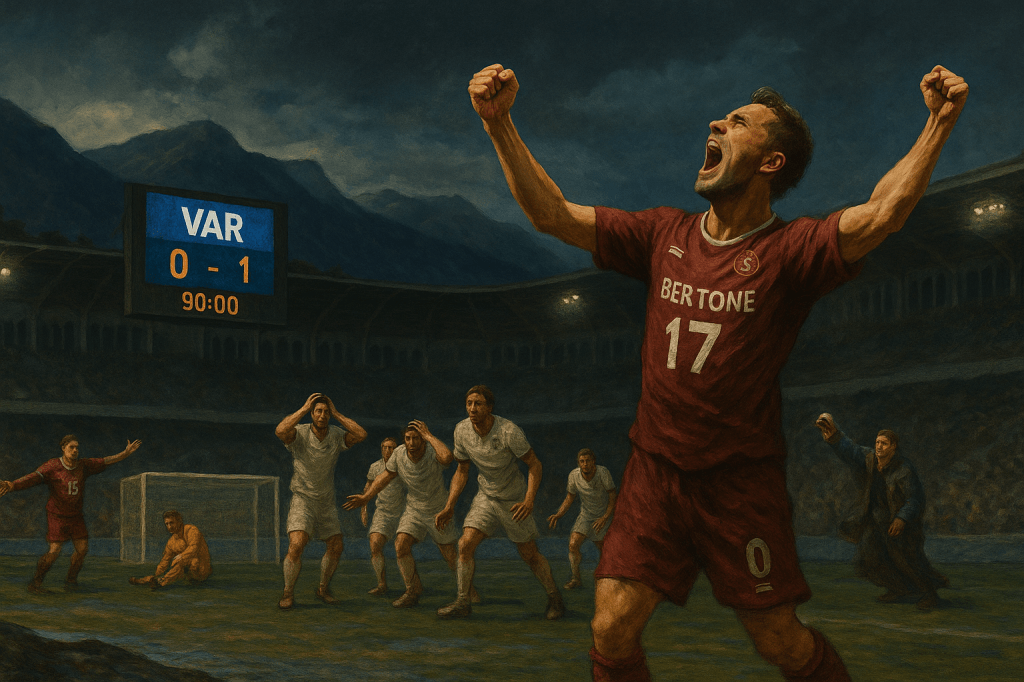
In a game where bureaucracy threatened to choke the pulse out of football, FC Thun reminded everyone what happens when structure collides with spirit. One second. That’s all it took — a 90th-minute free-kick from Leonardo Bertone that curved like a signature on destiny — to turn a stale stalemate in Geneva into the latest chapter of Thun’s fairytale.
For Servette FC, the vice-champions of last season, this was supposed to be the night they rediscovered dignity. For Thun calcio, the newly promoted insurgents, it was about defying logic itself. And when the whistle blew at Stade de Genève — a cavernous bowl half-empty, half-hopeless — it was the mountain men from the Bernese Oberland who walked out as leaders again.
The Leader’s Curse, Broken in Geneva
Every league has its superstition. In Switzerland, it was whispered that no team sitting atop the table could win the next round — the so-called Leader’s Curse. Thun arrived in Geneva daring the gods to try them. Five straight league wins, a budget that wouldn’t cover a Basel substitute’s salary, and a coach who talks about football like a mechanical engineer building a bridge: Mauro Lustrinelli.
Servette, by contrast, were sinking — tenth place, the air thick with frustration. The headlines before kickoff weren’t about tactics, but about patience. Jocelyn Gourvennec’s men had just been thrashed 4–2 by Winterthur, their season decaying in slow motion. The home crowd wanted blood.
What they got instead was VAR — the new villain of Swiss football — and ninety minutes of tension that felt more like an audit than a game.
Bureaucracy vs. Blood
If passion is the heartbeat of football, VAR is its defibrillator — functional, cold, necessary, but soulless. Twice in the first half, Thun thought they’d earned justice. Twice, technology intervened. A foul downgraded to “outside the box.” A handball ruled “non-punishable.”
The rhythm was broken before it ever began. Geneva’s lights glared, the referee checked the screen like a bureaucrat stamping denial forms, and both teams started to look frightened of joy.
Servette controlled 60 percent of possession. They played safe, neat football, the kind that pleases analytics departments and kills atmospheres. They generated a higher xG (1.89) than Thun’s 1.69, but that statistic became a monument to impotence.
Because football, unlike spreadsheets, breathes.
The Long Silence Before the Roar
For most of the match, it was football’s everyday life — Fussball-Alltag — all sweat and no sparkle. Thun were compact, disciplined, content to frustrate. Servette probed down the left, where Alexis Antunes and Lilian Njoh produced flashes of real artistry, Geneva’s last remaining pulse.
In the 54th minute, Antunes thought he’d found salvation. A left-footed drive crashed in, the crowd finally stood — and then VAR killed it again. Offside. Geneva’s joy frozen mid-cheer.
You could feel the air leave the stadium. The players looked up not at each other, but at the giant screen — the new altar of modern football.
And yet, somewhere in that silence, Thun waited. They always wait.
The One Second of Passion
When the clock hit ninety, the game should’ve died. Instead, Marco Bürki, Thun’s captain and emotional compass, was fouled near the edge of the box. It looked harmless, one more set piece in a night of interruptions.
Then Leonardo Bertone stepped up.
He’s the sort of player who’s seen too much to panic — a veteran, a thinker, a man who bends games rather than breaks them. The free-kick sailed up and out like a promise, then dipped violently into the top corner.
1–0. Geneva gasped. The Thun bench erupted.
Six consecutive wins. The Leader’s Curse slain. And a reminder that you don’t need ninety minutes of dominance when one second of perfection will do.
The Pressure Cooker Explodes
At full time, Servette’s players walked toward their fans — not to celebrate, but to plead. Words were exchanged, hands raised, heads bowed. The boos cut through the cold night air. Former Swiss international Rolf Fringer later described it with disgust:
“Sich wie begossene Pudel zusammenscheissen lassen — das finde ich fürchterlich.”
(“To be scolded like drenched poodles — I find it terrible.”)
The dressing room mood was just as bleak. Gourvennec’s “project” — built on patience and possession — was disintegrating in real time. Florian Ayé, their French striker with six goals this season, cut a lonely figure up front. Antunes, the local hero, looked haunted.
Meanwhile, the visitors sang. Thun’s entire squad gathered under the away section, fists raised, singing to a handful of travelling fans who had come down from the Bernese Oberland.
For them, this was more than another Thun match. It was proof that small towns can still defy geography and gravity in football’s corporate age.
Coherence vs. Chaos
What separates Thun from Servette isn’t just momentum — it’s philosophy.
Mauro Lustrinelli’s Thun play football like an architectural diagram: clean lines, reliable joints, structure everywhere. But there’s emotion underneath. His side has become a collective organism — every press, every recovery, every late surge built on faith in the system.
As midfielder Bertone said afterward:
“Wir bleiben am Boden.”
(“We remain grounded.”)
They are. Even as league leaders, even as dreamers.
Servette, on the other hand, are a collage of expensive ideas. “Great technical quality,” Gourvennec admitted, “but not yet the consistency to show it.” His team has more shots, more possession, more statistics — and yet, fewer goals. Six fewer, in fact, than Thun this season, despite all that ball control.
That’s not misfortune. That’s incoherence.
The Anatomy of a Giant-Killing Machine
Formation: Thun lined up in a compact 4-4-2, the system Lustrinelli treats like an old family heirloom — simple, proven, adaptable.
Strengths: intensity, balance, belief. Even without suspended midfielders Valmir Matoshi and Ethan Meichtry, they remained functional. The substitutions of Nils Reichmuth (who changed the rhythm) and Brighton Labeau (who bullied Servette’s backline) were textbook examples of “game management.”
Weaknesses: offensive harmlessness — until they’re not. For 89 minutes they were cautious; for one they were lethal.
Compare that to Servette’s 4-2-3-1, a shape designed for possession that often drowns in its own patience. The Geneva side completed twice as many passes but none that mattered.
When you strip away the metrics, Thun’s 40 percent possession looks less like retreat and more like control.
The Language Divide, the Cultural Rift
Swiss football is a mirror of its nation — multilingual, fragmented, fascinating. In that sense, this was more than a game. It was German-speaking precision vs. French-speaking flair, the Oberland vs. the lakeshore, Thun calcio vs. Servette’s élégance.
But language didn’t matter when Bertone’s strike hit the net. Geneva fell silent in every tongue.
Only 6,820 fans showed up to a stadium that holds over 30,000. Empty seats framed Servette’s despair. In contrast, every Thun supporter will remember this night as pilgrimage — the night the Alps echoed with belief.
From 2005 to Now — Remember the Dream
For older fans, the numbers carried déjà vu. In 2005, Thun last lived the impossible — qualifying for the FC Thun Champions League group stage, rubbing shoulders with Arsenal and Ajax. That season, they also went on a seven-game winning streak.
Now, twenty years later, they’re flirting with history again. Six straight wins, first place, a budget of barely seven million CHF, and a city of barely 45,000 daring to dream. Know any other teams in red and white dreaming of UEFA?
President Andres Gerber refuses to downplay it:
“We are not just playing for survival. We are playing for something greater.”
The local press call it a “pied de nez” — a slap in the face to the league’s wealthy elite. To Basel, Young Boys, and yes, Servette.
The Truth Beneath the Glory
Strip the romance away, and this was an ugly match. Long-winded. Disjointed. Frustrating. But football isn’t theatre — it’s survival dressed as spectacle.
And Thun survived beautifully. They outlasted VAR, possession, and the pressure of leadership. They won with one second of passion, not ninety minutes of control.
In the numbers:
Servette xG 1.89 – Thun 1.69
Servette 60% possession, 6 corners, 20 fouls
Thun 40% possession, 2 corners, 11 fouls
Result: Thun 1 – 0 Servette
Statistics tell one story. The scoreboard tells another.
After the Whistle
As Geneva cooled into night, FC Thun live coverage showed fans still singing long after the players left. Lustrinelli walked to the stands, clapped once, and smiled — that small, private smile of a man whose design worked.
In the press room, Gourvennec looked hollow. “We must stay calm,” he said, but his tone betrayed him. Calm doesn’t survive in a relegation fight.
The headlines in the morning papers said it best:
“A Huge Slap in the Face — Thun’s Discipline Humiliates Servette.”
What It Means
For Thun calcio, this isn’t an anomaly — it’s a movement. Six wins, top of the table, the small-town project that’s re-engineering Swiss football from the inside out. Their next test, post-international break, will decide whether this was a spark or a firestorm.
For Servette, this defeat is existential. A club that once flirted with grace now flirts with the barrage zone. Their identity — possession, precision, and patience — is curdling into paralysis.
The Servette vs Thun prediction before kickoff said Geneva should win. The truth said otherwise.
Because in football, coherence beats chaos. Structure beats star power. And sometimes, one second of passion beats an entire city.
Epilogue — The Small-Town Symphony
In the stillness of the Bernese Oberland, they’ll remember this night the way mountain folk remember avalanches — sudden, unstoppable, awe-inducing.
The stadium lights in Geneva have long since gone out. The headlines have been written. But Thun’s echo lingers — the underdog’s anthem, played in 90 minutes of doubt and resolved in one beautiful second.
FC Thun news will call it another win. The romantics will call it fate.
Either way, the table has been rewritten.
 doragon sports