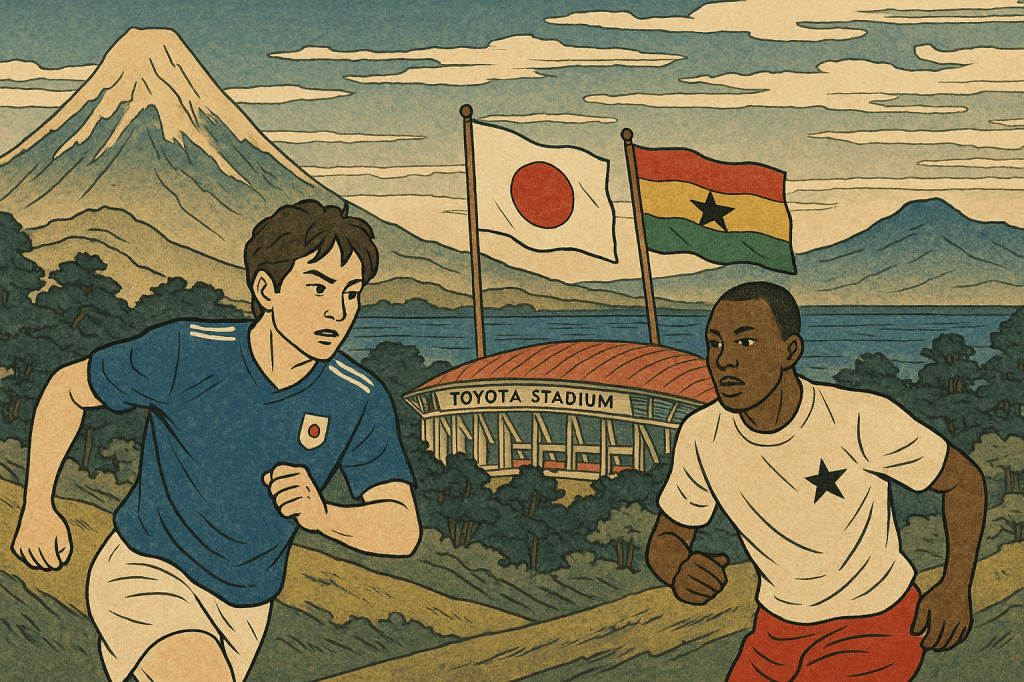
The rain is waiting over Aichi.
Forecasts whisper of drizzle at Toyota Stadium, the kind that turns floodlight beams into silver spears. The flags are already damp along the concourse. By Friday night they will lift again when the Samurai Blue meet the Black Stars, a fixture that has never learned how to stay quiet.
This is no ordinary friendly.
It is the opening act of the 2025 Kirin Challenge Cup, but it beats like something larger, the last deep breath before the 2026 FIFA World Cup begins to rise on the horizon.
Both sides are qualified. Both sides are restless.
The Calm Before a Collision
For Japan, qualification came early, smooth and clinical, a two to zero victory over Bahrain back in March that sealed their route to North America. Coach Hajime Moriyasu now turns the Kirin Cup into a proving ground, not for survival but for refinement.
His call-up list reads like a balancing act between duty and discovery.
Wataru Endo, the metronome from Liverpool. Takumi Minamino, still threading Monaco’s attacks. Kaoru Mitoma, missing through injury but leaving a shadow across the left flank.
In their place come new names, Kokubo Leo Brian, Goto Keisuke, Kitano Sato, untested but carrying the hum of tomorrow.
And then there is Suzuki Zion.
Born in Japan to Ghanaian parents, his presence adds a quiet tremor to the air. The goalkeeper stands between two histories, the Black Stars’ rhythm and the Samurai Blue’s discipline, a living thread between both sides of the field.
Across the tunnel, Otto Addo’s Ghana arrive with equal focus, the long journey from Accra still in their muscles.
The Black Stars travel knowing they too have secured their place at the World Cup, confirmed by that late October win over Comoros. Addo’s squad is an intersection of experience and experimentation, veterans who know the weight of tournament air and newcomers still learning to breathe it.
Jordan Ayew, Ghana’s top scorer in qualifying, carries the forward line again.
He is joined by Mohammed Kudus, Tottenham’s creative voltage, and Antoine Semenyo, whose strength gives shape to Ghana’s surging transitions.
Behind them, Thomas Partey at Villarreal, dictating rhythm like a conductor pacing the storm.
And somewhere on standby, Prince Kwabena Adu, the Czech based striker waiting on his visa, name pencilled in the margin like a hope Addo refuses to erase.
History in the Mist
Eight meetings since 1964.
Five wins for Japan, three for Ghana.
Eighteen goals to fourteen, a record that never quite settles into dominance.
Their first encounter came during the Tokyo Olympics, Ghana three Japan two, the first African team Japan had ever faced.
Every match since has carried that sense of threshold, two footballing philosophies, different in rhythm but bound by mutual curiosity.
Two thousand nine still lingers, the four to three in Utrecht where Ghana led three to one before Japan turned the night inside out.
Two thousand eighteen brought the reverse, Ghana two Japan zero, Partey bending a free kick into Yokohama’s sky.
And the latest meeting in two thousand twenty two tilted back toward Asia, a four to one for Japan, goals from Mitoma, Kubo, Maeda and Yamane.
The pattern is cyclical. Whenever one side looks ascendant, the other replies.
Which means this ninth meeting on November fourteen sits exactly on the hinge.
Tactics Drawn in Rainlight
Japan’s game remains an act of architecture.
Short passes like brushstrokes, triangles that fold and refold until space appears.
Moriyasu’s squad chase a kind of calm perfection, less about dominance, more about rhythm.
In front of their home crowd they will try to paint order onto motion.
Ghana will come to smudge that painting.
Addo’s players move through force, speed and intuition.
When Kudus accelerates, geometry becomes suggestion. When Ayew drops deep, chaos feels deliberate.
The Black Stars defend narrow, counter sharp and flood transitions with runners who treat every open metre like a prayer answered.
This will not be a slow dance.
It will be a meeting between lines, one straight, one curved, and how they bend each other before breaking.
The Stakes Hidden but Heavy
There are no points here, no eliminations, but the stakes hum under every pass.
For Japan the challenge is control, turning preparation into poetry, avoiding the complacency that often follows early qualification.
For Ghana the mission is coherence, transforming flashes of brilliance into collective certainty before the plane to America departs.
Every selection in Aichi has consequence.
Does Moriyasu trust youth under the lights
Does Addo let Kudus roam free or hold him within structure
Can Suzuki, the bridge between two worlds, keep his composure when Ayew closes in at speed
The Setting of Friday Night
Kickoff comes just after sunset.
Toyota Stadium’s roof gleams in the drizzle, shaped like a shell turned upward to the sky.
Fans in blue ponchos move in quiet procession past food stalls. From one corner, a lone Ghanaian drum starts its rhythm early, low and patient.
By the time the teams walk out, the air will smell of wet turf and steam.
Cameras will catch the faces, Endo’s composure, Kudus’ intent, Ayew’s calm aggression.
Even the floodlights will seem to listen.
Why This Meeting Matters
There is something deeper than form here.
Japan and Ghana, distant on maps, are bound by reflection. Each sees part of itself in the other’s football.
For Japan, Ghana represents instinct unchained, the courage to let the game breathe outside the grid.
For Ghana, Japan reflects what discipline can achieve without losing grace.
When they meet, each side studies the other’s reflection.
Sometimes they learn, sometimes they resist it, but they always leave changed.
That is why this friendly refuses to feel friendly.
It is a dialogue about identity, spoken in movement and answered in silence.
Expect a tempo that shifts like weather.
Japan will try to write patterns into the rain. Ghana will erase them with sudden storms.
Endo’s positional rhythm against Partey’s rolling thunder.
Kubo’s footwork against Kudus’ burst.
Suzuki Zion’s quiet focus against the noise of ancestry.
In the stands, fifty thousand witnesses.
Each breath of wind turning into chant, each bead of rain joining the song.
Aichi will not sleep early.
Prediction Without Numbers
If history holds, this will not end without goals.
In the last five meetings twenty four in total, fifteen by Japan and nine by Ghana.
Defences bend, midfields open, and time itself feels shorter when these colours collide.
Expect late drama. Expect beauty in error. Expect the match to remember its ancestors.
The scoreboard will matter less than the rhythm beneath it.
Japan sharpening their symmetry, Ghana testing their speed of heart.
Both sides stepping closer to the storm that waits next summer.
 doragon sports