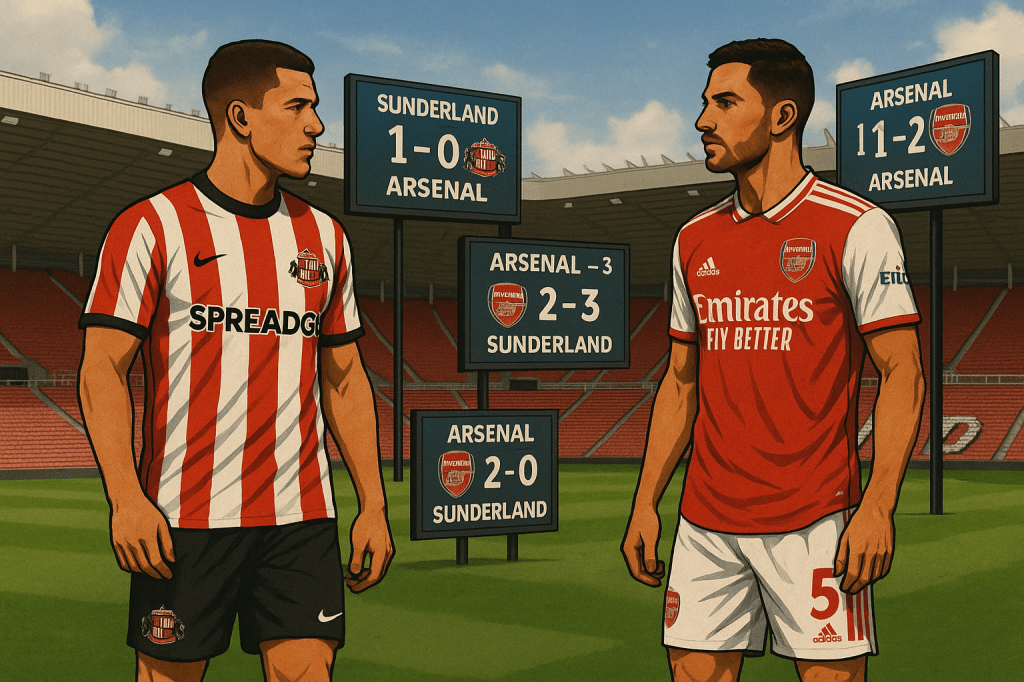
There’s something almost mythic about the way football repeats itself — like the same song played by different hands.
Sunderland and Arsenal have met often enough to form their own small folklore: grit vs grace, steel vs silk, the north trying to humble the capital, the capital trying to outthink the noise.
On November 8 2025, the story adds its strangest chapter yet — the Granit Xhaka derby, a reunion wrapped in memory, redemption, and a Stadium of Light that feels ready to hum itself into legend.
The Day Sunderland Shook the System — August 19 2000
It was opening day, sunshine slicing across Wearside, and Arsenal — the immaculately pressed version of English football — arrived expecting to stroll.
Instead, they walked into a wall of red-and-white intent.
Niall Quinn’s header was less a goal than a declaration: Sunderland weren’t here to decorate the Premier League; they were here to dent it. Patrick Vieira’s red card told you how rattled Arsenal were. Even Arsène Wenger, normally the embodiment of continental calm, lost his composure in the tunnel.
BBC Football’s report that night called it “a shock,” but it wasn’t. It was a statement from the north — that Arsenal’s symmetry could still be disrupted by a team that played like it owed the city something. The Stadium of Light had found its first real roar, and Arsenal had found a wound they’d keep prodding for years.
Highbury Heist — November 6 2002
By 2002, Arsenal had become a machine. But every machine has a glitch.
Enter Marcus Stewart.
A League Cup tie that should’ve been routine turned biblical. Arsenal led 2–0 at half-time — elegant, inevitable — until Sunderland decided they’d had enough of being extras. Stewart struck twice in two minutes, slicing through a defence that looked insulted by its own fragility.
When the third went in, Highbury gasped. Wenger called it “unbelievable.” For Sunderland fans, it was the kind of night that lived longer than most trophies: the reminder that hierarchy means nothing if your pulse is louder.
Somewhere in the archives of safc banter, there’s still a thread celebrating that comeback — typed in all caps, half-joking, half-religious.
Henry’s Last Kick — February 11 2012
Every rivalry needs its cinematic moment, and this one came framed in gold.
Thierry Henry’s final Premier League goal — scored in stoppage time at the Stadium of Light — felt like football deciding to sign its own autograph.
Sunderland had led through James McClean and looked set to pull off another act of defiance. Then Arsenal’s legend stepped off the bench, chest out, eyes glazed with history, and wrote the ending himself.
A faint touch, a hush, then delirium.
It was romantic, sure. But for Sunderland, it hurt — because it underlined the difference between almost and forever. Arsenal’s artistry still had teeth; Sunderland’s fight still needed miracles.
Years later, people still say you could feel that goal more than you saw it — like a door closing on an era.
When the North Bit Back — February 18 2012
A week later, the sequel.
Same ground, same sides, completely different mood.
Arsenal arrived bruised from Milan and mentally shot. Sunderland smelled blood. Fraizer Campbell scored, Stéphane Sessegnon sealed it, and the FA Cup dream went north for the night.
The pitch was heavy, the tackles heavier. Wenger’s side looked like ghosts.
In pubs from Roker to Ryhope, the mood was jubilation — this was vindication, a cleansing. The BBC Football write-up was coldly factual, but those who were there swear it felt personal. Arsenal’s elegance had been dragged into the mud and left there.
Sometimes the north doesn’t need style; it just needs revenge.
The Sánchez Years — 2016 to 2017
The pendulum swung back.
By the mid-2010s, Arsenal’s firepower was ridiculous: Alexis Sánchez playing like he was personally offended by defenders, Olivier Giroud arriving off the bench like a tank with a smirk.
At the Stadium of Light in 2016, they dismantled Sunderland 4-1 — clinical, cruel, inevitable.
But hiding inside those fixtures was a subplot no one cared to read yet: Granit Xhaka, the new signing, quietly navigating a new league and a fanbase that didn’t quite understand him.
He played through noise — boos, debates, the eternal online question: why did Xhaka leave Arsenal? — and yet, he endured.
The 2-0 win in 2017, sealed by Sánchez again, was Arsenal at their most controlled. For Sunderland, it was the final bow before the fall. For Xhaka, it was the education of a lifetime: how to stay composed when everyone else panics. That lesson would come back to matter.
The Reunion — November 8 2025
Now the circle closes.
Sunderland are back in the big time, fourth in the table, a club reborn under Régis Le Bris. Now a club, yearning for the heights of playing Qarabag on cold midweek nights. Arsenal arrive top, ruthless, unbending — but facing the one man who knows them too well.
Granit Xhaka, Sunderland captain, 33 years old, earning every penny of his reported granit xhaka wage as both midfield anchor and spiritual thermostat, stands in the tunnel opposite the badge that once defined and divided him.
He left Arsenal in 2023 because he had to — not in anger, but evolution. German football and Leverkusen gave him redemption; Sunderland gave him belonging.
Now, the man who was once booed off at the Emirates leads out a team that hasn’t lost at home all season.
He smiles, shakes hands, and somewhere between ritual and memory, there’s peace. But kick-off will strip that away.
Because when Arsenal meet Sunderland, it’s never just a match. It’s a conversation between two versions of English football — one polished, one raw — and both convinced they’re the real thing.
As for the sunderland v arsenal predictions? Forget them.
Games like this aren’t decided by form tables or clean sheets — they’re decided by ghosts, grudges, and the sound of a captain returning to his light.
 doragon sports