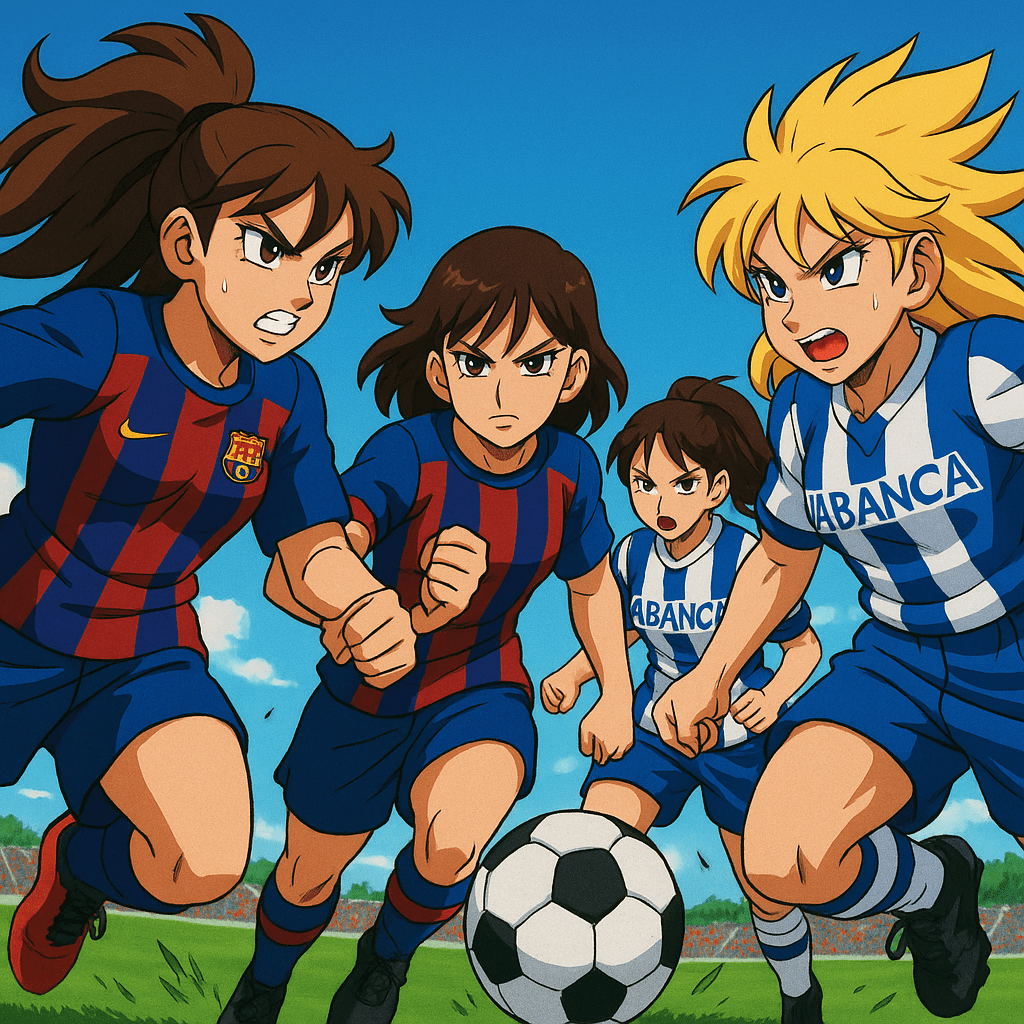
There is something unnatural and pleasing when watching a giant bleed.
It feels like seeing the ocean stop in mid tide or a cathedral flicker under lightning. That is what happened last week when Real Sociedad struck a hammer through the illusion of invincibility. Barcelona were humbled one nil, stripped of their aura and left staring into the mirror of their own myth.
Now they return home to the Johan Cruyff Stadium for a Liga F game that feels heavier than the points at stake. The leaders face Deportivo Abanca on Sunday, not just for victory but for reassurance that their dynasty is not starting to decay.
Because after perfection comes exposure. And now Barcelona Femení are standing there, blinking under the light, wondering if they are still who they thought they were.
The Weight of the Shattered Myth
For two years Barcelona Femení did not lose an away match in Liga F. Every fixture looked rehearsed. Another wave of passes. Another avalanche of goals. But the one nil defeat in Zubieta was a seismic moment. It cracked the silence that had surrounded the league.
Their unbeaten away streak of more than two years vanished. Their record of scoring in every league match since January 2020 ended. The mythology collapsed in one sharp instant.
The Liga F table suddenly has a pulse again.
Barcelona remain first with twenty four points, yet Real Madrid and Real Sociedad now breathe down their necks with twenty each. The cushion has turned into a thin line. The next stumble could detonate the most competitive title race in the professional era.
The tyranny of blue and red has started to tremble. Deportivo Abanca arrive as the uninvited truth test.
Deportivo Abanca, the Proud Survivors
They sit thirteenth in the standings with seven points.
Nine games. No wins since the first weekend. Three straight defeats by a single goal. The type of record that suggests a slow collapse. But Deportivo are not built to bow. They survive.
Their motto inside the dressing room is simple. Pride. Hunger. Faith. The words sound small until you picture their week. A trip to the Canary Islands for the Copa de la Reina, followed by a long journey east to Catalonia. Three thousand kilometres by bus, plane and fatigue.
Fran Alonso, their coach, calls it a hard week. He admits the team struggles in attack but insists that the defensive structure remains solid. They are a side that plays within its limits and fights beyond them. Against Barcelona, that desperation becomes a weapon. Sometimes in football the starving side bites the hardest.
Barcelona’s Crisis of Faith
This is not just about defeat. It is about doubt.
Pere Romeu’s team still play the most beautiful football in Spain, but lately the rhythm looks tired. The injury list is brutal. Patri Guijarro, the metronome. Ewa Pajor, the finisher. Salma Paralluelo, the storm on the wing. All missing. The team feels decaffeinated, blurred, almost hesitant.
Without them, the creative weight falls on Aitana Bonmatí and Alexia Putellas. Two Ballon d’Or level players forced to invent new solutions against defences that now dare to dream. Romeu admitted after Zubieta that Barcelona struggle when the tempo breaks, when rivals waste time, when the rhythm becomes human rather than divine.
This match is therefore a therapy session disguised as a league game. The chance to remember who they are and remind everyone else.
Faces That Define the Battle
Clàudia Pina is Barcelona’s top scorer with seven goals. She has become the sharp edge of a side missing its natural number nine. Her recent double against Bayern Munich in the Champions League showed she is ready to take the spotlight.
Beside her, Aitana Bonmatí remains the architect. Five goals, endless influence. The Ballon d’Or winner still dictates every possession sequence like a composer who refuses to lower her baton. Alexia Putellas is the captain, the heartbeat, the one who knows how to carry a team that has forgotten how to lose.
For Deportivo, the story belongs to Millene Cabral. Six goals and three assists out of the team’s seven total strikes this season. Every attack flows through her. Cris Martínez, the captain in defence, holds everything together. She calls A Coruña her home and plays like it.
Between them stands the goalkeeper Inês Pereira, known for her aggression and defiance. Five yellow cards and one red tell you the temperament. Against Barcelona’s stars, she will need the match of her life.
Tactics and Tension
Barcelona FC will line up in a four three three that may mutate during the match. They will dominate possession again, possibly close to eighty percent as they did in Zubieta. But the real question is what that control means without penetration. Against Real Sociedad they completed nearly seven hundred passes yet created only one real chance. Possession without incision is a slow suffocation of their own making.
Deportivo will play with a four two three one. Compact, pragmatic, heavy in numbers behind the ball. They will invite Barcelona forward and rely on Millene Cabral to chase the transitions. Their weakness is obvious. Only seven goals scored all season. But their pride is equally visible. They refuse to collapse early.
Statistically, Barcelona’s dominance remains absurd. Thirty nine goals scored, two conceded, goal difference plus thirty seven. But that single defeat changed everything. A crack in the numbers is enough to let in the doubt.
The Psychological Theatre
The Johan Cruyff Stadium will hold about five thousand fans, all waiting for reassurance. They want a performance that scrubs the memory of the defeat, something that proves the machine still runs. The chants will echo off the small stands, more intimate than the Olympic Stadium, more personal.
For Deportivo Abanca, this is not about points. It is about proof of belonging. Every minute survived, every interception, every sprint is a statement that they deserve to be here. Their director Kevin Cabado describes the club as special, different, worth protecting because of the social bond behind it. He calls it a club with a heart no one else has.
In a world of super teams and giant budgets, Deportivo carry the dignity of those who keep fighting because they must. Their existence is its own kind of rebellion.
The Game of Humanity
Barcelona have been called an implacable machine, a work of perfection. But now they are being reintroduced to something more fragile and more real. Humanity.
The challenge is to decide whether that humanity is a weakness or a spark. Whether the struggle refines them or unravels them. The Liga F standings still list them first, yet the psychological position is uncertain. The team that once crushed everything now faces questions about rhythm, energy and faith.
Pere Romeu’s philosophy is to control the uncontrollable, to win through beauty. Fran Alonso’s is to defend through suffering. One believes in geometry, the other in grit. The collision will be a test of patience against persistence.
Some matches rewrite tables. Others rewrite emotions. This one might do both.
Possible Turning Points
The duel between Clàudia Pina and Deportivo’s deep block will define the day. Can she and Caroline Graham Hansen find the final pass that failed them in Zubieta The patience of the crowd may erode if the first half ends without a goal. In that silence, Deportivo’s faith will grow.
At the other end, Millene Cabral will hunt for a single mistake from Cata Coll, Barcelona’s keeper who has kept five clean sheets this season. One sharp counter could turn the stadium cold.
Young players like Vicky López and Martine Fenger may become decisive. Their freshness contrasts with the mental fatigue of the veterans. López already has five league goals. Fenger made her debut in the Real Sociedad loss and might get more minutes as the coach improvises with a short squad. The youth now carry the responsibility of recovery.
The Poetics of Pressure
This match is more than statistics or formations. It is a question of identity. Barcelona once played football like silk. Deportivo play like stone. One weaves. The other resists.
When those styles meet, something beautiful and brutal happens. The silk tests the stone. The stone dulls the silk. In that collision, the truth of both is revealed.
If Barcelona win convincingly, the narrative resets. The myth reforms. The fear returns to their opponents. But if they falter again, even slightly, the idea of absolute dominance will crumble further. The rest of Liga F will smell blood.
There is a phrase whispered among pundits now. The natural wear of a winning cycle. No dynasty lasts forever. Every era ends not with collapse but with erosion. A missed pass here, a tired leg there, a morning when perfection feels like labour.
That is why this Sunday is not simply another fixture in the Liga F games list. It is an examination of mortality disguised as a football match.
The scoreboard at the Johan Cruyff Stadium will record only numbers. Three points or none. Goals for or against. Yet underneath those figures runs the deeper story.
Barcelona Femení, first in the Liga F table, the club that turned dominance into routine, now faces a mirror held up by defeat. Deportivo Abanca, thirteenth, exhausted but unbroken, will arrive with nothing to lose and everything to prove.
One side needs redemption. The other needs recognition.
 doragon sports