
There’s a sound that doesn’t often echo through Zubieta — disbelief.
Not the kind born of despair, but the sharp, electrifying disbelief of a crowd watching the impossible unfold. Barcelona Femení, the unbreakable machine, the eternal monarch of Liga F, had finally short-circuited. And it wasn’t Real Madrid or Atlético who pulled the plug. It was Real Sociedad — smaller budget, smaller stadium, enormous soul.
This was no tactical blip or fluke. This was a statement, carved into Basque soil: football still has room for miracles.
The Broken Shield
Barcelona arrived in Guipúzcoa on Sunday with all the arrogance of inevitability. Eight games, eight wins, a season so smooth it looked pre-written. They’d scored 32 goals and conceded two. They hadn’t lost away in the league since March 2023. And they hadn’t failed to score in nearly five years of Liga F football.
But Zubieta doesn’t bow to royalty.
By the time the whistle went, Real Sociedad Femenino had cracked open the aura that protected Barça for half a decade. 1–0. Edna Imade, from the spot. The world champions of control suddenly looked human — legs heavy, ideas dulled, glances desperate.
The result didn’t just dent a record; it ripped the myth to shreds. Barcelona’s dominance had been so complete that defeat itself felt fictional. Yet here it was — raw, real, and loud.
In the words of one Spanish commentator: “La Real Sociedad supo encontrarle las cosquillas a este todopoderoso Barcelona y convertirlo en superable.”
They found the giant’s weak spot — and proved she could bleed.
From Obligation to Fragility
Every dynasty eventually reaches that point where winning stops being joy and becomes duty. That’s where Barça are now — and where cracks begin to show.
Coach Pere Romeu stood on the touchline like a man searching for a chord that no longer played. His usual poesía del toque — the elegant passing rhythm, the hypnotic carousel — sounded off-key. Possession? 78%. Passes completed? 589. But in the final third, silence. Only one shot on target across 90 minutes.
You could call it sterile domination, or simply exhaustion. Fifteen players had just returned from international duty, several clocking full matches across continents. Add a brutal injury list — Ewa Pajor, Salma Paralluelo, Patri Guijarro, Kika Nazareth — and you get a team running on fumes.
What remained was an eleven built on muscle memory and obligation. When obligation replaces freedom, artistry dies — and on Sunday, Barcelona’s art flatlined.
Real Sociedad’s Gospel of Grit
Where Barcelona brought pedigree, Real Sociedad brought conviction.
Manager Arturo Ruiz had one plan: suffer beautifully. His team didn’t chase illusions of possession or elegance. They built a wall and guarded it with every ounce of txuri-urdin soul.
A deep 4-5-1 became a suffocating 5-4-1 when necessary. Every Barça forward met two defenders. Every run met resistance. Real Sociedad completed just 96 passes all game — fewer than Barça made in five minutes — but every one of them had purpose.
And then came Edna Imade.
A loan signing from Bayern Munich, the Nigerian forward had been quietly efficient all season. On 37 minutes, she became immortal. Laia Aleixandri’s outstretched arm caught the ball in the box. Imade stepped up, exhaled, and rolled the penalty past Cata Coll with the composure of someone who’d seen a thousand of them before.
The celebration said it all — not wild, but righteous.
Real Sociedad weren’t stealing a win. They were earning one.
A Defeat of Symbolism, Not Statistics
Football sometimes speaks through numbers; this game refused.
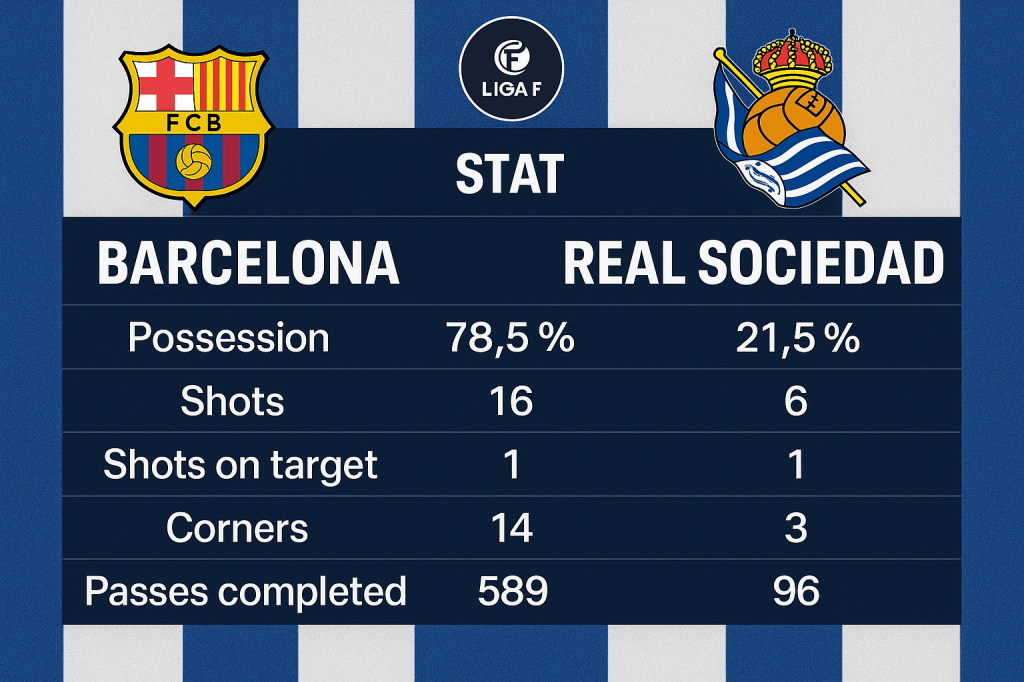
Everything about those figures screams Barcelona dominance — yet every fan watching knew exactly who controlled the match.
Real Sociedad’s defensive discipline wasn’t luck; it was poetry in its own right. The kind that doesn’t glitter, but endures. Every tackle landed like a hymn. Every clearance drew applause from a crowd that knows effort means more than elegance.
When Esmee Brugts fired a rocket towards goal in the 21st minute, María Molina’s instinctive, almost miraculous save under the bar felt like destiny intervening. From that moment, belief took over.
The Human Barça
Barcelona’s empire hasn’t fallen, but it’s wobbling. The footballing gods that once floated above Liga F — Aitana Bonmatí, Alexia Putellas, Graham Hansen, Pina — looked mortal.
Putellas, the eternal compass, couldn’t find direction. Bonmatí, normally the conductor, was stuck playing the same note. Clàudia Pina buzzed around the box but found only shadows and blue-and-white shirts.
Romeu’s substitutions around the hour mark — a triple change meant to revive energy — felt like rearranging furniture on a sinking ship. By the 85th minute, his eyes told the story: confusion, disbelief, and the first flicker of fear.
And yet, football still offered its cruel little tease. In stoppage time, debutant Martine Fenger, a 19-year-old Norwegian plucked from the academy, rose from a corner to head home what looked like salvation. Zubieta fell silent. But seconds later, VAR cut through the noise — offside. Dream denied.
That was Barça’s night in miniature: hope, crushed by inches.
Zubieta: The Cathedral of Belief
Zubieta isn’t a grand arena. It doesn’t have the technological sheen of the Johan Cruyff Stadium. What it has is something Barcelona might have lost — intimacy.
Tucked into the green folds of Guipúzcoa, the ground feels alive. You can smell the Atlantic breeze, hear every shout, every gasp, every heartbeat. Here, football isn’t performed; it’s shared.
The Basque supporters have built an identity on effort — “aplaudir el esfuerzo tanto como el resultado” — applaud the grind as much as the glory. On Sunday, they did both. When the final whistle went, Zubieta became a cathedral, ringing with the hymn of collective triumph.
For Real Sociedad, this wasn’t just three points. It was validation. Proof that passion can outmuscle payroll. That faith and structure can still dismantle empire.
The Managers: The Pragmatist vs. The Poet
If this match were a painting, Arturo Ruiz would be the minimalist — a man who removes every stroke until only meaning remains. His Real Sociedad executed perfection through subtraction. No frills. No flourishes. Just organisation, timing, and courage.
Romeu, by contrast, was the frustrated romantic. His canvas demands movement and colour, but with half his palette missing through injury, he painted in grey. His ideas were clear, but his tools weren’t.
And yet, Ruiz didn’t “park the bus.” He tuned his side to the rhythm of suffering. Every player knew their line, their distance, their moment to bite. The counter-attacks were precise — never frequent, but always venomous.
Tactically, it was a masterclass in how to beat a better team without ever pretending to be one.
The Aftershock: Liga F Reawakened
For years, Liga F games involving Barcelona have felt like processions — foregone conclusions dressed as fixtures. The league needed this. The fans needed this. The sport needed this.
This result reanimates the Liga F standings:
Barcelona Femení still top on 24 points. Real Madrid and Real Sociedad breathing down their necks with 20 each. Suddenly, the race isn’t a coronation — it’s a contest.
When the champions lose, belief spreads like wildfire. Every dressing room in Spain will look at this result and think: “If they can do it…”
The Anatomy of Exhaustion
This was also a warning shot fired at Barcelona’s boardroom. Success can disguise complacency, but not forever. Romeu’s thin squad — just 14 available outfield players — left no margin for rotation. The injury crisis isn’t bad luck; it’s bad planning.
Ewa Pajor’s absence exposed the lack of a true striker. Salma Paralluelo’s injury robbed Barça of their chaos element. Without Patri Guijarro, the midfield lost its metronome. Even with Bonmatí and Putellas on the pitch, there was no rhythm, no incision.
A long season across domestic and European fronts looms, and for once, Barcelona look like a team that might not be able to simply glide through it.
Beyond Numbers: A Moral Victory
The poetic truth of football is that the smaller victory often carries greater meaning. For Real Sociedad, this wasn’t a tactical win — it was existential.
They stood against the inevitability of hierarchy and refused to flinch. Their players fought like artisans defending their craft. Every tackle had history behind it, every clearance was culture embodied.
In Basque football, there’s a word for this: orgullo guipuzcoano — Guipúzcoan pride. It’s not loud. It’s not marketable. But it’s eternal.
When the final whistle blew, the players didn’t rush to selfies or social media moments. They hugged. They screamed. Some cried. They’d written a page of gold into Real Sociedad’s story — and into Liga F’s future.
The Reflection of a Fallen Giant
For Barcelona, the post-match silence was telling. No outrage, no excuses — just reflection. Romeu admitted afterward that the team “must reflect on its offensive sharpness.” He’s right. The defeat doesn’t destroy them; it humanises them. And maybe, deep down, they needed that.
Every great empire requires a fall to remind itself what made it rise.
The culés will regroup, and they’ll likely win again — perhaps even dominate again — but the spell is broken. Liga F has proof that the invincible can be beaten.
Forget xG. Forget stats. Forget possession maps that look like crime-scene diagrams.
What happened in Zubieta was the return of something football had been missing: unpredictability.
For one cold Basque afternoon, Real Sociedad reminded the world that tactics, money, and legacy mean nothing if your soul’s not in it.
Barcelona Femení’s streak will fill pages of record books — but Real Sociedad’s defiance will live longer in memory. Because records belong to history; resistance belongs to legend.
The Liga F standings show a four-point gap, but spiritually, the distance just closed.
In Zubieta, football exhaled. The game still breathes.
 doragon sports