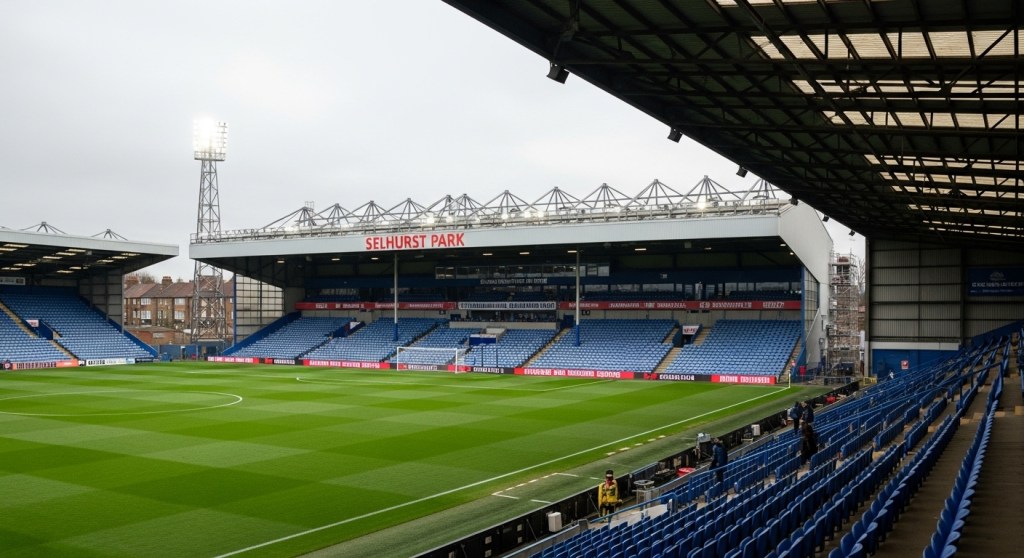
Take a stroll down Whitehorse Lane on matchday and you’ll feel it long before you reach the turnstiles.
The hum of chatter spilling from The Clifton Arms, red-and-blue scarves fluttering from upstairs windows, and then — the sound that defines South London.
Not a polite cheer. A roar. A full-bodied, wall-shaking chorus that turns neighbours into family. That’s Selhurst Park — a place where concrete shakes and emotion breathes.
It isn’t the glossiest ground in England. It isn’t even easy to find on the Selhurst Park map. But it’s alive. Tight, noisy, impossible to ignore — and proud of being exactly that. Whether you’re checking the Selhurst Park seating plan or just following the noise from Norwood Junction, you’ll end up at the same destination: a citadel of sound where football still feels local.
And when the Holmesdale Stand erupts under the floodlights, you’ll understand why fans say there’s nothing quite like it — 25,486 voices, every one of them ready to make South London shake.
The Story of the Club
The Eagles of South London
The roots of Crystal Palace F.C. run deeper than most realise. The story starts in 1861, when workers at the original Crystal Palace Exhibition Hall formed one of England’s earliest football teams — and again in 1905, when the professional side took flight.
They were once The Glaziers, a nod to their glass-palace heritage. Today, they’re The Eagles — still underdogs, still defiant, still playing like every tackle means something.
This is a club that doesn’t polish its history; it owns it. Nestled in Selhurst, in the heart of Croydon, Palace have grown into the heartbeat of South London — stubborn, street-smart, and fiercely proud of who they are. Their old home hosted FA Cup finals until 1914, and their current one, Selhurst Park, still feels like it was built for the people rather than the cameras.
That sense of identity lives on in the stands — and in the players who’ve carried the badge with fire.
Ian Wright, the working-class hero who exploded from these terraces to England stardom.
Daniel Muñoz, the Colombian full-back whose relentless energy mirrors the crowd itself.
And Abbie Larkin, the rising star of the women’s side, a glimpse of Palace’s bright, fearless future.
Whether you’re here for a Selhurst Park tour, grabbing Selhurst Park tickets, or booking one of the many hotels near Selhurst Park, you’re not just visiting a stadium — you’re stepping into a living piece of South London mythology.
Fan Identity & Culture
Few fanbases wear the badge of defiance like Palace supporters. They know what it’s like to flirt with relegation, to be mocked by the moneyed elite, to see bigger clubs swoop in for their best players — and they sing louder because of it.
Leading that passion are the Holmesdale Fanatics, the ultra group who’ve turned one corner of Selhurst into something straight out of the Bundesliga. Tifos, flags, flares (the legal kind), and relentless noise. They’ve brought European-style fan culture to English terraces, pushing back against football’s creeping corporatism.
Their motto says it best: “Selhurst Park roars loud — South London and Proud.”
And when 25,000 people chant “Sha la la la la la la, Crystal Palace”, the rest of London hears it.
The Stadium
Old Bones, New Ambition
Selhurst Park opened in 1924, designed by the legendary Archibald Leitch, the same architect behind Ibrox, Goodison, and Highbury. His signature steelwork still frames the Main Stand — weathered, narrow, but packed with character.
The stadium sits deep in a residential maze, surrounded by terraced houses and corner shops. You don’t stumble upon it — you arrive. That’s part of the charm. It’s football stitched into the neighbourhood.
Capacity & Layout
Selhurst holds 25,486 fans — a modest number in Premier League terms, but that compactness is the secret. Every shout bounces off the roofs, every groan rolls through the stands like thunder.
Here’s how it breaks down:
- Main Stand: The 1924 original, capacity 5,460 + press seats. It’s undergoing a full rebirth — a £100m redevelopment that’ll turn it into a 13,500-seater glass-fronted masterpiece, echoing the original Crystal Palace. Completion: 2027.
- Holmesdale Road Stand: Built in 1994, this is the beating heart. 8,329 fans, all energy. This is where the Fanatics lead the charge.
- Arthur Wait Stand: 9,574 seats along the touchline, home to away supporters — roughly 3,000 of them. It’s infamous for its obstructed views, the kind that force you to lean and swear just to see a corner.
- Whitehorse Lane Stand: 2,219 seats plus executive boxes and the Jumbotron. Family stand, hospitality zone, and a decent view of the chaos below.
Unique Quirks
Selhurst Park doesn’t pretend to be modern. It sweats atmosphere.
When the wind howls and floodlights cut through the drizzle, this place feels like a time capsule of English football.
That claustrophobic design makes it one of the loudest grounds in the country. Ask any away fan — by the 60th minute, you feel like the whole of Croydon is singing in your ear.
And yes, that’s Ted Lasso’s fictional AFC Richmond home you’re looking at. Apple TV’s cameras didn’t need CGI — Selhurst already looked cinematic.
Matchday Experience
Getting There
Here’s the first thing every visitor learns: Crystal Palace Station is a trap. It’s two miles away and a hilly trek you’ll regret by halftime. Ignore it.
If you’re plotting your route on the Selhurst Park map, aim for one of these instead:
- Norwood Junction – a brisk 10–15-minute walk; trains from London Bridge take around 30 minutes.
- Selhurst Station – roughly 40 minutes from London Victoria, perfect if you’re staying in central London.
- Thornton Heath – another Victoria line stop, same distance, with good links for fans staying in hotels near Selhurst Park.
Driving? Don’t even think about it. Parking is near impossible — narrow residential streets, permit zones, and traffic chaos once the final whistle blows. If you absolutely must, pre-book a private driveway nearby.
Turnstiles open two hours before kick-off, and the roads around the ground close well before the teams emerge from the tunnel. Arrive 45–90 minutes early. That way, you’ve got time to grab a pint, browse the Selhurst Park seating plan on your phone, and watch the atmosphere build from calm to chaos.
Before & After the Whistle
The Fanzone outside the Main Stand is where it all begins — music, giveaways, The Crystals cheerleaders, and street food. It’s family-friendly, but don’t mistake that for tame. Palace fans start early.
If you want the full, chest-thumping version of the day, there’s only one place to go: The Clifton Arms. It’s less a pub, more a pre-match ritual. This is where stories about Ian Wright’s early goals get retold over pints, and you’ll probably hear someone debating whether Daniel Muñoz’s lung-busting runs are the best since the club’s 2013 promotion.
Visiting supporters will usually be pointed toward The Prince George or The Selhurst Club — both solid spots about ten minutes’ walk away. If you’re after something easy-going and chain-friendly, The Flora Sandes (a Wetherspoons near Thornton Heath Station) is the safe play.
Inside the ground, it’s all cashless. The food is simple but proper — pies, burgers, and chips sourced from local partners. And yes, the Early Bird Offer is still one of the Premier League’s best-kept secrets: a hot meal and a pint for £8.00, or a soft drink for £6.50, if you’re early enough.
The queues move fast, the smell of fried onions fills the concourse, and when the Holmesdale Stand starts up its drums, it feels like the whole of Croydon joins in.
Club Shop & Facilities
The Club Shop on Whitehorse Lane opens from 9:00 a.m. and stays open an hour after full-time. It’s a good spot to pick up matchday souvenirs — shirts, scarves, and retro gear paying tribute to the Selhurst Park capacity crowds that make this place shake.
Match programmes cost £3.50, and the Information Centre (Entrance 9) handles bag and bike storage free of charge. If you’re on a stadium pilgrimage, book the Selhurst Park Tour — you’ll walk through the same tunnel that produced heroes like Ian Wright and today’s stars like Abbie Larkin.
And when the Main Stand redevelopment finishes, the site will include a club museum — a tribute to every chant, save, and survival story that’s shaped this corner of South London.
The City Snapshot
This isn’t central London glitz — it’s Croydon grit. Selhurst Park sits in the middle of everyday life: terrace houses, takeaways, and buses.
If you’re staying nearby, head to Boxpark Croydon before or after the match — street food, craft beer, and giant screens showing other games.
For a quieter slice of history, the Crystal Palace Museum and Crystal Palace Park are worth the trip, both paying tribute to the 19th-century glass exhibition that birthed the club’s name.
Locals will tell you Croydon has character. And they’re right. It’s not polished — it’s real.
Players & Legacy
Heroes Between the Posts
Every club has a cult hero; Palace has Julián Speroni. The Argentine keeper, dubbed “Manos de Dios” (Hands of God), became a folk legend here. His 250th appearance was celebrated with a full-stand banner — a gesture few goalkeepers ever earn.
Other greats have worn the shirt, from Geoff Thomas to Wilfried Zaha, but Speroni’s connection to the Holmesdale makes him almost mythical.
The Bosses
Palace have never lacked character in the dugout.
- Steve Coppell – The man who gave Palace its identity, across four spells from the 80s onward.
- Roy Hodgson – The elder statesman who brought calm amid chaos.
- Oliver Glasner – The present-day tactician steering the post-Hodgson era, tasked with modernising without sanitising.
Tickets & Essentials
How to Buy
The safest route is through official membership, priced between £25–£60. Palace games often sell out, so don’t risk third-party sites or touts.
Season tickets start from £545 in Zone 5, rising to £790 in Zone 1.
What to Know
- Cashless stadium – contactless cards only.
- Bags: Small only, must fit under a seat. Free storage available at Entrance 9.
- Prohibited items: Flares, bottles, cans, glass, fireworks — the usual suspects.
- Flags/Banners: Allowed with pre-approval and a fire certificate; no politics, no hate.
Final Word
Selhurst Park isn’t just a stadium — it’s a stubborn reminder that football still belongs to the streets.
It’s floodlights over rooftops, chants echoing through terraced rows, and kids in Palace shirts chasing a ball on the pavement.
For all the talk of superclubs and billion-pound brands, you come here to remember what football sounds like when it’s real.
So take the train, grab a pint at The Clifton, and let the Holmesdale show you how South London does noise.
 doragon sports