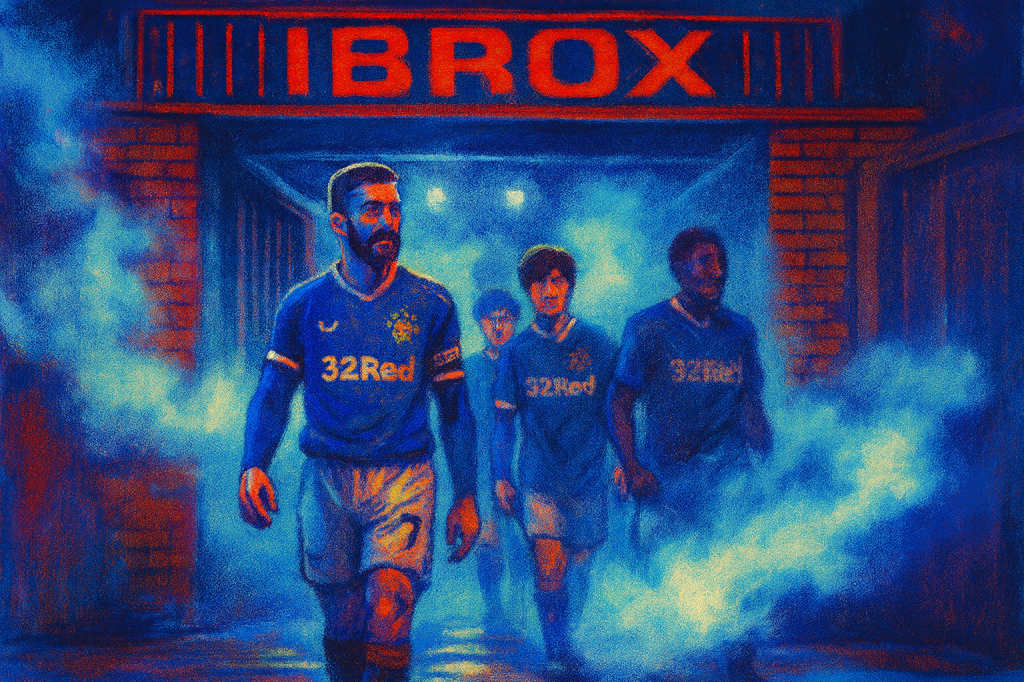
There are football stadiums — and then there’s Ibrox.
A red-brick temple that hums with electricity, loyalty, and memory. The kind of place where you can feel the weight of history in the air — and still hear the noise long after you’ve left Edmiston Drive.
This is not a ground you visit. It’s a pilgrimage.
Club Identity & Origins
Rangers Football Club were founded in 1872, a number etched into every scarf, mural, and fan’s soul. Based in Glasgow, the powerhouse city of Scotland’s industrial revolution, Rangers embody blue-collar pride, structure, and an almost militaristic sense of order.
Supporters call them The Gers, The Light Blues, or affectionately The Teddy Bears — nicknames that feel homegrown, unpretentious, and proud. From the public pitches of Glasgow Green to the fortress of Ibrox, Rangers’ story is the story of Scottish football itself.
Their legacy is vast: 55 League titles, 34 Scottish Cups, and 28 League Cups — the kind of numbers that make historians sweat. They’ve shared the British record of nine consecutive championships and survived one of football’s darkest modern episodes: liquidation and rebirth in 2012. Rangers fought their way back from the lower divisions — a resurrection their fans now treat as sacred myth.
Culturally, Rangers have always existed inside a pressure cooker. The Old Firm rivalry with Celtic remains one of the fiercest, and often ugliest, in world football — religion, politics, and passion blended into a dangerous cocktail. Yet to understand Ibrox, you have to understand its people. For all the stereotypes, Rangers fans are, at their core, loyal to the point of obsession. They see themselves as guardians of tradition — believers in hard work, identity, and belonging.
That’s why when you walk past the Union Jacks, the murals of John Greig, and the blue smoke curling from the pre-match flares, it doesn’t feel like tribalism. It feels like ritual.
Slogans, Mottos & The Sound of Ibrox
The soundtrack is unapologetic, booming from every corner of the 51,000-seater cathedral.
“Follow, follow.”
“We are the people.”
“Blue sea of Ibrox.”
And, of course, Tina Turner’s immortal “Simply the Best” — a track so synonymous with Rangers that it feels like an unofficial national anthem.
That’s what people mean when they talk about Ibrox noise. It’s not just volume — it’s voltage. It’s the collective voice of a fanbase that doesn’t watch football; it inhabits it.
The Stadium: A Red-Brick Cathedral
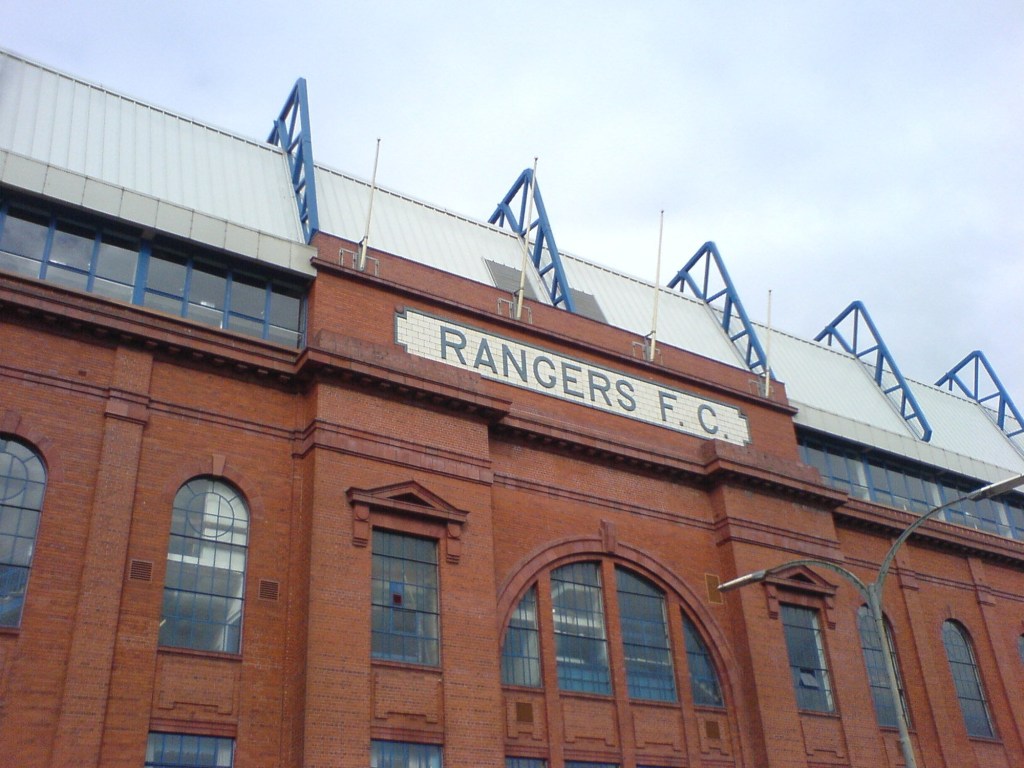
Officially opened in 1899, Ibrox Stadium sits proudly on 150 Edmiston Drive, Glasgow (G51 2XD). Its deep red facade dominates the Ibrox district on the south side of the River Clyde. Designed by the legendary Archibald Leitch, the man behind Britain’s most iconic football architecture, it remains a masterpiece of balance — old-school majesty with modern bones.
With a total Ibrox capacity of 51,700, it ranks as Scotland’s third-largest football stadium, and one of UEFA’s elite Category Four venues. But it’s not just about size — it’s about presence.
Layout
The Bill Struth Main Stand (South): The brain, heart, and soul of Ibrox. A three-tiered monument with a listed red-brick front and Leitch’s ironwork signature. Inside: mahogany panels, marble stairs, and trophies stacked like religious relics.
The Sandy Jardine Stand (North): Named after one of the club’s classiest defenders, this stand houses families and die-hards alike.
The Copland Road Stand (East): The spiritual home of Rangers’ loudest — an expanded singing section keeps the place thundering, match after match.
The Broomloan Road Stand (West): The away end — though on European nights, when flags ripple and flares light up the dusk, even this feels like it belongs to Rangers.
Matchday Experience
Getting There
Ibrox is around 3 miles from Glasgow city centre, perfectly accessible by Subway, train, or bus.
Subway (Best Option): Take the circular “Clockwork Orange” line to Ibrox Station — an 8–16 minute ride from Buchanan Street or St. Enoch. It’s packed before kickoff and pandemonium afterward. Veterans recommend walking to Cessnock Station or simply hoofing it back to the city if you hate queues.
Train: Glasgow Central and Queen Street are your mainline hubs. Dumbreck Station is the closest rail stop, about 20 minutes on foot.
Bus: Routes 9, 9A, 10, 38, and 153 glide along Paisley Road West straight toward Ibrox.
Driving: Take the M8 (Junctions 24 or 26), but beware — matchday traffic is Glasgow Armageddon. Parking near Ibrox is limited, though Albion Car Park offers pre-bookable spots. Locals often park in Mosspark or Dumbreck and walk.
And if you’re flying in, Glasgow Airport is a convenient 20-minute drive away, often used by European fans doing weekend pilgrimages.
Before the Match
The Louden Tavern, opposite the Subway station, is ground-zero for fan culture. Blue walls, packed bodies, free pies, and chants that start three hours before kickoff. It’s loud, patriotic, and unforgettable.
Visitors should note that pubs close to Ibrox can be partisan, so neutrals often stick to city-centre bars like The Pot Still, The Ben Nevis, or Waxy O’Connor’s before heading to the ground.
Inside the Ground
Ibrox operates as a cashless stadium — contactless only. Food options include classic Scottish matchday fare: steak pies, burgers, chips, Irn-Bru. Alcohol sales remain banned under Scottish law.
The one gripe? Legroom. The older sections of the Main Stand are notoriously cramped — an authentic taste of British football’s architectural past.
Ibrox Tour & Museum
Rangers now offer one of Britain’s most complete stadium tours. The Ibrox tour takes you through the Bill Struth Main Stand, the dressing rooms, and the Marble Staircase, before letting you walk the tunnel and sit in the dugout. The highlight, though, is the Trophy Room — where silverware glints like stained glass.
Next door, Edmiston House houses the new Rangers Museum, opened in 2023. Inside, the club’s soul is laid bare — shirts from every era, the Cup Winners’ Cup, and personal items from legends like Greig, McCoist, and Gascoigne.
The City: Glasgow
Glasgow is not a city that whispers. It shouts. A place where the rain — yes, the Glasgow weather — feels like a personality trait.
It’s a working-class powerhouse built on shipyards and rebellion, yet rich in art and humour. Take a day to wander the Kelvingrove Art Gallery, the University of Glasgow, or Riverside Museum. Then hit Ashton Lane for whisky and neon before catching the Subway back to Ibrox.
On the other side of town lies Celtic Park — enemy territory — and Hampden Park, home of the Scottish Football Museum. But even among such heavyweights, Ibrox stands alone.
Rangers Players, Legends & Legacy
Few clubs revere their icons like Rangers. The names are passed down like family heirlooms.
John Greig: The granite-hearted captain whose leadership still echoes in the Main Stand. His statue stands sentinel outside Ibrox, forever watching.
Sandy Jardine: Elegant, loyal, a right-back who made defending look poetic. His stand carries his name with honour.
Ally McCoist: The smile, the goals, the soul. Super Ally is football joy personified — now part legend, part folk hero.
Brian Laudrup: Scandinavian silk in a sea of steel — elegance unmatched.
Jim Baxter: A 1960s wizard who played football like jazz.
Today’s Rangers side carries that spirit forward. James Tavernier, the captain and dead-ball specialist, embodies modern professionalism — leadership with flair. Rising talents like Katie Williamson and South Korean playmaker Kim Shin-ji are pushing the women’s team into new frontiers, part of the growing wave that’s made Ibrox their stage.
Rangers aren’t just evolving — they’re reclaiming.
Rangers Tickets & Essentials
Tickets are sold via the official site, phone line (+44 871 702 1972), or at the Rangers Ticket Centre beside the stadium.
Prices (Men’s Team):
Regular Premiership matches: £30–£40
Big fixtures: up to £50
MyGers members get priority and early access.
Prices (Women’s Team):
Adults: £11 (or £9 for MyGers)
Concessions: £6 (£5 for members)
Season tickets: £118 (Adults) / £33 (Concessions)
The ground opens 90 minutes before kickoff, and security is thorough — no alcohol, cans, or external food.
Ibrox Noise: What It Feels Like
Step inside before kickoff and listen. The hum builds slowly — a low vibration in your ribs. Then “Simply the Best” hits the tannoy, scarves go up, and 50,000 people merge into one voice.
That’s Ibrox noise. It’s not loud. It’s alive.
Even on cold winter nights when the Glasgow weather cuts through your coat, the sound keeps you warm. The way chants ricochet between the Copland and Broomloan stands feels tribal, but also strangely unifying — the football version of thunderclaps and bagpipes.
It’s football stripped of cynicism and turned into ceremony.
Final Word: The Pilgrimage
Visiting Ibrox isn’t about ticking off another stadium. It’s about paying respect. About walking through the Bill Struth Main Stand, seeing the marble and wood, and understanding that football, in Glasgow, isn’t a pastime — it’s a birthright.
Whether you’re a Rangers fan, a curious neutral, or a travelling supporter chasing atmosphere, Ibrox delivers something primal: connection.
In an era of sanitised football, Rangers still bleed authenticity — from the roar of the crowd to the rain on the red brick.
It’s not just “simply the best.”
It’s simply Ibrox.
 doragon sports