
It began like a goodbye wrapped in thunder.
Cardiff City Stadium — painted red, roaring loud, trembling with pride — stood to witness the kind of football moment that feels biblical. On one side: Jess Fishlock, Wales’ eternal heartbeat, playing her 166th and final match, her eyes glassy as the anthem echoed.
On the other: Sam Kerr, the Matildas’ thunderclap, returning to the pitch after 725 days of silence. Between them stood time itself — one career closing its curtain, another roaring back from injury to remind the world she still existed.
The scoreboard would read Wales 1–2 Australia, but this wasn’t a game — it was a crossroads. One nation saying thank you, another saying we’re not done yet.
The Farewell and the Return
There are few athletes who embody a nation’s footballing DNA the way Jess Fishlock does. For nineteen years, she bled for Cymru — through rain, heartbreak, and part-time wages. Every cap earned with jetlag and bruises. Every goal scored like a declaration of independence.
Her farewell match was poetry: 11,000 in attendance, a 10th-minute applause shaking the stands, and the sight of the Red Wall — the same faithful she’d dragged through decades of near-misses — now singing her home.
And yet, how fitting that her final battle came against Australia — a country she once called home, where she played, coached, and won under the guidance of her former mentor, Joe Montemurro. Across the touchline, her old boss now led the Matildas — sleek, possession-driven, disciplined. It was as if fate wanted her to face her football past before she walked away from her international future.
On the other side of the halfway line stood Sam Kerr, hair tied, armband shining, mind racing. 725 days gone. One ACL shredded. One trial survived. One reputation under the microscope. This was no mere return — it was defiance.
She didn’t score, didn’t dazzle, but she didn’t need to. Her gravity was enough. Her failed touch on Courtney Nevin’s 28th-minute free-kick deceived the keeper — a phantom assist — proof that even when quiet, Kerr bends games to her will.
Behind her, Hayley Raso — 100 caps deep, spine once fractured, heart still iron — captained Australia through the noise. She’s the survivor’s survivor. “I didn’t think I’d ever reach this day,” she said post-match, and you could tell she meant it.
These weren’t just footballers on the pitch. They were survivors of eras — Fishlock of the old, Kerr and Raso of the reborn.
When Styles Collide: Wales’ Fire vs. Australia’s Machine
The match itself was a duel of philosophies.
Rhian Wilkinson’s Wales came armed with intensity and pride — a 3-4-2-1 system built for energy and press, not possession. Joe Montemurro’s Australia were all rhythm and control, pulsing through a 4-2-3-1 that moved like a metronome.
The numbers told the story.
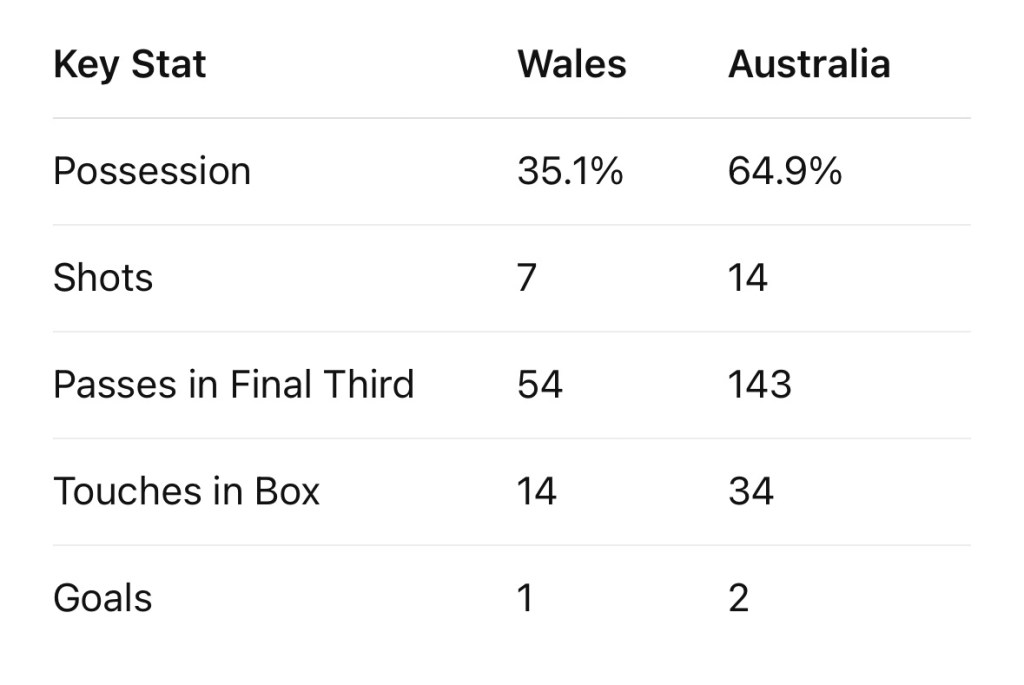
Australia hogged 64.9% of possession, made 143 successful final-third passes to Wales’ 54, and doubled the shot count (14 to 7). But for all that dominance, Wales made them bleed for it.
The Red Wall howled through every Fishlock tackle, every Ceri Holland press. Wales’ midfield was an act of defiance — all sweat and grit, forcing errors from the Matildas’ back line. But Australia are nothing if not patient surgeons. Their first incision came in the 28th minute: Courtney Nevin, 38 caps without a goal, curling a free-kick that ghosted past Kerr’s attempted flick and nestled in. Fortunate? Maybe. Deserved? Absolutely.
Kerr’s presence alone bent Wales’ defensive line, freeing lanes for Kyra Cooney-Cross and Caitlin Foord to carve space. The pair would eventually combine for the 85th-minute winner — the Arsenal connection firing like clockwork.
Australia’s DNA under Montemurro is technical precision, a rebuild of identity.
He’s chasing fluency, not chaos. Retention, not reaction. “The more we retain the ball, the more we’ll grow,” he said before the match — and you could see it materialising: clean triangles, wide overloads, patience until pressure broke.
But in that precision, Wales found their purpose — to disrupt, to dare.
The Goal That Passed the Torch
There’s something hauntingly beautiful about how football chooses its metaphors.
In the 55th minute, as Fishlock ran the midfield for one last surge, it wasn’t her who found the net — it was Mared Griffiths, 18 years old, born the year after Fishlock’s debut.
Her chipped equaliser — a delicate lob over Teagan Micah — was the kind of goal that drips with future. Calm, instinctive, poetic. The Red Wall erupted, knowing it was witnessing something bigger than a goal: the moment Wales’ torch was physically passed.
Fishlock smiled — a tired, teary smile — the look of a general seeing her successor’s first victory.
“Mared’s got something special,” said Wilkinson post-match. “And she learned it watching Jess.”
When the final whistle came, Fishlock was substituted to a standing ovation.
The tears she’d held back for two hours finally broke. Teammates swarmed. Opponents applauded. Montemurro — her old mentor — walked across the pitch to embrace her. The kind of embrace that says, we built this game together.
Then, under the Cardiff dusk, the crowd chanted her name one last time:
“There’s only one Jess Fishlock.”
The Machine and the Moment
For all the emotion, the data didn’t lie — Australia’s system worked.
They dictated tempo, owned the final third, and executed Montemurro’s blueprint with surgical precision.
Caitlin Foord’s winner — an 85th-minute dagger — came after a sweeping five-pass move starting with Ellie Carpenter, fresh off Chelsea duty. It was beautiful in its cold efficiency: Carpenter → Cooney-Cross → Foord → net. No fuss, no fluke.
Foord’s performance was immense.
One goal, three chances created, 85% pass completion, and the kind of movement that makes defenders question their positioning in real time. She’s not loud about her brilliance — she just accumulates it.
Behind her, Katrina Gorry — the metronome — hit 91% passing accuracy and rattled the crossbar early on. If she’s the heart, then Cooney-Cross is the brain — dictating with 10 progressive carries and the match-winning assist.
And then there was Kerr.
Statistically quiet — one shot, 65 minutes, no goal. But impact is not always measurable by numbers. The moment she left the pitch, Australia’s press dropped by 8%, their final-third touches decreased, and Wales found space to breathe. She didn’t need to score to remind everyone why she’s still the Matildas’ orbit.
The Legacy of the Night
When Jess Fishlock finally took the mic after the match, her voice cracked.
“All the fans, I want to say thank you… it’s been an honour of a lifetime.”
Then she cried. Cardiff cried with her.
They’d seen the full circle — the street footballer turned global symbol. From unpaid hotel rooms to Euro goals and MBE honours. From taking kicks in Icelandic mud to standing under Welsh floodlights one last time.
Former international Nia Jones said it best:
“I don’t know who builds the statues in Cardiff, but she needs one.”
Fishlock bridged two football worlds — amateur and professional, struggle and pride, invisibility and visibility. Her career made the modern Cymru possible. She leaves a nation ready to believe again.
And maybe that’s the quiet magic of nights like this.
Football is cruel, it never pauses — but sometimes it gives you perfect symmetry. The legend bows, the kid scores, and the world moves on with a little more poetry in its boots.
Australia’s Iron Rhythm
For the Matildas, this was more than a friendly — it was an experiment that worked.
Montemurro’s emphasis on ball retention has replaced the counter-punch style of the Gustavsson era. It’s slower, smarter, and less reliant on chaos. The numbers back it: 85% pass completion, 2.1 expected goals, 143 successful final-third passes.
Hayley Raso’s leadership anchored the tone — pressing from the front, instructing younger players. Her century cap wasn’t ceremonial; it was earned through grind and recovery. She’s the connective tissue of this side, the living memory of both their heartbreaks and breakthroughs.
Ellie Carpenter’s late cameo showcased depth — pace, precision, and a pre-assist that iced the game. Australia’s rotation looks rich. Their structure? Even richer. This team isn’t peaking — it’s learning how to peak on command.
And Kerr? She’ll score again soon. Her 64 goals in 128 caps stand as proof that every drought is just fuel for the next eruption.
Wales’ Next Chapter
For Wilkinson’s Wales, defeat didn’t sting — it inspired.
A 1–2 loss against the 15th-ranked team in the world after the emotional drain of a legend’s farewell? That’s not regression. That’s foundation-building.
The new faces — Griffiths, Zimmerman, the next wave — have seen what legacy looks like. They’ve seen the tears, the applause, the meaning. Now they get to build on it.
Wales had seven shots, 14 touches in the box, and forced enough turnovers to keep Australia guessing. Wilkinson was right post-match: “We’re showing we can live with them — we just need the legs to last 90.”
That’s what transition looks like. It’s not about wins yet. It’s about endurance — emotional and physical.
One Last Image
After the final whistle, Fishlock walked alone toward the Red Wall. She took off her boots and placed them on the touchline — a small, symbolic act.
Behind her, Sam Kerr and Caitlin Foord shared a laugh.
On the big screen, the scoreboard still glowed 1–2.
Generations shifted in that moment.
Fishlock left her legacy behind.
Kerr reclaimed her stage.
And somewhere between the tears and applause, football did what it always does — it moved forward.
Final Word: Wales v Australia
It wasn’t just a friendly. It was a handover ceremony.
A study in evolution — of players, of nations, of eras.
Jess Fishlock exited as Wales’ all-time record-holder, 166 caps, 48 goals, and an MBE that barely scratches the surface of her impact.
Sam Kerr re-entered with a heartbeat louder than any stat line, 725 days gone, now ticking again.
Hayley Raso stood between them, 100 caps of scars and steel.
Mared Griffiths lit the torch for the next two decades.
Football doesn’t give you fairytales often. But Cardiff got one that afternoon — and in true Doragon fashion, it burned bright, brief, and unforgettable.
Wales 1–2 Australia. Fishlock bows. Kerr rises. The game — as always — goes on.
 doragon sports