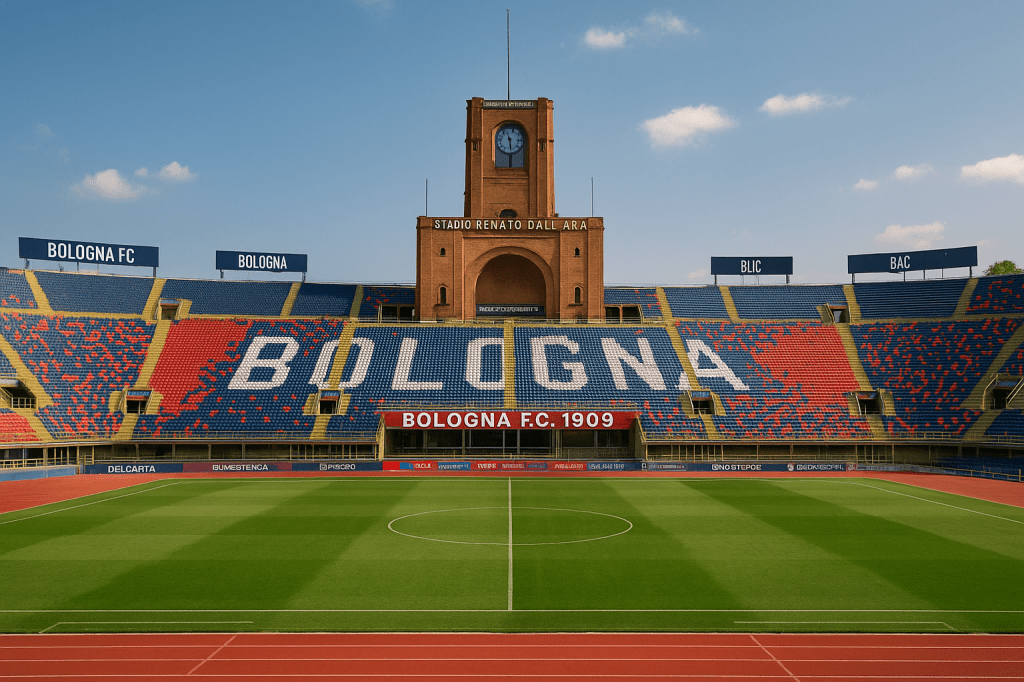
Welcome to Bologna, where porticoes run like arteries through a city that eats better than you and thinks faster than you — and where football still feels like civic ritual. The Stadio Renato Dall’Ara isn’t just a ground; it’s a monument reclaimed. A fascist-era colossus turned people’s theatre, red brick wrapped around red-and-blue devotion. Come for the food, stay for the fury: I Rossoblù sing with their stomachs full and their hearts louder.
Club Identity & Origins
Official name: Bologna Football Club 1909 S.p.A.
Founded: 3 October 1909
City/Region/Country: Bologna, Emilia-Romagna, Italy
Colours: Red & Blue
The Soul of I Rossoblù
Bologna’s colours mirror the civic shield and, by happy accident, the lineage of the club’s first captain — a Swiss influence that stuck and became identity. Around here, the nicknames carry weight: I Rossoblù (obvious and proud), I Veltri (The Greyhounds), I Felsinei and I Petroniani (historical nods that anchor the club in the city’s antiquity). This is a club whose flags don’t just decorate balconies; they mark territory.
A History Forged in Gold and Fire
Before the giant northern industrialists turned football into empire, Bologna were royalty. Seven Scudetti, heavy with 1920s-30s glam, and the Mitropa Cup (1932) when international football was still drawing its first borders. But the club’s defining fresco is 1963–64: a title run laced with scandal, protest, heartbreak and triumph. Five players, falsely doped; three points, wrongly docked; the city, in revolt; the truth, restored. Four days before the title tie-breaker with Inter, president Renato Dall’Ara died of a heart attack. The team played through tears and won 2–0 in Rome. Strip away the romance and that’s still a hard, steel-spined fairy tale.
The decades since have mixed grit and stumble: financial strife, a fall as far as Serie C1, and then a reset under the Joey Saputo era. Stability replaced drift. Ambition returned. Champions League football in 2024–25 for the first time since the 1960s; a Coppa Italia in the same window. Bologna stopped being a nostalgia act and started sounding like a threat again.
Fan Identity
Bologna shares its heart with basketball — this is “Basket City” after all — but on football nights the scales tip. The club is civic glue, the badge a shorthand for belonging. Visitors who turn up with curiosity are welcomed; tourists who treat it like a checklist stop are corrected. Love the city and the club, and the city will love you back.
The Stadium: Stadio Renato Dall’Ara
Full name: Stadio Renato Dall’Ara
Opened: 1927 (construction began 1925)
Original names: Stadio Littoriale (1927–45), Stadio Comunale (1945–83)
Location: Saragozza district, Via Andrea Costa 174
Capacity: ~38,279 (current)
Monumental Home, Modern Pulse
Dall’Ara was Italy’s first truly modern stadium and it looks it — a rationalist temple clad in the same deep red brick that colours Bologna’s skyline. It was a regime project, yes, but time, people, and purpose have rewritten the meaning of those walls. The portico motifs, the sweeping curves: it’s architecture with shoulders broad enough to carry memory and matchday all at once.
Crowning the complex is the Torre di Maratona (Marathon Tower), 42 metres of vertical punctuation that centres the whole amphitheatre. Before WWII, there was an equestrian statue of Mussolini here; in 1943, it was destroyed. The tower remains, re-contextualised: from propaganda to pride.
World Cup ’90 brought upgrades — more seats, the controversial running track — and a slice of English mythology: David Platt’s swivel-and-volley against Belgium, a goal that still hums on highlight reels like a vintage amplifier.
Atmosphere and Fan Spaces
The stadium’s throat is the Curva Bulgarelli (Curva Nord/Andrea Costa) — named for Giacomo Bulgarelli, captain and conscience of the ’64 champions. Ultras like Vecchia Guardia work with colour, fabric and fire; when this end gets moving, songs don’t so much echo as ricochet.
Opposite is Curva San Luca — renamed in honour of coach Árpád Weisz, a tactical pioneer murdered in the Holocaust. It’s a decision that keeps football tethered to memory and decency. Away fans land in the Curva Ospiti (SW corner), a 2,500-seat enclave that hears everything and answers anyway.
Matchday Experience
Getting There
Distance: ~3–3.5 km from Piazza Maggiore. A city stroll, not a slog.
On Foot / By Bike: 30–45 mins. Follow the porticoes of Via Saragozza — a UNESCO-listed corridor of arches that turns a walk into a scenic procession. Some locals take a quicker cut past the Certosa Cemetery; it sounds morbid, it’s not.
By Bus (TPER): From Bologna Centrale: Bus 21 (Filanda direction) to Stadio; ~15–21 mins. From the centre: Bus 14 along Via Andrea Costa; Bus 20 to Dello Sport near the away end.
Taxi: 6–10 minutes from Centrale if traffic behaves.
Car: Don’t. Parking evaporates on matchdays and the motorway exit (Bologna Casalecchio) funnels you into frustration.
Pre- and Post-Match: Eat Like You Mean It
Bologna is La Grassa for a reason. Inside the ground you’ll get fast fuel — panini, pizza slices — with the very Italian perk of beer in your seat. Outside, hunt down a mortadella focaccia (pistachios if you’re righteous) and accept that the phrase “Bologna sandwich” was stolen and misused abroad. The real thing lives here.
Fan meet-ups: bars around Via del Borgo di San Pietro and along Via Andrea Costa bloom early. Ultras congregate at Skeggia near the main entrance; the old soul of the place hums at Billi Bar 1833 (behind Curva San Luca) and Bar Maratona beneath the tower. Post-match, tagliatelle al ragù on Via Saragozza is ritual, not suggestion.
Essentials
The Bologna FC Official Store sits on Via dello Sport off Andrea Costa; the Macron BFC Store in Galleria Cavour handles downtown needs. Stadium tours — hospitality decks, press room, dressing rooms, that tunnel walk — are run by Succede solo a Bologna. For once, the name’s not marketing. It’s a vibe.
City Snapshot: La Dotta, La Grassa, La Rossa
Bologna does triple-threat identity effortlessly:
La Dotta — the learned one; the University of Bologna is the world’s oldest. Brains everywhere.
La Grassa — the fat one; food that makes Naples jealous and your waistband surrender.
La Rossa — the red one; rooftops and politics both earn the tag.
Piazza Maggiore anchors the medieval centre under the heavy grace of San Petronio. The UNESCO-listed porticoes (40 km of them) turn rain into theatre and summer heat into shade. Dip into the Pinacoteca Nazionale for Emilian masters, the Basilica di San Domenico for cool marble silence, then wander to the Two Towers to remind yourself gravity negotiates in Bologna, it doesn’t dictate.
Eat properly: tagliatelle al ragù (never “spag bol”), tortellini in brodo, crescentine with cold cuts. For petrolheads, Ducati Museum sits in Borgo Panigale, while the Autodromo Enzo e Dino Ferrari (Imola) is a regional train away. Football, engines, and carbs — the triangle of joy.
Players & Legacy
Giacomo Bulgarelli — captain of ’64, club-record 488 appearances, name on the Curva, spirit in the concrete. Fabio Capello once called him Italy’s greatest midfielder; hyperbole ages, class doesn’t.
Angelo Schiavio — one-club icon (1922–39), 242 goals in 348, scorer of Italy’s 1934 World Cup winner. If Bologna had a Mount Rushmore, he’s the first face cut from stone.
Roberto Baggio — a single incandescent season (1997–98, 22 Serie A goals). A stopover that felt like a concert: brief, perfect, unforgettable.
Ezio Pascutti — elegance and aggression in the air; diving headers as calling card.
Giuseppe “Beppe” Signori — late-90s swagger, UEFA Intertoto lift in 1998, the bridge back to relevance.
The Modern Project
Head Coach: Vincenzo Italiano — appointed July 2024 after Thiago Motta’s Champions League charge. Shape: 4-2-3-1. Ethos: man-oriented pressing, territorial squeeze, and wing-heavy combinations (the right side is a weapon). The football aims to live high, win it back sooner, and punish wide.
Heroes now:
Riccardo Orsolini — talisman, output machine, right-side metronome and machete.
Lewis Ferguson — Scottish engine and vice-captain, raids the box like he’s late for something.
Lorenzo De Silvestri — captain, steel and standards.
Ciro Immobile — marquee free-transfer punch; goals change games, names change atmospheres.
This isn’t nostalgia cosplay. It’s a live project with teeth.
Tickets & Essentials
How to Buy
Online: Official channels and Vivaticket. Use print@home and stroll past the queue like a local with places to be. In person (advance): Macron BFC Store (Galleria Cavour) and Bologna Welcome (Piazza Maggiore). Tabacchi (tobacco shops) still do brisk trade.
Matchday: Ticket offices on Via Andrea Costa and Piazza della Pace open ~3 hours before kickoff. Cheaper and calmer if you’ve already sorted it.
Bring photo ID for purchase and entry. Italy loves a name-on-ticket check; Bologna enforces it.
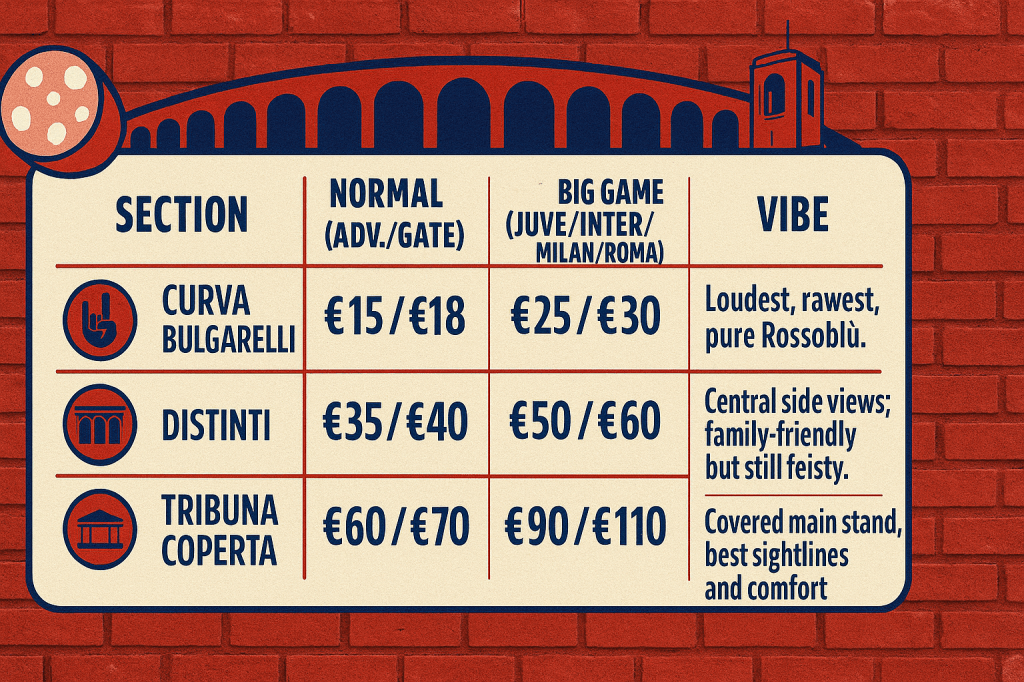
Where to sit: first-timers who crave atmosphere go Curva (if you can get in; season tickets dominate). If you want to read the game, hit the Distinti. If you want to feel like a director in a dress shirt, Tribuna Coperta.
Away fans: Curva Ospiti (SW corner, access via Via Menabue off Via Porrettana). Buy in advance; don’t expect walk-up availability.
Ground Rules (the boring bit you’ll be glad you read)
Prohibited: glass/plastic bottles, cans, alcohol >5% ABV, fireworks, poles, blades, the usual. Expect metal detectors at the turnstiles and CCTV everywhere. The name on your ticket needs to match your ID. Steward won’t debate your middle name spelling when the Curva’s already singing.
Final Whistle
The Stadio Renato Dall’Ara is Bologna written in brick: learned, layered, and louder than you think. It carries political ghosts, football saints, and the noise of a city that knows how to live. Soon, the stands will slide closer, the track will vanish, and the songs will hit the pitch in seven steps instead of eighteen. Progress — with the past still visible in the masonry.
Come hungry. Leave hoarse. And remember: in Bologna, the pasta is al dente and the football is never half-cooked. Rossoblù is a colour, a noise, and a way of walking down Via Andrea Costa on a Sunday night like the world makes sense.
 doragon sports