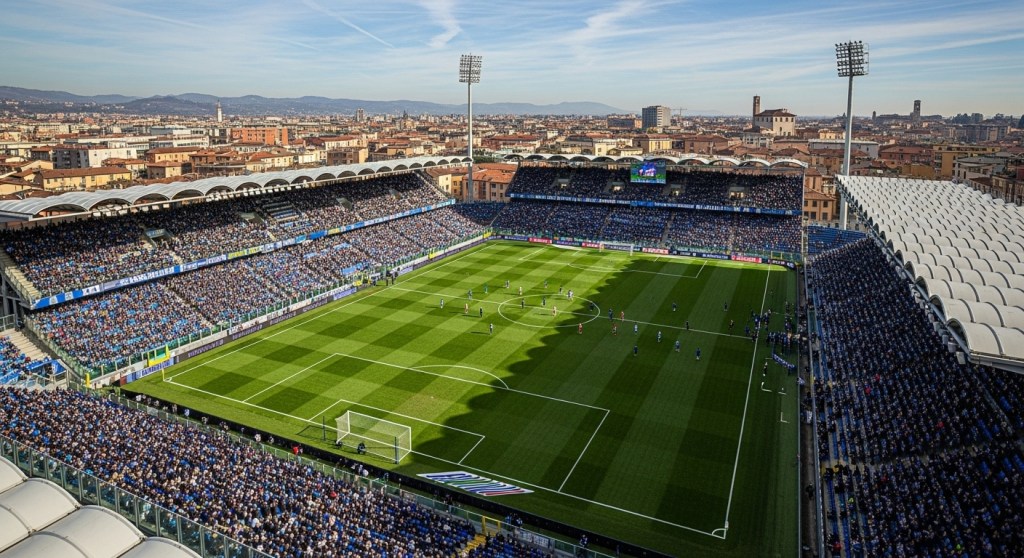
Welcome to Bergamo — a city split between heaven and hustle. The medieval Città Alta watches from its hilltop perch while the Città Bassa hums below, all beneath the gaze of the Alps. Somewhere in between lies the heartbeat of one of Europe’s most compelling modern football stories: Atalanta Bergamasca Calcio. Known simply as La Dea (The Goddess), Atalanta have transformed from provincial battlers to continental conquerors — and their home, the New Balance Arena, captures that very spirit.
This is your full guide to the club, the culture, and the pilgrimage every fan should make to Bergamo.
Club Identity & Origins
The Black and Blue Ambition
The club’s official name is Atalanta Bergamasca Calcio SpA. Founded in 1907 by students of the Liceo Classico Paolo Sarpi, Atalanta embodies Lombardy’s mix of grit and intelligence. The now-iconic black and blue stripes (I Nerazzurri) arrived after a 1920 merger with Bergamasca, another local side — a union that gave birth to a symbol recognised across Europe.
Nicknames & Mythology
Atalanta takes its nickname, La Dea, from the fleet-footed huntress of Greek legend — a symbol of speed, courage, and divine independence. Locally, they’re also known as Gli Orobici (The Bergamasques), but perhaps most famously as the Regina delle provinciali, the “Queen of the provincial clubs” — a nod to their defiant success despite never hailing from a capital city.
Cultural Roots & Resilience
The story of Atalanta is one of survival and reinvention.
They lifted their first major silverware in 1963 with the Coppa Italia, reached the Cup Winners’ Cup semi-finals in 1988 while still a Serie B side, and after decades of oscillation, rose again in the 2010s under Gian Piero Gasperini — peaking with the 2024 UEFA Europa League triumph. In a football world of oil money and mega-brands, Atalanta became Europe’s blueprint for how intelligence, unity, and tactical evolution can overturn the odds.
Fan Culture & Rivalries
In Bergamo, football borders on religion. The Curva Nord Pisani is one of Italy’s loudest and most visually intense terraces — a sea of blue and black banners, drums, and choreographed chaos.
The fiercest rivalry is with Brescia, their neighbours in the Derby Lombardo. The two cities have been at odds since the 12th century, and even today, the insults remain medieval: Bergamaschi call the Brescians “pigs,” and Brescians respond with “rabbits.” Expect no handshakes.
The Stadium: New Balance Arena (Stadio di Bergamo)
History and Transformation
Originally opened in 1928, the New Balance Arena — also known for UEFA fixtures as the Stadio di Bergamo — has worn many names: Stadio Mario Brumana, Stadio Comunale, Stadio Atleti Azzurri d’Italia, and most recently, the Gewiss Stadium.
Atalanta purchased it outright in 2017, a rarity in Serie A, and by 2024, it had been reborn. Gone are the running tracks and crumbling stands — replaced by sharp sightlines, an intimate bowl, and a modern façade that finally befits a club of Atalanta’s stature.
Capacity & Layout
- Capacity: 24,950 seats
- Surface: FLexGrass Vertix hybrid pitch
- Design: A rectangular, football-first arena with covered stands on all sides
- Named Tribunes:
- Curva Nord Pisani – Ultras’ home, named for Federico Pisani (player, died 1997)
- Curva Sud Morosini – Away section, honoring Piermario Morosini (youth product, died 2012)
- Tribuna Rinascimento – Main stand, nodding to Bergamo’s cultural heritage
From the Curva Nord, fans can glimpse Bergamo’s orange rooftops and green hills in the distance — one of the most picturesque views in Italian football.
Atmosphere
The New Balance Arena is widely considered one of Serie A’s most atmospheric stadiums. When La Dea attacks toward the Curva Nord, the sound is seismic — a chant-driven wall of devotion that echoes far beyond the city walls.
Visiting supporters are placed in the Curva Sud, where the welcome is… educational. The noise doesn’t relent, and the energy feels more Champions League night than Sunday afternoon.
Historic Moments
- 1963 Coppa Italia triumph
- 1988 Cup Winners’ Cup run as a Serie B club
- 2020 Italy vs Netherlands Nations League tie, played here as tribute to Bergamo after the COVID-19 crisis
- 2024 Europa League champions — Atalanta’s defining modern chapter
Matchday Experience
How to Get to the New Balance Arena
Getting to the Atalanta stadium is straightforward, though the Limited Traffic Zone around it means timing is key.
From the city centre (Porta Nuova):
- 🚶♂️ Walk: Around 30–35 minutes (2–2.5 km), or a short stroll downhill from the Città Alta.
- 🚌 Bus: Take ATB Line 9 (main line to the stadium) or Line 6 from the train station. Line 3 connects directly from the Città Alta.
- 🚗 By Car: Exit the A4 motorway at “Bergamo.” Note: cars are banned from entering the immediate stadium area from 2 hours before to 30 minutes after kickoff.
- 🅿️ Parking: Limited — early arrival essential.
- ♿ Accessibility: Shuttle buses run from Piazzale degli Alpini, including accessible services.
Pre-Game & Post-Match Food and Drink
Bergamo is Italy’s answer to slow-burn indulgence.
Near the Stadium:
- Bar Bettineschi Bocciodromo – local pre-match haunt.
- Fuorigioco – modern bar near the Curva.
- Il Baretto – for a quick espresso or aperitivo.
- America Graffiti & Burger King – for fast food options.
- Mandorlacchio – homemade gelato, because this is still Italy.
In Town:
- Trattoria Parietti and La Colombina (traditional Casoncelli and Polenta Taragna)
- Circolino Città Alta (historic spot for locals)
- The Tucans Irish Bar and Pub Sant’Orsola (expat-friendly football pubs)
All kiosks inside accept cash and card. Carry your passport/ID, as all Atalanta tickets are name-specific — Italian stadium laws require identification matching your ticket.
Club Shop & Memorabilia
The official Atalanta Store sits right outside the stadium on Viale Giulio Cesare. Inside: home shirts in crisp blue and black, Europa League final memorabilia, and the now-iconic La Dea crest merch. There’s no dedicated club museum, but for those chasing history, the Museo delle Storie di Bergamo in the Rocca Fortress is a worthy detour.
The City: Bergamo in Focus
Città Alta – The Old Soul
Take the Funicolare di Bergamo Alta and step into another world. The Upper Town’s cobblestone maze reveals the Piazza Vecchia, Basilica di Santa Maria Maggiore, and the Cappella Colleoni — Renaissance landmarks with panoramic views stretching to the Alps.
For luck, touch the “three testicles” on the Colleoni family crest at the chapel gate — locals swear by it.
Città Bassa – The Pulse Below
Down below, Città Bassa offers sleek shops, bars, and the artistic twin pillars of Accademia Carrara and GAMeC. The nightlife is laid-back and cultured — think craft cocktails, not chaos.
What to Eat
- Casoncelli alla Bergamasca – stuffed pasta with butter and sage.
- Polenta Taragna – polenta blended with cheese.
- Stracciatella Gelato – invented here in 1961 at La Marianna.
- Polenta e Osei – sponge cake topped with chocolate marzipan birds.
If you only have time for one dish, go for the Casoncelli. It’s Bergamo on a plate.
Day Trips
From Bergamo, Lake Como, Lake Iseo, and San Pellegrino Terme are all within an hour. For hikers, the Bergamo Alps offer easy day trails and postcard scenery.
Players, Tactics & Legacy
The Gasperini Revolution
Few clubs have been so defined by a manager. Gian Piero Gasperini (2016–2025) turned Atalanta into Italy’s most fearless side — high pressing, high scoring, no compromise. His 3-4-1-2 system, built on man-marking and overlapping wingbacks, became a tactical reference point across Europe.
Three consecutive third-place finishes, four straight Champions League runs, and that 2024 Europa League victory sealed his legend.
Legends of La Dea
- Cristiano Doni – midfield visionary, over 100 goals
- Gianpaolo Bellini – one-club man, 435 appearances
- Josip Iličić – mercurial genius behind the first UCL surge
- Papu Gómez – the creative heartbeat of the Gasperini years
- Gaetano Scirea & Antonio Cabrini – youth products turned World Cup winners
Current Heroes (2024/25)
- Rafael Toloi (Captain) – leader and defensive constant
- Ademola Lookman – 2024 Europa League Final hat-trick hero, African Footballer of the Year
- Marten de Roon – the midfield’s “Wavebreaker”
- Éderson – dynamic, progressive midfielder
- Marco Carnesecchi – elite young goalkeeper, now rated among Europe’s best
Tickets & Essentials
How to Buy
Tickets can be purchased through the official Atalanta website or in-person at authorized sales points. Italian regulations are strict:
- Tickets must bear your name and match your photo ID.
- They are non-transferable.
- Always carry your passport to the turnstile.
Prices
- Curva Nord/Sud: €20–€75 (Under 16 discounts apply)
- Tribuna Sections: €75–€220 for major fixtures (Champions/Europa League)
- Away End: approx. €30
Early booking is vital for European nights, as Atalanta tickets sell out quickly, especially after their continental rise.
Final Word
Atalanta’s story is what football romantics dream about — a working-class club turned European force, a city reborn through sport, and a fan base that sings like a cathedral choir under floodlights.
Whether you’re coming for Atalanta FC Bergamo, the New Balance Arena, or the alpine skyline glowing at sunset, one truth remains: La Dea doesn’t just play football — she enchants it.
 doragon sports