
Few clubs in the world blend sport and art like ACF Fiorentina.
In Florence, football isn’t just a game — it’s an act of civic theatre, wrapped in Renaissance colour and emotional volatility. And at its centre stands a monument that’s as poetic as the city itself: Stadio Artemio Franchi, the swirling concrete cathedral that has hosted joy, fury, collapse, and rebirth for nearly a century.
Club Identity & Origins
La Viola — Florence in Purple
Born in 1926, Fiorentina are Tuscany’s flagbearers, their purple shirts (I Viola, I Gigliati) a symbol of identity as much as football [5]. Legend has it that the club’s original red-and-white kit met a tragicomic end in the River Arno, its dyes bleeding into one another until the water birthed that signature shade of violet. Florence never looked back.
They’ve since carved out a legacy of beauty and volatility — two Serie A titles, five Coppa Italias, and one European Cup Winners’ Cup. Their story swings between grace and chaos: the glories of the 1950s, the heartbreak of relegation in 1993, the bankruptcy of 2002, and the loyalty of icons like Angelo Di Livio, who stayed when others fled.
Oh and now, the club has a very eye catching women’s team who compete with the very best in Serie A. Including a great result against Milan.
Culture of the Curva
Florence’s fans aren’t casual observers — they are performers in their own right. The Curva Fiesole is a living mural of defiance, full of purple smoke, song, and raw judgement. Supporters don’t demand victory; they demand respect for the shirt. Lose the fight, and they’ll let you know. Win with heart, and you’ll be immortalised.
The club’s anthem says it best: “Maglia viola, combatti con vigore” — purple shirt, fight with vigour. It’s less a song, more a contract.
And nowhere does that contract echo louder than at the Stadio Artemio Franchi.
The Stadium: Stadio Artemio Franchi
A Florentine Monument to Concrete and Emotion
Set in the Campo di Marte district, just northeast of the city centre, the Stadio Artemio Franchi is both an architectural masterpiece and a crumbling relic of Italy’s sporting past. Built in 1931 by the legendary Pier Luigi Nervi, it remains one of Europe’s most iconic football structures — a temple of reinforced concrete that somehow feels alive.
Its features are unmistakable:
The Torre di Maratona, a 70-metre tower that pierces the sky like a sculpted spine. The elegant helical staircases, coiling like DNA strands of modernist ambition. The cantilevered roof of the main stand, revolutionary in its day. The backdrop — the green Tuscan hills rolling beyond the terraces.
At full capacity, the Franchi holds 43,000. The four classic sections — the covered Tribuna Centrale, the open Maratona, the Curva Fiesole (home end), and the Curva Ferrovia (away fans) — form a near-perfect oval that amplifies the noise until it’s physical.
But beauty fades. Decay crept in, seats cracked, concrete weathered, and fans began to call it “the crumbling masterpiece.”
Rebirth Under Construction
The stadium is now amid a €95 million redevelopment. Fiorentina will remain here through it all, playing in a temporarily reduced 30,000-capacity arena while the scaffolding surrounds them.
The goal? A fully modernised 35,000–40,000 seat version by 2029, preserving Nervi’s iconic design under cultural-heritage protection laws. The tower and helical staircases will stay; the soul will not be erased.
It’s not just a renovation. It’s a resurrection.
Historic Matches & Moments
The Franchi has witnessed everything from World Cups to the surreal.
It hosted matches in both 1934 and 1990 — including Argentina’s penalty win over Yugoslavia — and even a 1945 American football game, the bizarrely named “Spaghetti Bowl.”
But perhaps the strangest came in 1954, when a UFO sighting interrupted play in front of 10,000 fans. Florence has always blurred the line between heaven and hysteria.
Matchday Experience
Getting to the Ground
The Franchi sits just 3 km from central Florence, reachable by a scenic 30–45 minute walk through leafy streets.
By Train:
Take the regional train from Firenze Santa Maria Novella to Campo di Marte — a five-minute hop that lands you just 400 metres from the stadium. From there, follow the “purple procession” of fans over the small overpass to the gates.
By Bus:
Buses 7, 17, and 20 run directly from Piazza San Marco and Santa Maria Novella.
By Car:
Exit the A1 at Firenze Sud and follow signs for “STADIO.” Free parking exists, but it’s more survival exercise than convenience.
Pre-Match Rituals: Food, Beer, and Chaos
Outside the Franchi, matchday feels like a Tuscan street carnival.
Vendors hawk lampredotto sandwiches — Florence’s iconic tripe panino — steaming from silver pots. Beer flows from kiosks by Bar Marisa, the unofficial headquarters for pre-match chatter. The smell of espresso mingles with fireworks, and the closer you get to kickoff, the thicker the smoke.
Other local haunts:
Bar Stadio – traditional, loud, full of locals. Moonshine – small and atmospheric, perfect for a post-match drink.
Inside, expect queues. Pizza, panini, beer, water, soft drinks — the usual Italian stadium staples. Bathrooms, however, are a rite of passage: medieval in function, unforgiving in design.
Insi
Inside the Curva Fiesole
If you want the real Fiorentina, stand here.
The Curva Fiesole isn’t a section — it’s a personality. Purple flags, flares, and full-throated chants. Everyone sings. Everyone participates. It’s not optional.
Expect fireworks (literally). Expect emotion (definitely). Expect a moment in the 13th minute, when the entire stadium rises to applaud in memory of the late Davide Astori, the club’s beloved captain.
The Curva Ferrovia, opposite, hosts the away contingent — separated, caged, but often visible through the smoke.
Security is tight: ID checks, metal detectors, and zero tolerance for bottles, fireworks, or intoxication. You enter as a guest; you leave either converted or exhausted.
Florence: The City Beyond the Stadium
Florence doesn’t just host football — it defines it in Italian culture.
This is the cradle of the Renaissance, where art, history, and calcio blend into a living canvas.
A few must-sees before or after your match:
The Duomo di Firenze – climb its dome for a view that could convert an atheist.
Uffizi Gallery – Botticelli, Da Vinci, Caravaggio; football can wait an hour.
Piazzale Michelangelo – the perfect sunset view, purple skies matching purple shirts.
Boboli Gardens – quiet, green, surreal.
If you’re lucky enough to visit during Calcio Storico, the ancient 16th-century blood sport that inspired modern football, you’ll see Florence at its most primal.
Eat: Bistecca alla Fiorentina — thick, rare, unapologetic.
Drink: Chianti, obviously.
Snack: Lampredotto, with a Peroni in hand, standing under a purple flag. That’s your baptism.
Fiorentina Players & Legacy
Few clubs boast such a tapestry of legends.
Gabriel Batistuta, the divine gunman, scored 152 Serie A goals and became bronze before retirement.
Giancarlo Antognoni, the poet in midfield.
Rui Costa, silk made flesh.
Kurt Hamrin, the Swedish magician.
Roberto Baggio, whose transfer to Juventus caused riots — and whose refusal to score against Fiorentina turned him into something close to a saint.
Modern Florence still clings to this duality — glory and betrayal, art and agony.
Today’s squad under Stefano Pioli (second spell) reflects it perfectly: a patchwork of brilliance and imperfection. Veterans like David de Gea anchor the backline; Moise Kean and Rolando Mandragora shoulder the attack. When they click, Fiorentina can beat anyone. When they don’t, the boos echo off Nervi’s concrete like thunder.
Tickets & Essentials
How to Buy
Tickets for Fiorentina home matches are available:
Online via TicketOne.it At Fiorentina Point (Via dei Sette Santi 28r) Or the official club store at the I Gigli shopping centre
Some fixtures require a Fidelity Card (Tessera del Tifoso), especially high-risk derbies or Juventus games.
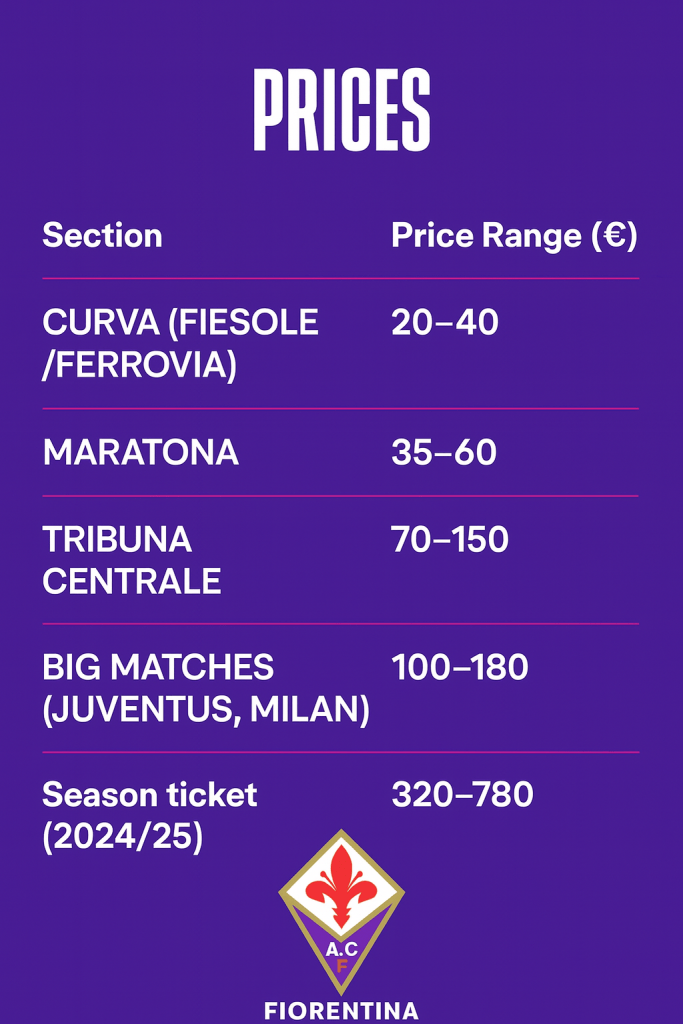
Tickets for the Curva Fiesole go first. Locals queue for hours. Get in early or settle for the Maratona.
Matchday Rules
You’ll need ID that matches the ticket name. Expect airport-level security.
Banned items include umbrellas, bottles (even plastic), smoke bombs, and visible rival colours.
Florence isn’t violent, but respect is currency — wear neutral colours and embrace the atmosphere.
Stadio Artemio Franchi isn’t just a ground. It’s a museum that still breathes, a paradox of beauty and decay where every echo tells a story. When the wind hits the concrete right, you can almost hear Batistuta’s roar or the Curva’s thunderous chant of “Forza Viola!”
Yes, it’s aging. Yes, the toilets are terrible.
But you don’t go to Florence for comfort — you go for feeling.
And no stadium in Italy delivers feeling like this one.
 doragon sports