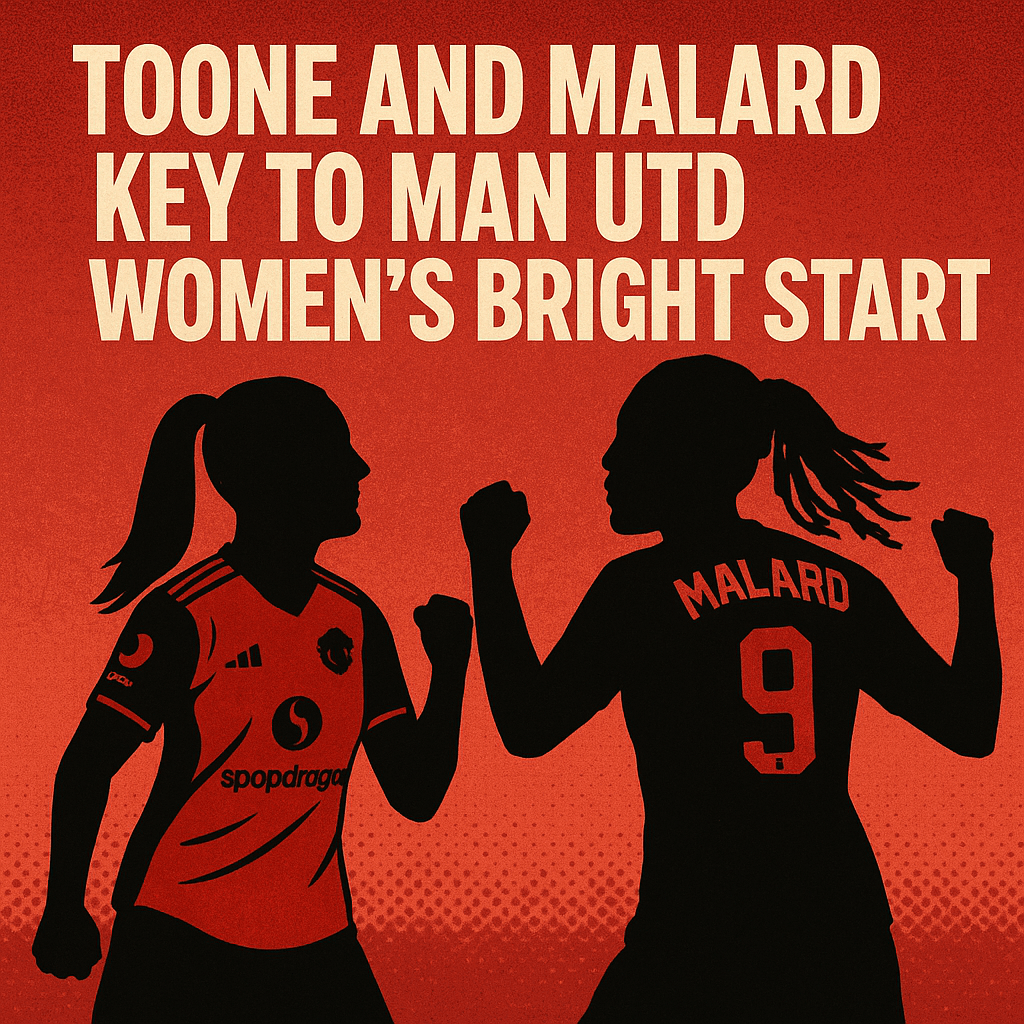
There’s a rhythm to Manchester United’s football this season that feels different. It isn’t built on chaos or fortune, but on chemistry — the kind that doesn’t just happen on training pitches, but in moments of instinct. When Ella Toone looks up, Melvine Malard already knows where the ball will fall. When Malard bursts forward, Toone is already sliding into space. It’s intuition turned into structure; flair turned into function.
And it’s the foundation of United’s unbeaten start to the 2025/26 campaign — a start that has carried them not just to the upper reaches of the Women’s Super League table, but into Europe with real authority.
As Marc Skinner’s side prepare to face Atlético Madrid in the UEFA Women’s Champions League, the spotlight belongs to the two players who have made this moment possible. Ella Toone, the creator. Melvine Malard, the finisher. Together, they’ve given Manchester United more than goals and assists; they’ve given them identity.
A Partnership Built on Trust
Six games into the new WSL season, Manchester United sit third in the table, undefeated with four wins and two draws. The numbers are impressive — 16 goals scored, just three conceded, the league’s best goal difference — but the story beneath them is more human.
Toone has four assists to her name already, leading the team. Malard has scored five, topping the league. Yet their impact goes far beyond raw statistics. In the 4–1 comeback against Everton earlier this month, it was the pair’s understanding that turned frustration into dominance. Toone orchestrated the second-half surge with calm precision, assisting twice. Malard equalised and then forced an own goal that flipped the narrative of the match entirely.
That performance was more than a win. It was proof of evolution — a sign that this Manchester United team now possesses the kind of maturity that Europe demands.
“I feel good. I’m confident, and my teammates give me confidence,” Malard said after being named Player of the Match that day. There was no arrogance in her tone, only the quiet assurance of a forward who has found her place.
The Heir to Old Trafford’s Swagger
It’s fitting that Marc Skinner has compared Malard to Eric Cantona. The French forward might not share his predecessor’s raised collars or brooding mystique, but the spirit is unmistakable. She carries herself with that same unshakeable calm in decisive moments — that refusal to flinch when the spotlight narrows.
Skinner described her as “probably the most Manchester United player I’ve ever met,” and it’s not just a compliment. It’s a statement of philosophy. For a club that built its heritage on boldness, Malard’s flair, movement, and confidence embody the revival of United’s attacking ethos.
Her adaptation from Lyon to Manchester was not instant. There were early language barriers, tactical adjustments, and a shift from the French league’s rhythm to the more physical, transitional chaos of the WSL. But Skinner notes that this season, something has clicked. “Now she understands the language happily, so she can translate quicker in-game… she can take instruction and perform it,” he explained recently. The difference is visible — every run sharper, every finish more ruthless.
Malard’s five goals in six games tell a simple story: she’s not just scoring; she’s dictating. The French striker now moves like a player who belongs entirely to the club’s rhythm.
Toone: The Creator, The Constant, The Symbol
If Malard is the emblem of United’s ambition, Ella Toone is the proof of its soul.
Toone has worn red since before the club even had a senior women’s side. When Manchester United Women were reborn in 2018, she was there. When they climbed from the Championship to the WSL, she was there. And when they finally earned their place among Europe’s elite, she was the first to describe it as “so special — a dream I’ve had since the club started.”
For supporters, Toone represents something few modern players can: continuity. She’s the kid from Tyldesley who grew up idolising United, and then became the face of the very team she once watched from the stands.
Her game has matured with the club. Once a free-spirited attacking midfielder with flashes of brilliance, she’s evolved into a tactical metronome — part conductor, part catalyst. Her assists this season have showcased both precision and emotional intelligence: the weighted pass for Jess Park’s first against Everton; the disguised ball through traffic that led to another.
Yet for all her growth, Toone remains deeply grounded. Her engagement this summer, her advocacy for the NHS in memory of her late father, her vocal support of young girls entering football — all of it adds dimension to the player United fans see every week. She’s not just a footballer now; she’s a role model built from resilience and perspective.
The Marc Skinner Project Comes of Age
When Marc Skinner speaks about his team, he often talks about “mentality before method.” He’s building something that can withstand the physical and emotional weight of European football — a team that thrives out of possession, presses intelligently, and keeps its composure when games twist away from plan.
In his words: “To show our credentials, we must be the best out of possession. Be fast, be aggressive. That’s what gives you confidence in possession.”
This philosophy has shaped the season’s early success. United’s structure is tighter, their transitions faster, and their pressing far more co-ordinated. The defensive core of Phallon Tullis-Joyce and Maya Le Tissier has been immense, conceding only three goals in six games. And when Skinner turns to his bench, he finds new energy — especially in Jess Park, whose move from Manchester City raised eyebrows but is now paying rich dividends.
It’s no longer a side defined by hope. It’s one defined by systems, synergy, and a shared belief that they can compete with Europe’s best.
The New United Identity
Malard’s arrival and Toone’s consistency have brought balance to a team that once leaned too heavily on individual brilliance. Now, United play as a collective — a side comfortable rotating between pressing high and controlling the ball patiently.
Their 65% possession and 632 passes against Everton illustrated both confidence and control. Their +13 goal difference is the product of sustained rhythm, not occasional bursts.
But beyond data lies emotion — and emotion drives this squad.
For Malard, scoring goals in the Champions League isn’t just another achievement. It’s redemption, a chance to step out of Lyon’s shadow and create her own legacy. For Toone, each European night is a chapter in a story that started long before this competition existed.
Maya Le Tissier called United’s opening UWCL group match “a special night — one that mattered immensely,” a sentiment shared by the entire dressing room. This is a team living its first European adventure, not merely playing it.
The European Test Ahead
Now comes the true examination. Atlético Madrid, fresh from a devastating 6–0 demolition of St. Pölten, are no soft entry point into continental football. Their style — direct, physical, and emotionally charged — will stretch United’s control and resilience in ways the WSL cannot.
But if United have shown anything this season, it’s adaptability. They have won games with possession and without it, with dominance and with grit. Their comeback against Everton, their discipline against Valerenga, their relentless attacking metrics — all of it paints the picture of a squad learning how to win in different ways.
And the chemistry between Toone and Malard gives them an edge that data alone can’t measure. It’s the kind of partnership that changes games at Champions League level: one sees patterns seconds ahead, the other turns them into goals.
Beyond the Scoreboard
What makes this story resonate isn’t simply that Toone and Malard are performing; it’s that they represent two halves of Manchester United’s evolution. Toone, the homegrown constant — proof that the club’s vision for women’s football has roots as deep as its ambition. Malard, the international statement — a sign that United now recruit not to survive, but to dominate.
Together, they embody the duality of modern Manchester United: tradition meeting progress.
Their connection mirrors what the club has always thrived on — combinations born from trust, belief, and imagination. Think of Rooney and Ronaldo. Scholes and van Nistelrooy. Now, in the women’s game, Toone and Malard are carving their place in that lineage.
If United can continue to build around their strengths — Toone’s composure in tight spaces, Malard’s predatory movement, Park’s dynamism off the bench — the possibilities stretch beyond the group stage. They become contenders not just in name, but in substance.
A Club Rising Together
What stands out most this season isn’t the results, but the atmosphere. There’s a sense of unity about this group — a conviction that every player, from starter to substitute, is pulling towards the same goal. Malard acknowledged it best after her recent performance: “It’s very important, the girls on the bench — when you come in and make a difference.”
That depth, both tactical and emotional, is what separates this version of Manchester United from any before.
The club that once relied on resilience now wins with rhythm. The team that once needed miracles now manufactures them. And at the heart of it all stand two players — one from Lyon, one from Leigh — building something bigger than either could alone.
As United step into their next European night, they do so with purpose. For Toone, it’s a dream fulfilled. For Malard, it’s a challenge embraced. For Marc Skinner and his squad, it’s the dawn of belief that this team, finally, belongs on the biggest stage of all.
If their connection continues to grow, there’s no ceiling on how far Manchester United Women can go. From Old Trafford to Madrid, they are not just participating in Europe — they are announcing their arrival.
 doragon sports