It was supposed to be a test. A friendly, they said. A tune-up before the big one on home soil.
Instead, it turned into a demolition — the kind that doesn’t just ruin your night, but makes you question what you’ve been building for years.
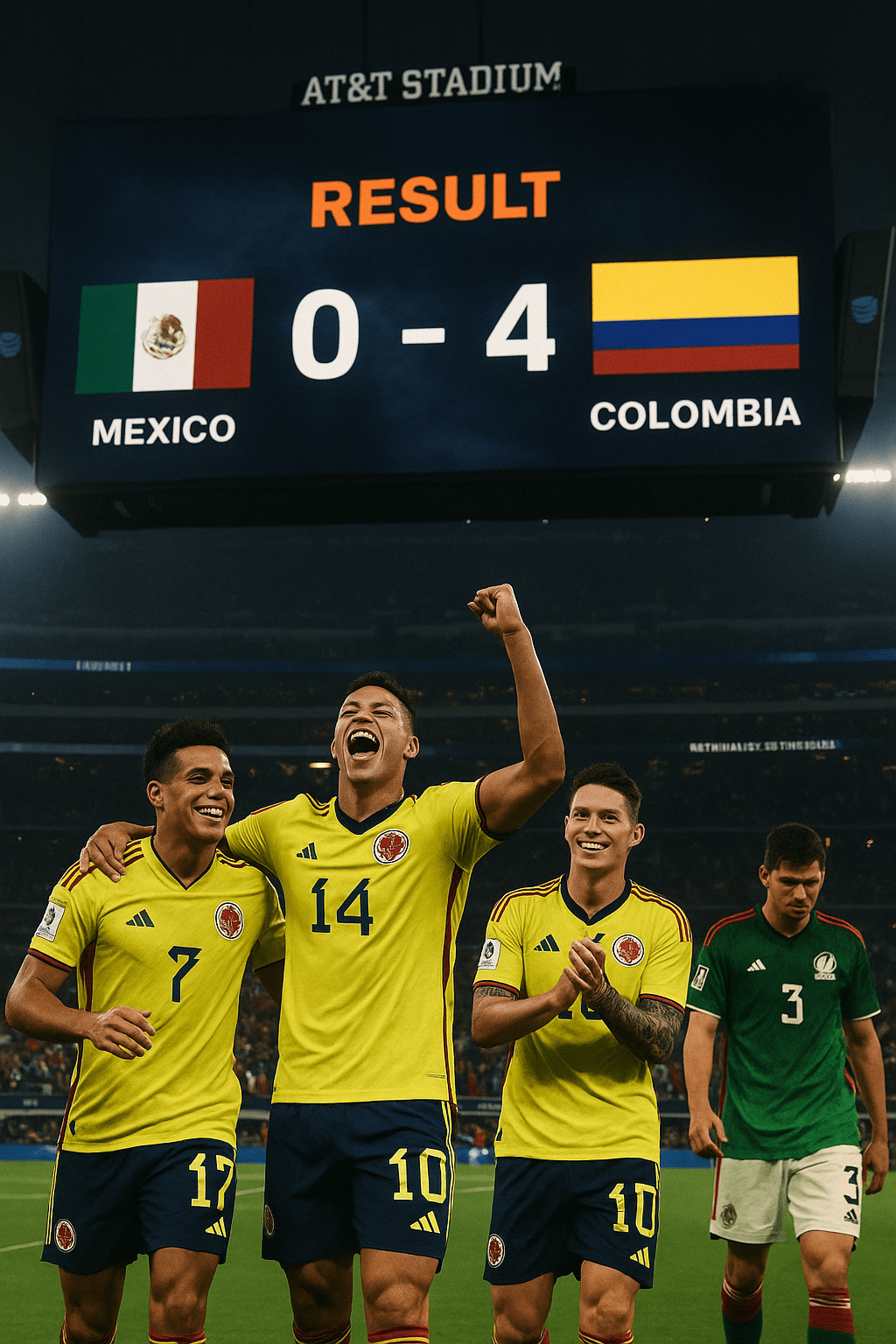
At AT&T Stadium in Texas, under the glossy lights and the 74,000-strong Latino roar, Mexico were dismantled by Colombia. Four goals to nil. No excuses. No illusions. Just 90 minutes of pure exposure — technical, tactical, emotional.
For El Tri, this was meant to be another checkpoint on the road to the 2026 FIFA World Cup — their World Cup — the one they’ll co-host alongside Canada and the USA. Instead, it was a flashing red warning sign: something is broken, and time is running out to fix it.
A Friendly in Name Only: Mexico v Colombia
Saturday night in Arlington was meant to be about progress. A chance for Javier Aguirre, the old fox of Mexican football, to see how far his rebuilt squad had come. After recent draws with Japan and South Korea, optimism still lingered. The manager’s mantra — “saber competir mejor” (know how to compete better) — was supposed to shape a side that could handle pressure, structure, and identity.
But Colombia don’t do polite sparring sessions. They came to play, and they came to hurt.
Led by Néstor Lorenzo, their Argentine tactician who’s transformed Los Cafeteros into a sleek, confident unit, Colombia treated this so-called friendly like a qualifier. And it showed.
The result — 4-0 — wasn’t just a scoreline; it was an exorcism. For Colombia, this was redemption for years of underachievement. For Mexico, it was humiliation dressed as preparation.
A Manager Under Siege
Aguirre’s post-match tone said everything:
“Cualquier cosa que comente después de un 4-0 puede sonar a cualquier cosa y asumo mi responsabilidad.”
(Anything I say after a 4-0 can sound like an excuse, and I take responsibility.)
It’s the kind of line you deliver when you know the storm is coming. And in Mexico, it’s already here.
Nine months out from the World Cup, El Tri don’t know their best XI. They don’t know their formation. They don’t even know their goalkeeper.
Luis Malagón, solid at Club América but hesitant at this level, was caught in no-man’s-land for multiple goals. Two from set pieces. Two from transitions. It was, in Aguirre’s words, “avoidable.” Yet, the structure in front of him — César Montes and Johan Vásquez — looked more like a suggestion than a defence.
Colombian media didn’t hold back. Caracol called it a “tremenda sacudida” — a tremendous shake-up — and claimed Los Cafeteros “shut the Mexicans up.” Brutal, but fair.
The Toothless Attack
No Raúl Jiménez. No goals. No plan B.
That’s the uncomfortable truth haunting this Mexico side. Without their talismanic striker, the front line looked like a flickering light bulb — full of effort, short on spark.
Santiago Giménez, fresh off his move to AC Milan, darted and drifted but never found rhythm. With James Rodríguez pulling strings for Colombia and Lerma anchoring their midfield, Mexico’s own creative core vanished. The possession stats (59% for Mexico) were a hollow comfort; as one pundit put it:
“La posesión es azteca, pero no saben generar.”
(The possession is Aztec, but they don’t know how to create.)
Even with their share of the ball, Mexico mustered just two shots on target. Colombia had four — and scored four. That’s not efficiency; that’s a schooling.
James, Díaz, and the Art of Ruthless Football
There’s something poetic about watching James Rodríguez back in control — the kind of player who, when his rhythm clicks, makes football look cinematic.
On this night, he didn’t just play — he orchestrated.
Two direct assists, countless moments of calm amid chaos, and that trademark elegance that’s made him one of Colombia’s most enduring figures.
Beside him, Luis Díaz was a nightmare. The Bayern Munich winger’s second-half goal — a delicate chip over Malagón — silenced what was left of Mexico’s optimism. He drew fouls, stretched the pitch, and played with the kind of swagger that reminds everyone why Colombia can still scare the giants.
And then came the hammer blow — Jefferson Lerma. The Crystal Palace man’s third goal, a volley from just outside the box, was the exclamation mark on an evening that blurred the line between friendly and humiliation.
By the time Johan Carbonero slid home Colombia’s fourth — his first ever international goal — the stadium had become a sea of yellow and blue. The Inter Porto Alegre winger wept. Mexican fans just stared

But statistics only tell half the truth. This wasn’t about numbers. It was about mentality.
Every Colombian transition felt like a dagger. Every Mexican corner felt like a sigh. The defensive shape evaporated under pressure, and the midfield duo failed to close lanes.
César Montes said it best:
“Debemos tener un poquito de atención en los goles, porque son dos a pelota parada y dos en transiciones.”
(We have to pay a bit more attention to the goals, because two came from set pieces and two in transitions.)
That’s what separates contenders from hosts. Contenders control chaos. Hosts let it consume them.
A Night That Belonged to Colombia
Let’s not undersell the victors. This was Colombia at their most lethal — compact, efficient, and emotionally charged.
Their rise under Lorenzo has been measured, but nights like this show the project’s maturity.
James as the creator. Díaz as the finisher. Lerma as the enforcer. Carbonero as the dreamer.
Four names. Four goals. Four statements.
The kind of performance that tells the world Colombia are ready for the 2026 World Cup — not as dark horses, but as believers.
And there’s a cultural weight here too. For Colombia, every win still whispers of 1994 — of Valderrama, Escobar, and lost potential. The ghosts of that tragic World Cup linger, but this generation, powered by humility and grind, feels different.
When the Stands Turn
The AT&T Stadium is a colossus — one of the modern cathedrals of football in North America. On Saturday night, it became a split temple of two nations.
The attendance — 74,438 — was a record for a Latin American friendly in the U.S. this year. Flags waved, horns blared, and the first half felt like a festival.
Then the second half began, and Colombia turned it into a coronation. Every pass from James drew “Olé!” chants. Every Mexican touch was met with unease.
By the fourth goal, the energy had shifted completely. Yellow smoke. Blue drums. Red shirts bouncing in unison. And silence — deep, stunned silence — in the Mexican sections.
Aguirre looked into the stands afterward and said quietly:
“Duro que la gente vuelva a casa, que no le gustó lo que vio.”
(It’s hard for people to go home not liking what they saw.)
It was more than just a line. It was an admission — the fans deserved better.
The Soul-Searching Starts Now
For El Tri, the questions multiply.
Who starts up front if Jiménez isn’t fit? Who commands the backline when things start falling apart? And who replaces Malagón if he continues to struggle?
These aren’t small details. They’re structural cracks in a national project that’s about to face the ultimate test on home soil.
In three days, Mexico face Ecuador in Guadalajara — a match that suddenly carries emotional weight it shouldn’t have. A “revenge game” for pride, not points.
Colombia, meanwhile, head to New Jersey to face Canada — high on confidence, dripping with momentum, and glowing in belief that they might finally be ready to rewrite their World Cup story.
Beyond the Scoreboard
A 4-0 doesn’t just hurt; it lingers. It changes perception. It forces accountability.
Mexico’s footballing establishment can dress it up as a “learning experience,” but fans aren’t stupid. They saw a team that looked lost, a coach who looked tired, and a system that couldn’t withstand pressure.
Colombia saw the opposite — a group united, balanced, and brimming with ideas.
This wasn’t just a friendly. It was a glimpse into the future.
One nation is nearly ready for the World Cup. The other is running out of time to be ready.
 doragon sports