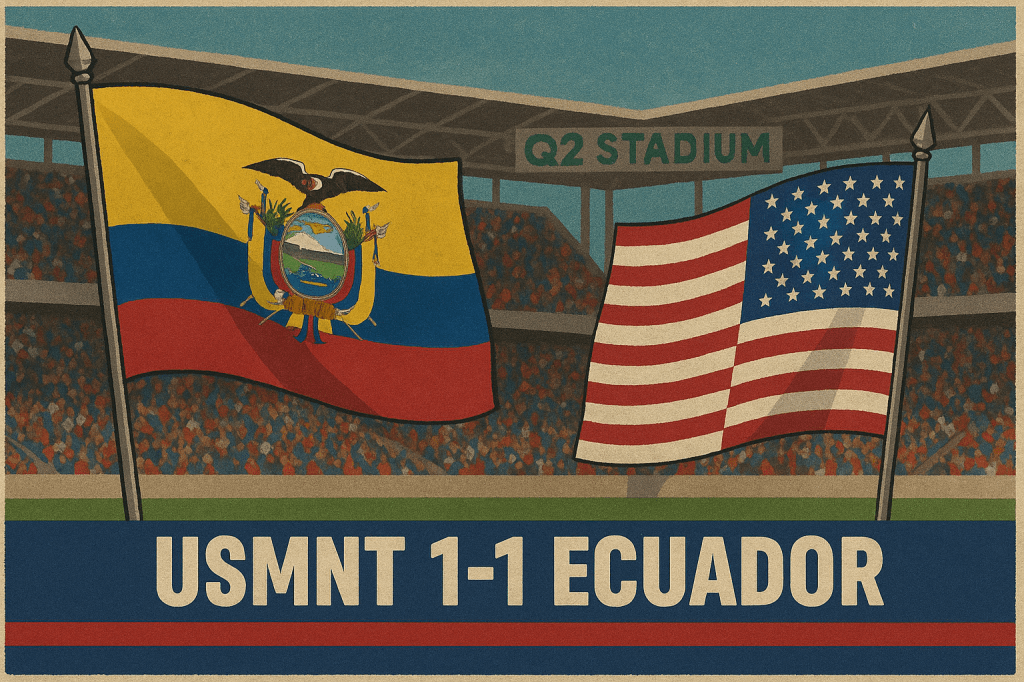
There’s something intoxicating about a football crowd in Texas. Maybe it’s the heat. Maybe it’s the noise. Or maybe it’s that rare mix of swagger and sincerity — when an entire stadium forgets it’s watching a friendly.
On a warm October night at Q2 Stadium, the United States Men’s National Team didn’t just play Ecuador — they wrestled with expectation. The selección de fútbol de Ecuador, bright in their yellow shirts and louder in their chants, came to Austin to test a host nation’s nerve. The Americans responded with fight, frustration, and finally, a flicker of belief that this Pochettino project might just be real.
The scoreboard read 1-1, but beneath the surface, the draw spoke louder than a dozen easy wins. It told a story of redemption, risk, and one Texan bull back from exile.
Bull in the Middle, Hope in the Air
They call Weston McKennie the Bull.
It’s not just about how he plays — charging, chest out, all elbows and ego. It’s about what he represents. Texas born. Juventus hardened. The archetype of American midfield fight. Although anyone who endured watching his loan spell at Leeds United, would disagree.
And for six months, he’d been gone. Dropped. Forgotten. The man once seen as indispensable to the USMNT’s rhythm was left off the September roster after a poor run of form. But football, like Texas, has a long memory for pride.
Back at home, in front of a sellout 20,738 crowd at Q2, McKennie looked reborn — bulldozing through Ecuador’s tight midfield, setting the tone in tackles, and forcing a save of the night from La Tri’s cat-like goalkeeper, Hernán Galíndez. Every crunch of boot on turf was a message: I got the memo, boss.
Mauricio Pochettino — all black coat and cool composure — had warned before kickoff that “performance and development” mattered more than results. He got both. The US were aggressive, structured, and far more professional than the chaos-ridden versions of old.
This was the one-year anniversary of Pochettino’s first game in charge — also at Q2 — and the difference was night and day. Then, the USMNT were hesitant. Now, they pressed like a unit that believed it could beat anyone.
Belief — the word McKennie later repeated — is what this team’s been missing. Friday night in Austin felt like a step toward finding it.
One Team Learning to Bite, One Team Refusing to Blink
Ecuador arrived unbeaten in eleven, second only to Argentina in South American qualifying, and ranked 24th in the world. Their incentive? Win, and they’d leapfrog South Korea into Pot 2 for the 2026 World Cup draw. Lose, and that dream evaporated.
That’s the beauty of friendlies when the World Cup is around the corner — one man’s experiment is another’s lifeline.
For 70 minutes, it looked like Ecuador would steal it. Enner Valencia, still lethal at 35, punished a sloppy transition with a low drive past Matt Freese. It was trademark La Tri — absorb pressure, then strike on the counter with surgical precision.
The US dominated possession (66%, to Ecuador’s 34%), but lacked the killer instinct.
Their xG of 1.09 told the story: plenty of control, little ruthlessness.
Pochettino’s men were smooth until the final third, then suddenly second-guessing. He later sighed, “We need to be a little more clinical in our last pass.” A diplomatic way of saying what fans were screaming: finish the damn chance.
And then came Folarin Balogun.
The AS Monaco forward, now cemented as America’s No. 9, has the kind of quiet arrogance that great strikers exude. He doesn’t talk much; he calculates.
After 71 minutes, Malik Tillman pressed high, nicked the ball, and fed it into Balogun’s stride. One touch, low shot, equalizer.
Cue chaos. The crowd erupted into “U-S-A!” chants that echoed through Austin’s night sky. Balogun didn’t even celebrate much — just grabbed the ball and jogged back.
“It’s good to build momentum,” he said later, half-grin hiding ambition. “We were the better side.”
That goal broke Ecuador’s 520-minute shutout streak, a defensive record that stretched across ten games and two continents.
For Ecuador, the result was an amargo (bitter) disappointment — they’d come for ranking points and left with regret.
Rhythm & Flow: Inside the Fire and the Fine Margins
Inside the Fire and the Fine Margins
What made this draw fascinating wasn’t the goals — it was the collision of ideas.
Pochettino’s U.S. side has shifted away from the old reactive style toward something more assertive, flexible, European. The 3-4-3 morphing into a 4-2-3-1 in defense reflected the hybrid system he’s been drilling for months — full-backs as midfielders, midfielders as press triggers.
Tim Ream, the 38-year-old captain, was the quiet fulcrum.
While pundits debate the Tim Ream age question — whether he can really go one more year to the World Cup — the numbers still back him. His stats on the night were vintage: 91% pass accuracy, seven recoveries, zero misplaced headers.
Pochettino clearly trusts him not just as a defender, but as an emotional compass. Few players in modern U.S. history have lasted this long in that role.
Ream is now only the fourth outfield player to represent the U.S. at age 38 or older since 1969.
The fact he still looks composed next to kids half his age says as much about professionalism as it does genetics.
Beside him, Chris Richards was steady. Ahead, the returning McKennie brought tempo. And between the lines, Tillman — Leverkusen’s creative agitator — stole the show. His 8.0 player rating led the team, and his movement opened lanes that even Pochettino’s famous vertical system couldn’t script.
“Feed him and we’ll score,” he’d said about Balogun pre-match. He wasn’t wrong.
Ecuador’s Fight: The Grit and the Grumble
On the other side, Sebastián Beccacece — Ecuador’s fiery Argentine coach — looked every bit the tortured artist. Hands clapping, hair flying, barking in Spanglish as his team clung to shape.
He admitted afterward, “Nos faltó tener más la pelota y ser protagonistas” — we lacked possession and weren’t protagonists.
For all their discipline, Ecuador looked drained by the second half. Missing stars like Moisés Caicedo, Piero Hincapié, and Gonzalo Plata, they relied on the spine of veterans — Valencia’s poise, Galíndez’s miracles, and the promise of 18-year-old Kendry Páez.
Páez, the Chelsea loanee, flashed brilliance. An “electric turn” that earned Miles Robinson a yellow card showed exactly why Europe’s elite are obsessed with him. But he faded as the U.S. fitness took over.
Ecuador’s counter-attack remains one of South America’s most feared weapons, yet without Caicedo’s engine or Hincapié’s distribution, their transitions felt mechanical. Even Beccacece admitted his side went “de más a menos” — from more to less.
Still, Ecuador didn’t come to play dead.
They came to test a host nation — and they did.
Fire, Flags, and Future Tense
Under Austin’s floodlights, the Ecuador flag rippling beside the Stars and Stripes, both sets of fans roaring through a bilingual night of football theatre. The chants of “USA!” tangled with cries of “¡Vamos Ecuador!” — part fiesta, part proving ground.
For Ecuador, this was about identity.
A small nation with a big footballing soul, pushing to prove it belongs in the same breath as Argentina and Brazil. For the U.S., it was about validation — that the USMNT schedule isn’t just a series of warm-ups but stepping stones to something legitimate.
Balogun’s goal didn’t win a trophy, but it felt symbolic: the U.S. breaking through a South American wall that has so often crushed their confidence.
And yet, Pochettino wasn’t celebrating.
He’s seen too much. “We talk now about actions, formations — not about commitment or attitude,” he said post-match. “That’s a massive step up.”
He’s building something less romantic and more ruthless — a system that outworks, outthinks, and outlasts opponents.
The era of the “heroic underdog” might finally be ending.
The Atmosphere: Austin, the Bilingual Cauldron
Austin’s Q2 Stadium continues to prove it’s more than an MLS novelty. The crowd was “electric,” “pulsating,” “ruggedly physical” — pick your adjective, it fit.
It was Hispanic Heritage Night, and that meant dual colors everywhere. Half red-white-blue, half yellow-blue-red.
By kickoff, Ecuadorian fans made up the majority — a carnival on foreign soil. It wasn’t hostility; it was heritage. “A prelude,” one South American journalist wrote, “to the fiesta that will be lived in the World Cup.”
The American players felt it.
“The crowd really pushed us on,” said Balogun. “They don’t realize how much we rely on their support.”
Captain Tim Ream echoed him: “To feel that togetherness from a sellout crowd and hearing the chants — it was special.”
Belief, again. The most important currency in football.
The Aftertaste: Bitter for Ecuador, Sweet for the U.S.
For Ecuador, the draw was cruel. They “wasted the opportunity” to climb into Pot 2 — their fans knew it. The post-match headlines in Quito called it “un empate amargo,” a bitter tie.
For the United States, though, it was something else — proof that this team is maturing. They’d outplayed a top-25 side, broken a record streak, and shown tactical discipline without their biggest stars (Christian Pulisic and Antonee Robinson).
Even the numbers tell a tale:
11 shots to 8, 8 corners to 4, and a clear xG edge.
But it’s the intangible that counts.
This was a team that, for the first time in a while, looked like it knew who it was.
McKennie’s redemption.
Balogun’s authority.
Tillman’s creativity.
Ream’s leadership — at Tim Ream age 38, still writing his name into the stats column, still the calm amid chaos.
Ecuador will head back to South America frustrated but unbroken — their selección de fútbol de Ecuador still among the most tactically resilient sides on the continent. But in Austin, the night belonged to belief — to a U.S. team finally ready to stop surviving and start imposing.
The Final Word
Sometimes football isn’t about who wins. It’s about who learns faster.
The U.S. learned they can dictate games without their biggest stars. Ecuador learned that being unbeaten isn’t the same as being untouchable.
And the rest of us? We learned that under the glow of Q2 Stadium, between two flags waving in opposite corners of the pitch, the balance of power in the Americas might just be starting to tilt.
 doragon sports