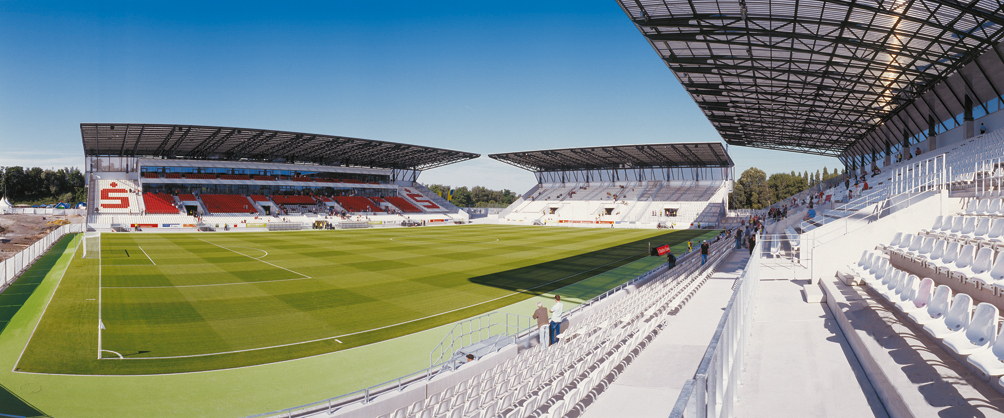
You hear it before you see it: the low, steady hum of a city built on industry, now powered by passion. Then, the scent of grilling bratwurst and poured Stauder beer cuts through the air, guiding you down the Hafenstraße. At the end of the street, it rises—not a relic of the past, but a modern fortress built on tradition. Welcome to the Stadion an der Hafenstraße, the beating heart of football in Essen, Germany, where the battle cries of Rot-Weiss Essen and SGS Essen echo under free-floating roofs.
Beyond the Mine: Finding Football’s Heart in Essen, Germany
So, what’s the deal with Essen football? It’s a tale of two clubs sharing one home, united by a working-class soul.
First, there’s Rot-Weiss Essen (RWE). This is a club with glory in its bones and struggle in its recent history. Founded in 1907 in the shadow of the mines, their golden era saw them lift the German Championship in 1955 and the DFB-Pokal in 1953. But the last few decades? A brutal “leidensweg” (path of suffering) through financial crises and the lower leagues, a test of faith that forged a fanbase defined by three words: “Kampf, Wille, Leidenschaft” (Fight, Will, Passion). Their return to the professional 3. Liga in 2022 wasn’t just promotion; it was a catharsis.
Then, in the same stadium, you have SGS Essen—the women’s Bundesliga team that operates like the “Gallic village” of the league. In a world of commercial giants, SGS is a pure football club, a bastion of youth development that has produced stars like Lena Oberdorf and Lea Schüller. They are a testament to grit and talent, consistently punching above their weight.
This is the essence of Essen healthcare for the soul: football as therapy, where every match is a release of decades of pent-up hope and pride.
The Stadium: An der Hafenstraße
The Stadion Essen is a modern marvel that feels timeless. Opened in 2012 on the site of the dilapidated Georg-Melches-Stadion, it’s a pure football ground—no running track, no corporate nonsense obstructing your view.
- Capacity & Layout. It holds 20,650, with a roaring 9,040 of those being standing places. The roofs are ingeniously free-floating, so no pillar will ever block that winning goal.
- The Quirks: This is where the personality shines. The main stand, the legendary WAZ-Westkurve, is actually in the east—a nod to tradition so firm that they kept the name despite the geography. Look for the last remaining floodlight mast from the old ground, a silent sentinel watching over the new era.
- And the name itself? The fans literally paid for it through a fundraising campaign to keep it the “Stadion an der Hafenstraße,” spurning a corporate sponsor. That tells you everything you need to know.
Matchday Experience in Essen, Germany
Getting here is part of the ritual. Your match ticket includes free travel on the region’s transport network. Hop on the S2 to Essen-Bergeborbeck station, and you’re a five-minute walk from the action.
But the real experience starts at the “Hafenstädtchen,” the legendary pre-match hub that bills itself as the VIP lounge for the common man. This is where you’ll grab that essential pre-game pint of Stauder, poured right from a window. It’s loud, it’s proud, and it’s the perfect primer for the atmosphere inside.
Once you’re in, head for the Westkurve. When RWE scores, the place erupts. The chant of “Oh RWE!” thunders around the bowl, followed by a shower of 5,000 flying beer cups—a messy, magnificent spectacle of pure joy. Check the **wetter essen** forecast, though; while the roof covers most seats, that classic Ruhr Valley drizzle can still find a way in.
The City Snapshot: Essen
Zoom out, and you see the stadium is a mirror of Essen, Germany itself—a place that transformed its industrial muscle into cultural green lungs. This is a city that was named a European Green Capital, where Zollverein, a former coal mine turned UNESCO World Heritage site, features art galleries and an ice rink.
Before the game, dive into the vibrant Rüttenscheid district, a hub of Essen bakery spots, cafes, and bars. After the final whistle, if you’re not soaking in the post-match buzz at a local pub, catch a film at the Cinemaxx Essen. This is a city of contrasts: you can ponder priceless art at the Museum Folkwang in the morning and be roaring in the Westkurve by evening. Football here isn’t a distraction from city life; it’s its most passionate expression.
Essen Players & Legacy
The ghosts of legends are everywhere here. For RWE, you can’t escape the shadow of Helmut Rahn, the 1954 World Cup hero immortalised in bronze outside the ground, or the eccentric Willi “Ente” Lippens, who famously lived in a room under the old stadium (if you believe the legend, that is).
The current RWE side, captained by Michael Schultz, is built in the city’s image: hard-working, direct, and physical. Watch for striker Jannik Mause to provide the goals and keeper Jakob Golz to anchor the defence. Their game is all about that Essen ethos: Kampf, Wille, Leidenschaft.
For SGS Essen, the legacy is one of creation. They are a factory for future German internationals. While the 2025/26 season started as a struggle, the fight shown by captain Jacqueline Meißner and the effort from forwards like Ramona Maier embody the club’s resilient spirit. They represent the relentless, often underfunded, heart of women’s football.
Tickets & Essentials
Ready to join the pilgrimage to Essen? Here’s how to make it happen.
- How to Buy: Head to the official RWE online ticket shop or the Fanshop at the stadium. For most games, you can even grab them at the box office on the day.
- Prices: You’re in luck—this is some of the most authentic football in Germany, and it’s priced that way. Expect to pay around €9 for standing and €15-€25 for a seat.
- The Vibe: This is a passionate but welcoming ground. The entire stadium is a no-discrimination zone, and the club also runs a sustainability initiative that collects empty bottles for charity. Come for the football, leave your cynicism at the door.
Final Whistle
The Stadion an der Hafenstraße isn’t the most significant ground you’ll ever visit. But it might be one of the most honest. It’s a place where history isn’t just remembered; it’s fundraised for, chanted about, and lived with every tackle. It’s where you’ll feel the gritty, glorious soul of the Ruhr, and understand why, in Essen, football will always be a matter of heart.
You hear it before you see it: the low, steady hum of a city built on industry, now powered by passion. Then, the scent of grilling bratwurst and poured Stauder beer cuts through the air, guiding you down the Hafenstraße. At the end of the street, it rises—not a relic of the past, but a modern fortress built on tradition. Welcome to the Stadion an der Hafenstraße, the beating heart of football in Essen, Germany, where the battle cries of Rot-Weiss Essen and SGS Essen echo under free-floating roofs.
 doragon sports