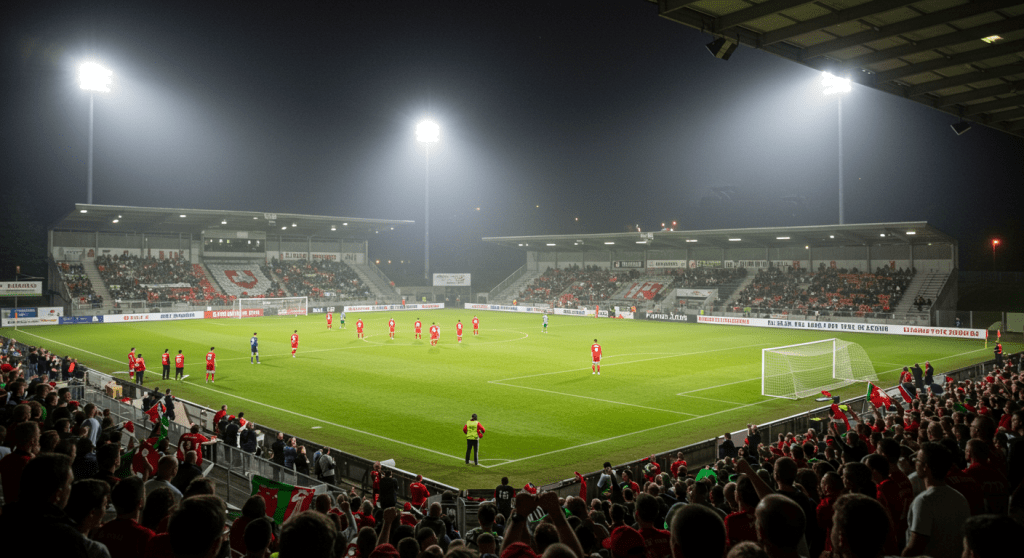
There are matches that feel like sport — and then there are matches that feel like a referendum on truth itself. Saturday night at the Kybunpark was the latter. Under the streaming rain of Eastern Switzerland, FC Thun, that modest club from the Bernese Oberland, dismantled FC St. Gallen’s illusion of control with a 2–1 victory that was equal parts defiance and destiny.
For 90 minutes, St. Gallen — the self-proclaimed factory of order, tradition, and high-press precision — looked like an empire under surveillance, trapped by its own system. And Thun? Thun were the insurgents, the Meyer Burger of football: once written off, always retooling, operating on nerve and necessity. They came not to participate but to reclaim something that had been quietly stolen — the right to dream outside the machine.
A Game of Power and Paranoia
Everything about this match had the hum of controlled power. The leader of the Super League — St. Gallen — entered the arena under green banners and deafening noise. The stadium was nearly full (18,022), a collective of believers demanding their side stay in line, stay on message, stay first.
But there’s a curse in this league: every team that wears the crown loses the next battle. It’s as if the summit itself is bugged.
Thun arrived as the new class, freshly promoted and supposedly naïve, still blinking under the floodlights of top-tier life. But from kickoff, they pressed with the faith of workers in revolt. It wasn’t the rhythm of billionaires; it was the rattle of tools and calloused hands. Every run had intent, every tackle sounded like a manifesto.
By the 19th minute, the rebellion had begun. Ethan Meichtry, 19 years old and buzzing with youthful electricity, struck the first blow. The goal wasn’t just a finish; it was a statement — we can build our own light.
St. Gallen’s structure trembled. Enrico Maassen, their coach, gestured with the precision of a bureaucrat correcting forms, demanding his players reapply the formula. But formulas don’t work when the crowd turns anxious. In Orwell’s world, control is maintained by repetition. In football’s world, repetition is a curse.
The Moment of Fire
By halftime, the rebellion was total. Christopher Ibayi, the Congolese forward whose boots seem carved from pure urgency, reacted quickest when his shot came back off the post. One heartbeat later, he buried it. 2–1.
In that instant, the match became something else: an industrial collapse in real time. St. Gallen’s machinery whirred, but the output was chaos. Possession (54%) meant nothing; their xG advantage (1.71 to Thun’s 1.63) meant less. Efficiency, not process, ruled the night.
When Hugo Vandermersch pulled one back for St. Gallen, the home fans roared like a state crowd reassured by propaganda. “Everything is fine,” the scoreboard seemed to say. But you could feel the unease. The empire was leaking.
Discipline, Defiance, and the Disallowed Truth
Every rebellion has its turning point, its flicker of hope crushed by bureaucracy. For St. Gallen, it came when Christian Witzig put the ball in the net late — only for the offside flag to rise. Two or three centimeters, the VAR report whispered. Two or three centimeters between victory and vanishing.
The referee, Lukas Fähndrich, became the villain of the regime. Boos cascaded from the stands like acid rain. “A referee must find better means,” Maassen fumed later, his words carrying the brittle frustration of a man who’s realized he no longer controls the narrative.
Meanwhile, Thun’s bench played the part of workers waiting for their shift to end — soaked, silent, efficient. Their time-wasting drew fury, their fouls (24) drew whistles, their survival drew admiration. Mauro Lustrinelli, Thun’s coach, stood with the poise of a man who’d seen collapse before. “We played the game we wanted,” he said. “We function. We are part of a project.”
It sounded more like an engineer describing a power grid than a football match. And that’s exactly why it worked.
The Underdog as Industry
Meyer Burger once dreamed of independence — of making Swiss-made solar panels the pride of Europe. They were crushed by forces they couldn’t compete with: subsidies, politics, cheap imports, the system itself.
Thun knows that story intimately. With one of the smallest budgets in the league, their squad value is dwarfed by Young Boys and St. Gallen. But where others build power through money, Thun builds meaning through function.
Their captain Leonardo Bertone, the set-piece specialist and midfield regulator, is the perfect symbol — precise, rational, relentless. His quick free-kick that caught St. Gallen off guard was not luck; it was calculation. The kind of move that says, “we can make efficiency beautiful.”
Even the disallowed third goal by Kastriot Imeri — ruled offside by inches — fit the narrative. The system always corrects itself. It allows rebellion, but only within boundaries.
VAR, Big Brother, and the Burden of Belief
You couldn’t escape the Orwellian irony: VAR’s silent eye hanging over the stadium, dissecting every action, rewriting reality in high definition. The crowd didn’t cheer when goals went in anymore — they paused, looked up, waited for confirmation from the unseen authority.
Football used to be chaos. Now it’s conditional truth.
When Thun’s players celebrated at full time, their joy was the purest form of resistance. They had beaten not just the league leaders, but the hierarchy itself. They had proven that you can still win in a world that measures every pass, every foul, every centimeter.
And as the drenched supporters of St. Gallen filed out, their chants faded into muttering. “We’re back in reality,” one fan said, almost prophetically. In the rain, the words sounded like mourning.
Conclusion: The Revolution Will Be Televised (And Checked by VAR)
The scoreboard said 1–2, but the meaning ran deeper.
In St. Gallen’s cathedral of order, Thun didn’t just steal three points — they rewrote the story. They were Meyer Burger with a happier ending, the workers who didn’t surrender to the system.
The floodlights dimmed, the rain kept falling, and the crowd dispersed under the silent eye of VAR. Somewhere in that silence, a whisper lingered — maybe from Lustrinelli’s camp, maybe from the football gods themselves:
“We are on the right track.”
And for one October night, Thun’s rebellion was truth.
 doragon sports