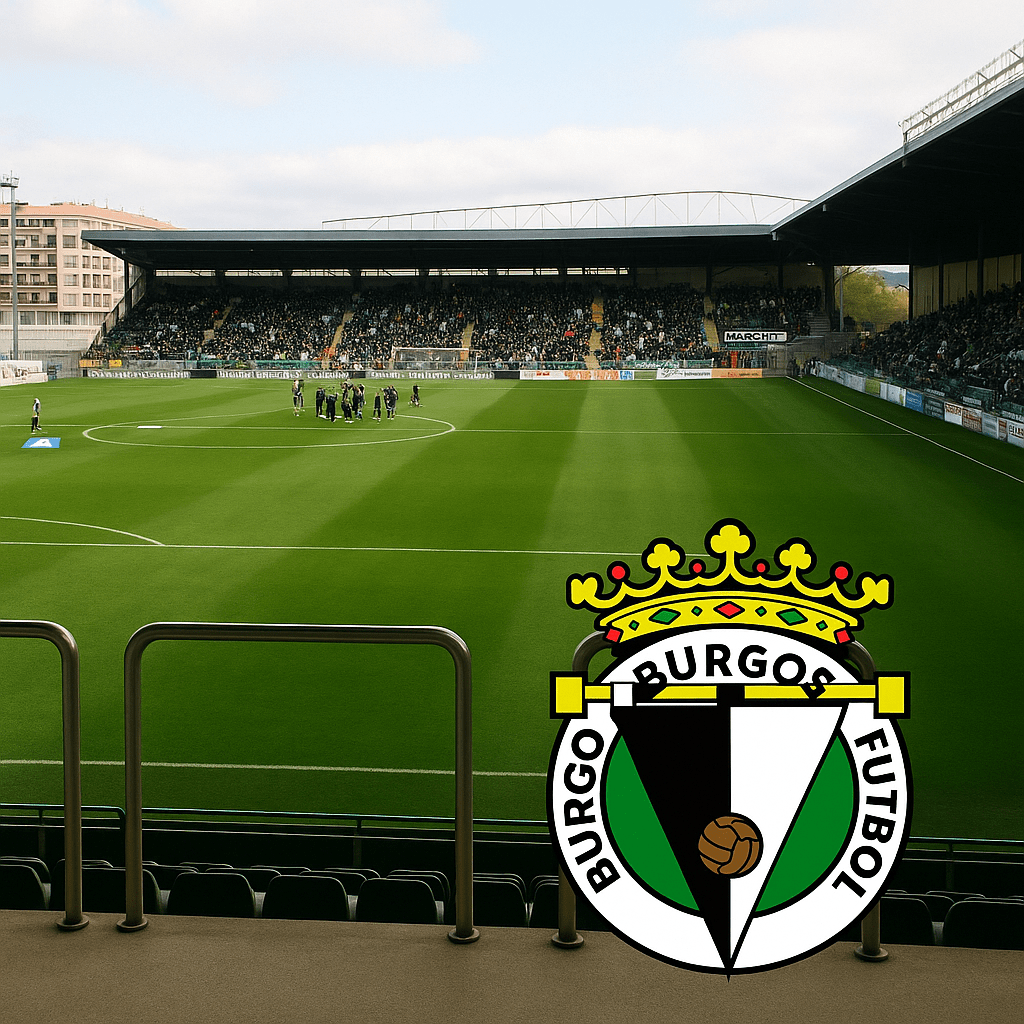
Walk up to the Arlanzón River on a bitter Castilian evening, and you’ll see it. El Plantío. The stands are close, the wind sharper than a striker’s studs, and the floodlights feel like interrogation lamps on a cold stage. They say Valladolid and Soria fight for the crown of Spain’s chilliest stadiums — Burgos politely disagrees. Ask anyone who’s frozen through a winter night in this ground: El Plantío wins hands down.
But this isn’t just about the weather. This is the story of cf Burgos, a club that’s been reborn, dissolved, humiliated, and dragged back up by its fans — all inside the modest but unforgiving walls of the Estadio Municipal El Plantío.
Stadium with a Bite
El Plantío opened on 13 September 1964, carved out of old military grounds in just 15 months. No pomp, no grandeur. Just concrete, steel, and a square, English-style layout: four stands hugging the grass so tightly you can hear every word the full-back mutters when he misplaces a pass.
The first match? A 2-0 win against Sociedad Deportiva Indautxu. Local forward Eduardo Pita Piñeiro wrote himself into the trivia books by scoring the first goal on this pitch. The north stand (Tribuna) was covered, the south end was a bare terrace by the river, and the whole setup looked like it could collapse if the wind changed direction. And yet, it was ours.
For decades, the stadium has reflected Burgos itself — practical, cold, a little rough around the edges, but fiercely proud.
Getting to El Plantío for a Burgos CF game
Burgos isn’t Madrid or Barcelona, but that’s the charm. You don’t take three metro lines and a tram to get here — you walk, you wander, you stumble through the city’s streets until the floodlights loom over the rooftops.
From the City Centre: It’s a 20–30 minute walk from Burgos Cathedral. Head west along Avenida del Arlanzón and the stadium appears just beyond La Quinta park, pressed up against the riverbank. It’s an easy enough trek — straight lines, plenty of bars en route.
By Bus: Local buses run along Avenida del Arlanzón and Calle Vitoria, both within a short walk. Routes including the 01, 08 and the 10 are all easily accessed from the Cathedral and then drop off less than a five minute walk to the ground.
By Car: The stadium’s wedged between housing and the river. Translation: parking is limited and chaotic. If you drive, arrive early or prepare for a 10–15 minute walk from side streets further out.
The Coldest Cauldron
What defines El Plantío isn’t size (capacity sits just over 11,300, depending which report you trust). It’s not design either, though the sharp-cornered “estadio inglés” look still gives it character. No, the defining feature is the atmosphere.
Picture it: a late-afternoon kickoff in winter, the sun stabbing into the tribuna from the west, shadows stretching across the pitch, the chill coming off the river. Visiting teams hate it. When full, El Plantío can be savage — compact, loud, and hostile. You don’t just play against Burgos CF here; you play against Burgos itself.
Fans joke it’s “where the away team’s lungs go to die.” A ground that feels colder the more your team is losing.
Renovations and Half Measures
El Plantío has been patched up more times than Burgos itself. North and South Stands bolted on in 1977. Changing rooms redone in 1987. Brightly coloured seats added in 1991 during Real Burgos’ fleeting Primera División days — they faded into an odd Neapolitan ice cream pattern. Charming? Maybe. Embarrassing? Definitely.
The 2000s brought fences down and electronic boards up. Then, in 2018, the real work started. Three of the four stands got modern roofs and makeovers. But the old Tribuna still lingers like a stubborn relic. Burgos CF, now leasing the stadium for 40 years, are obliged to finish the job — with grand promises of expanding capacity to 18,000, maybe 20,000 seats.
But this is Spain. Deadlines slip, plans stall, bureaucracy bites. The club has even admitted they might have to decamp to a modular stadium when construction finally begins. The dream is a modern fortress. The reality, for now, is half-new, half-old.
Matchday Atmosphere for a Burgos CF match
The truth? El Plantío is a throwback. No fan zones, no pyrotechnic light shows, no Spotify-sponsored nonsense. Just scarves, drums, and the kind of terrace banter you thought Spanish football had forgotten.
Pre-Match Rituals: Fans gather along the Arlanzón and around Calle Vitoria. Expect small taverns crammed with cañas, wine glasses, and the smell of morcilla de Burgos (black pudding with rice). It’s not glamorous — it’s authentic.
Inside the Ground: Once you’re through the turnstiles, you’ll notice how tight the stands are to the pitch. The English-style design means the noise isn’t swallowed — it’s spat back onto the field. Visiting teams hate it; home fans thrive on it.
Food & Drink: The kiosks are basic — sandwiches, beer, soft drinks. Don’t expect Michelin stars. The real eating is done before or after, in the city’s bars.
Weather Warning: This isn’t Andalusia. Winter games can feel like standing in a freezer. Locals bring blankets, gloves, and thermos flasks. Away fans who turn up in light jackets usually regret it by halftime.
Where to Sit
Tribuna (North Stand): The main stand, covered but older. Offers the clearest view, though it’s the one due for renovation.
Fondo Norte & Fondo Sur: Added in 1977, these are the noisiest ends. If you want the hardcore matchday feel, this is where the peñas (fan groups) are.
Lateral Este (East Side): Renovated, covered, and closest to the pitch. Popular with families.
Away End: Tucked into a corner, small, and exposed. Translation: loud but miserable in bad weather.
The Experience in One Line
El Plantío isn’t about comfort. It’s about atmosphere. You come here to freeze, to shout, to live football in its most old-school Spanish form. Every seat feels close, every tackle feels personal, and every win feels like survival
Tour El Plantío
Yes, you can book a tour. Or at least you could. The official “Tour El Plantío” is currently suspended, but when available it’s worth it. You get the full walk: the tunnel, the press room, the changing rooms, the premium club, and that glorious walkout onto the turf where generations have frozen their boots off.
It’s about an hour long. The guides speak Spanish or English, and it starts at Gate 3. For a Segunda División club, it’s a small but telling nod to ambition: treating their ground like a museum of scars.
Before El Plantío: The Lost Fields
Burgos’ football history isn’t confined to this stadium. Before 1964, clubs bounced around smaller grounds — Campo de Laserna, inaugurated in 1923 near the railway station, and Estadio de Zatorre, opened in 1943. These were the stepping stones, where local teams like Gimnástica Burgalesa tested themselves before the modern era arrived. El Plantío was meant to be the leap forward.
A Club with Nine Lives
Now, about the club itself. Saying “Burgos CF” is simple. Living through it? That’s another story.
There have been three Burgos clubs in a century.
The First Burgos CF (1922–1983): Born as Gimnástica Burgalesa Club de Fútbol, they had a run in La Liga’s top flight in the ‘70s. Four seasons in Primera. Then came the crash. Financial disaster. Administrative relegation. By 1983, they were dissolved.
Real Burgos CF (1983–1993): The phoenix, briefly. Three seasons in the Primera in hideous red, brown, and white kits that looked like a washing accident. Fell apart by the early 90s. Technically survived on paper until 2022, but only as a ghost.
The Current Burgos CF (1985–present): Founded in the shadow of failure, but didn’t start competing until 1994. They ground their way up the Spanish pyramid: Provincial leagues, Segunda B, then Segunda in 2001. And then? Administrative relegation again — this time for failing to convert into a Sociedad Anónima Deportiva (S.A.D.).
It took them 16 years to finally make that conversion in 2018. Two years later, promotion. In 2021, after 19 long years, Burgos CF were back in La Liga Segunda División.
The Legends and Nearly-Men
Even if the silverware is modest, Burgos has produced or polished names worth remembering.
Juanito (Juan Gómez): Loaned here in 1973, went on to Real Madrid glory and Spain caps. Burgos fans still claim a piece of him.
Miguel Ángel Portugal & Antonio García Navajas: Both starred here in the late ‘70s before heading to Madrid.
Today: It’s David González, a Burgos-born player who got a standing ovation after two assists in a comeback against Málaga this season. The link between club and city is alive.
What Burgos CF Means Today
So what is Burgos CF in 2025? A la liga segunda side with ambition, a president (Marcelo Figoli) who dreams of 20,000 seats and a commercial hub, and a coach (Luis Miguel Ramis) trying to keep them steady in mid-table.
They’re not giants. They’re not glamour. But they’re real — a club defined by survival, by grit, by nights where 11,000 feel like 30,000. In an era of plastic stadiums and corporate franchises, El Plantío is still an old-school venue where the stands breathe down your neck.
If you’re groundhopping through Spain, forget the tourist gloss of Camp Nou or Bernabéu. Go to Burgos. Feel the wind off the river. Order a hot caldo before kickoff. Watch the Blanquinegros fight for every point like it’s a scrap for survival.
Burgos CF aren’t here to dazzle you. They’re here to survive, to bite, to frustrate, to keep dragging themselves up no matter how many times the ground caves in beneath them. And El Plantío? It’s the perfect stage for that.
So next time you’re scrolling for away days in liga segunda division, stop at Burgos. Pack a scarf, pack gloves, and prepare to learn how football still feels when it’s stripped down to its rawest elements: cold, close, and utterly unforgiving.
 doragon sports