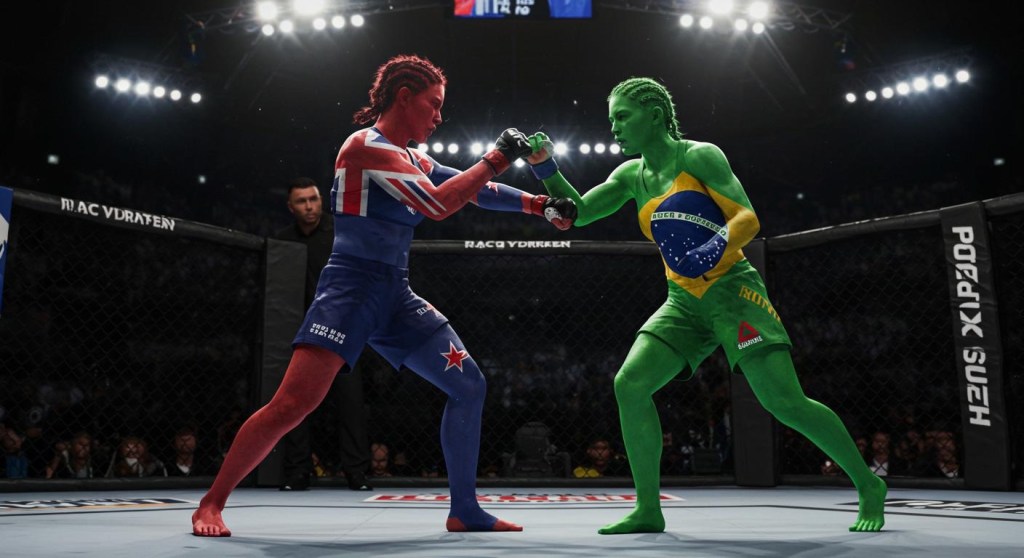
On a Saturday night in Perth, beneath the neon glow of RAC Arena, the fight game is preparing to eat another soul alive. There’s no mercy in the Octagon. You either walk out with momentum strapped to your back or you get trampled by the weight of reality. And at UFC Fight Night: Ulberg vs. Reyes, one fight on the prelims carries the kind of quiet menace that could shift careers: Michelle Montague, “The Wild One,” makes her UFC debut against veteran Luana “Dread” Carolina.
For Montague, this is history. She’s the first woman from New Zealand ever signed to the UFC, a national pioneer dragging the Kiwi flag into the blood and spotlight. For Carolina, it’s survival — a battle not just with her opponent but with the scale, with the ghosts of failed weight cuts, with her own body and mind.
The story is simple, brutal, and compelling: an undefeated submission monster meets a weathered striker who refuses to break. One brings perfection, the other endurance. Only one leaves Perth with momentum intact.
The Wild One: Montague’s Unblemished Hunt
Michelle Montague doesn’t play safe. She doesn’t point-fight, she doesn’t eek out decisions, she doesn’t even bother with variety. She’s a predator with a single weapon: the Rear Naked Choke.
Six fights. Six finishes. Six strangles.
It sounds reductive — laughable, even. In an era of well-rounded MMA, how can a fighter survive relying on one move? But the truth is harsher: Montague’s choke is so inevitable, so suffocating, that opponents know it’s coming and still can’t stop it. As commentator Andy Shepherd put it mid-finish: “When you’re so good at doing something that people know it’s coming, they can’t stop you.”
Montague, 31 years old, 5’9” with a wrestler’s hips and a grappler’s obsession, carved her path the hard way. From the matrooms of Matamata, New Zealand, to the shark tank at American Top Team in Florida, she has been forged by both Kiwi grit and world-class iron.
Her credentials scream legitimacy. Former IMMAF Amateur World Champion. Commonwealth Games freestyle wrestler. Multi-time BJJ national champion. She isn’t some plucky debutant — she’s an athlete who already ruled at every level before crossing into the UFC.
But the path was paved with agony. Between 2016 and 2019, she broke both legs — one year apart. A cruel test that could’ve ended her career before it even began. Yet here she is, undefeated, smiling about the “ten years of slog, tears, and working other jobs like everybody does” that dragged her here.
When Montague finally burst into the professional spotlight, she did so violently. PFL Challenger Series, PFL Playoffs, Bellator Dublin — all venues where she wrapped arms around necks and squeezed until resistance vanished. The most recent? A first-round RNC over Karolina Sobek in Dublin. Two minutes and forty-one seconds of inevitability.
Now she steps into the Octagon, carrying the hopes of Kiwi MMA on her shoulders. She’ll have Australia behind her in Perth. And she’ll have ATT in her corner — training daily with Kayla Harrison, calling the Olympic gold medalist and UFC bantamweight champ her best friend. That’s not just pedigree. That’s blueprint.
Make no mistake: Montague is here not to compete, but to conquer.
Resilience Woven in Blood and Bone
Montague’s story doesn’t just sell because of gold medals and chokes. It sells because she’s bent but never broken.
Those years of injury, those broken legs — they crafted her psyche. She talks about competition giving her “direction where your strengths are.” But the subtext is clear: she fought through despair, isolation, the hell of rehab, and found something stronger on the other side.
That’s what gives her RNC bite. It’s not just technique; it’s inevitability born from lived suffering. When she jumps on your back, she isn’t just fighting you — she’s fighting the versions of herself that almost didn’t make it.
And yet, she’s also grounded in Kiwi humility. She jokes about her one-track submission arsenal. She drops slang like calling Israel Adesanya and Dan Hooker “absolute GCs.” She’s a warrior who hasn’t lost her humanity. And that balance — wild yet relatable — makes her dangerous.
Luana Carolina: The Dread Who Refused to Break
Across the cage stands Luana “Dread” Carolina, and if Montague is a rising storm, Carolina is the scarred seawall that has taken wave after wave without collapsing.
Her record reads 11-4, with a 6-3 UFC slate. Not flashy. Not pristine. But the numbers don’t tell the story. Carolina is toughness personified — a striker who has crawled through the swamp of weight-cut hell and still shows up swinging.
At her best, Carolina is a nightmare in the clinch. She throws long straight shots, awkward angles, knees that crash through ribs, elbows that split faces. Her striking is messy, unpredictable, and therefore effective. She thrives in chaos, dragging opponents into ugly brawls.
She’s also absurdly durable. She once sat trapped in a D’arce choke for nearly two minutes — the kind of suffocating squeeze that ends careers — and refused to tap. Against Julija Stoliarenko, she fought off deep submission attempts, then rallied to earn her first UFC TKO. That’s Carolina’s trademark: she doesn’t quit, even when she should.
But her toughest opponent has always been herself.
The Weight-Cut Demons
Carolina’s UFC career has been stalked by the scales like a curse. Twice she missed weight at flyweight. Twice she cried her way through cuts that left her half-dead. She admits one time she shed pounds “only from crying tears.” Another time, her fight was scrapped entirely when she failed to get within five pounds of the limit.
Those moments weren’t just humiliating — they were financially devastating, emotionally brutal, the kind of failures that leave scars deeper than any elbow.
Now, in Perth, she fights at bantamweight. Ten pounds heavier. Stronger, safer, maybe freer. She wanted to keep squeezing into flyweight, but the cut broke her body. At 135, she has no excuses.
And she knows it. “I want people to fear me,” she said earlier this year. The desperation leaks out of every word.
The Styles Collide
This is classic grappler vs. striker, and that’s no cliché.
Montague wants one thing: to close the distance, drag Carolina to the mat, take her back, and squeeze. She has double-leg takedowns, even suplexes in her arsenal. But once she’s on your back, it’s already too late.
Carolina’s mission is simple but perilous: keep it standing. Keep Montague at range with jabs, punish her with knees in the clinch, stuff takedowns with her 74% defense, and let the fight drag into deeper waters. Carolina has gone the distance six times in the UFC. Montague never has.
If Carolina survives the first round, she could drown Montague in pace and awkward striking. But if Montague gets one clean entry, the fight may be over in seconds.
The Gatekeeper vs. The Pioneer
Every debutant faces a test, and the UFC matched Montague with a gatekeeper who won’t just fold. Carolina is ranked #15 at flyweight, battle-tested, and riding a three-fight win streak. This is not a free lunch.
Montague’s undefeated record is pristine but untested in the Octagon. Carolina knows the lights, the cameras, the chaos. She’s been humiliated, survived, and returned stronger.
This isn’t just Montague vs. Carolina. It’s perfection vs. imperfection. It’s the promise of the new vs. the scars of the old.
The Emotional Undercurrent
The stakes here go beyond rankings.
Montague isn’t just debuting; she’s carrying Kiwi history on her shoulders. The first woman from New Zealand in UFC history. The first to show young Kiwi girls that the Octagon isn’t just for men. Perth will roar for her, but it will also weigh on her.
Carolina isn’t just fighting Montague; she’s fighting for redemption. Fighting to prove that the scale won’t define her career. Fighting to prove she belongs in the bigger weight class. Fighting to prove resilience can still pay dividends.
Fight Night: What to Expect
Expect chaos early. Montague will charge, looking for a takedown within the first 90 seconds. If she gets it, Carolina may be forced into survival mode instantly. If Carolina sprawls, stuffs, and lands knees, we could see Montague drawn into striking exchanges — her one real vulnerability.
Round one is Montague’s best chance. Round two and three are Carolina’s playground. Cardio vs. inevitability.
Conclusion: The Stakes in Perth
This isn’t a main event, but it might be the most telling fight on the card.
If Montague wins, she doesn’t just go 7-0. She becomes the face of Kiwi women’s MMA. She proves that the hype wasn’t a mirage. She takes another step toward the kind of superstardom New Zealand hasn’t seen since Adesanya first swaggered into the cage.
If Carolina wins, it’s a resurrection. A statement that resilience and scar tissue can topple hype. That veterans still matter. That weight-cut demons can be beaten.
In Perth, the cage won’t lie. Montague’s perfection meets Carolina’s survival. The Wild One vs. The Dread. And only one leaves with their story intact.
 doragon sports