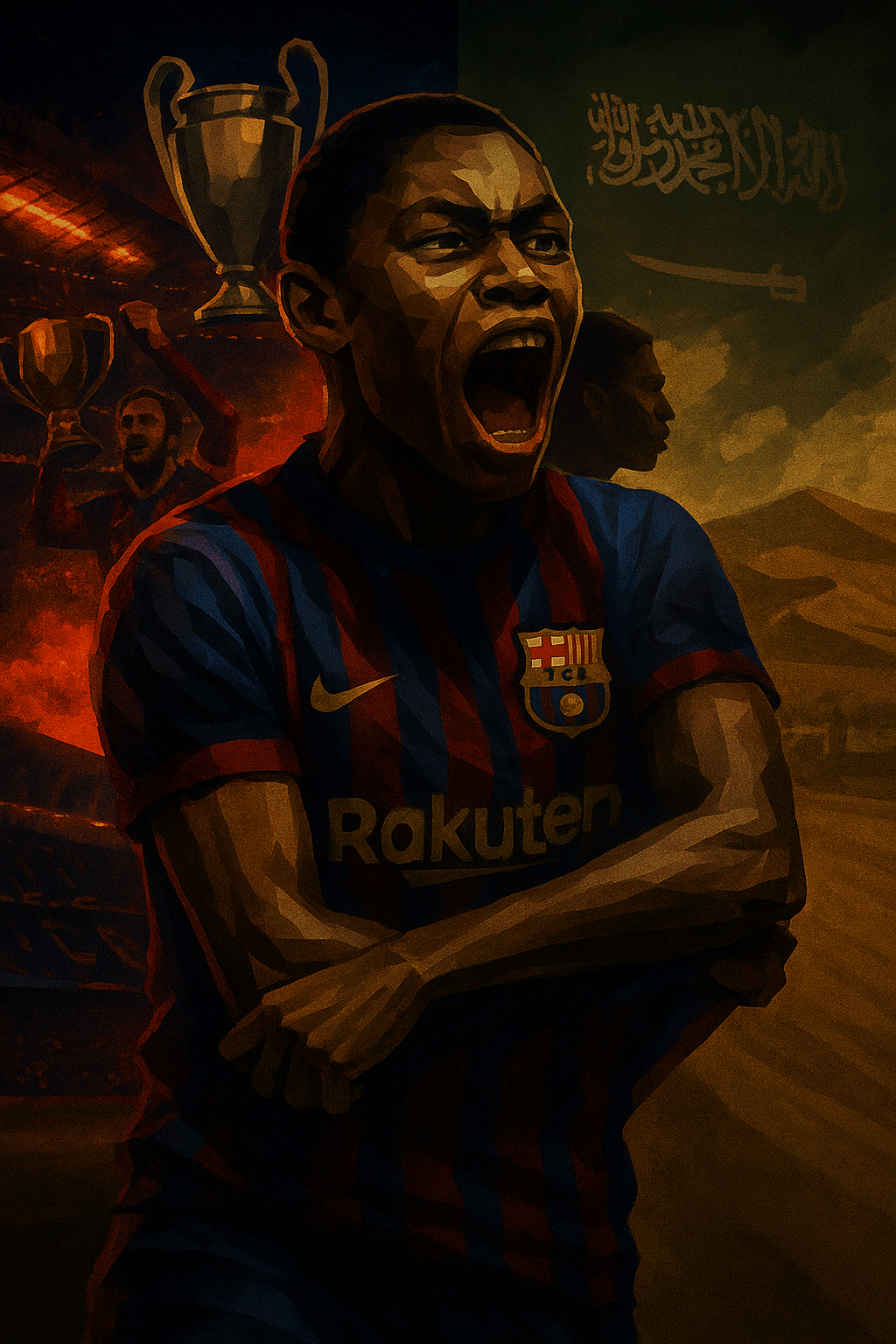
Football careers are not straight lines. They zig, zag, rise, and crumble, sometimes in the space of a single season.
Asisat Oshoala’s journey has been nothing short of a saga — the Ikorodu girl who defied her father’s rage and her mother’s fists to lace up her boots, the striker who carved open defenses in Lagos dirt pitches before conquering Europe’s grandest stage.
She became Africa’s face in women’s football, a record-breaking goalscorer, a six-time African Player of the Year, and a Champions League winner.
But legacy is fragile. In the past two years, Oshoala has gone from Barcelona royalty to a jarring misfire in the NWSL with Bay FC, before stunning the footballing world again with a move to Al Hilal in Saudi Arabia — a league that barely exists in global consciousness, and a club whose women’s news page hasn’t even been updated since 2023.
It leaves us asking: is this the natural twilight of a career, or a premature retreat into irrelevance?
A Girl Who Shouldn’t Have Made It
Oshoala never set out to be a footballer. She wanted to be a lawyer. Her parents wanted her at home, not playing with boys on the street. Her father, a strict figure in a deeply traditional Muslim household, was horrified at the idea of a daughter chasing a football. Her mother would shout, even deny her food when she returned with dirty kits. And yet she played anyway, sneaking away to the grandmother who offered her quiet protection.
The discovery that women’s football teams existed was a revelation. She joined immediately, and by 2014, she was not just playing but obliterating defenses at the FIFA U20 Women’s World Cup — winning Golden Boot and Golden Ball. That tournament was more than goals; it was the moment her father, once her biggest obstacle, finally blessed her career. From that point, she wasn’t just playing for herself. She was playing for family, for Nigeria, for a continent.
Building a Legend: From Liverpool to Barcelona
Oshoala’s European adventure began in England with Liverpool, then Arsenal. Injuries slowed her down, but her raw power and instinct were impossible to ignore.
A stint in China with Dalian Quanjian raised eyebrows — some saw it as a cash grab. She responded by banging in goals for fun, winning titles, and sharpening her killer instinct.
Then came the move that transformed her from African star to global icon: Barcelona.
At Barça she became unstoppable. The first African woman to score in a Champions League final. The first to win one. A three-time Champions League champion in total. Five-time Liga F winner. A goalscoring machine with 117 goals in 162 matches — the fourth-highest scorer in the club’s entire history.
She wasn’t just lifting trophies; she was smashing barriers, carrying the pride of Africa into stadiums filled with 90,000 fans. The 2021-22 season, when she won the Pichichi with 20 goals in 19 matches, was her peak. Every 51 minutes, she found the net. She wasn’t just Barcelona’s striker. She was Africa’s standard-bearer in the elite game.
When she left in 2024, her farewell was dripping with gratitude: “What I will cherish most are the relationships… you have become my family and I will forever be grateful.” But behind the tears of goodbye lay a bigger question: what could possibly top this?
Bay FC: From Statement Signing to Disappointment
The answer was supposed to be Bay FC, the NWSL expansion side in San Jose. Oshoala herself framed it as a challenge: she wanted to leave her comfort zone. Bay framed her as a statement signing, proof they could lure world-class talent. For a moment, it looked like it might work. She scored their first-ever goal in their first-ever game, history written in one sweet strike.
But history soon soured.
In 2024, she managed 7 goals — respectable, but not world-beating. By 2025, her form collapsed. No goals in the regular season. Only 458 minutes played across 12 matches, starting just five. For a player who once terrorized Chelsea in Champions League finals, this was not a slump; it was an implosion.
The criticisms were brutal. She didn’t run. She gave up on passes. She couldn’t handle the NWSL’s relentless physicality. Fans accused her of being disengaged, of caring more about sponsorships than matches. “She doesn’t want to play anymore,” one supporter spat online, echoing a sentiment that grew louder with every goalless outing.
Yes, she scored at WAFCON. Yes, she lifted another continental trophy with Nigeria. But in the league that prided itself on competitiveness from top to bottom, she looked washed. For the first time in her career, Asisat Oshoala felt ordinary.
The Saudi Shift: Ambition or Abdication?
And now, she has chosen Saudi Arabia. On paper, a two-year deal with Al Hilal. In reality, a move that feels like a retreat.
Al Hilal are part of the Saudi sports project, pouring resources into building a women’s league. Oshoala’s signing is supposed to be a headline. But when the club’s official women’s news page hasn’t been updated since 2023, it screams of smoke and mirrors. Is this about football, or optics?
For Oshoala, it’s framed as “another chance to break barriers.” But critics are sharper: she’s 30, still young enough to compete at the top, and instead she’s disappearing into a league with no global spotlight. It feels less like barrier-breaking and more like fading into obscurity with a healthy paycheck.
There’s an uncomfortable comparison here. Imagine if Lionel Messi, after leaving Barcelona, had skipped PSG and gone straight to a developmental league with barely any coverage. The outrage would have been nuclear. Oshoala deserves the same scrutiny. For all her talk of inspiration and legacy, this move feels like a soft landing, not a final roar.
The Path Not Taken: Why Not Liga F?
The most frustrating part is that the alternative was obvious. Liga F, where she dominated. Spain is still one of the strongest women’s leagues in the world. Teams outside Barcelona are desperate for elite goalscorers. Oshoala could have walked into Atlético Madrid, Real Madrid, Levante, or even returned to Arsenal in the WSL, and she’d still be battling for trophies in front of packed stadiums.
Instead, she’s gone where coverage is minimal, competition questionable, and ambition uncertain. For a player who spent years defining herself by breaking ceilings, this feels like settling for a basement.
Legacy Beyond the Ball
None of this erases her legacy. Oshoala has been more than a footballer. She’s a cultural figure, a role model who refused betting deals because of the kids who look up to her. She launched the Asisat Oshoala Foundation to give young girls in Nigeria the opportunities she never had. She preaches education alongside sport. She has spoken out about Africa’s “usage gap” in internet access, using her platform to highlight inequality in tech as well as sport.
She is a six-time African Women’s Footballer of the Year. A Champions League winner. A living legend.
But legends can stumble. And right now, Oshoala’s narrative is clouded: from Barcelona’s throne, to Bay FC’s bench, to Saudi sands.
Conclusion: The Final Act or a False Step?
Asisat Oshoala’s story began with defiance — playing barefoot when told not to, carving out a career in a world stacked against her. It became one of triumph — goals, trophies, records, global recognition. But the latest chapters are uneasy. Bay FC was a failure. Al Hilal looks like a paycheck move to a league that doesn’t yet matter.
Maybe she sees it differently — another frontier to pioneer, another door to push open. But football isn’t just about symbolism. It’s about where you play, who you play against, and what you win. Right now, Oshoala has chosen obscurity over spotlight.
For a girl who turned Ikorodu’s streets into her launchpad, it feels like a betrayal of her own story.
The Golden Girl of Africa still has fire in her boots. The question is whether she will use it to burn brighter again — or let it fade in the desert sands
 doragon sports