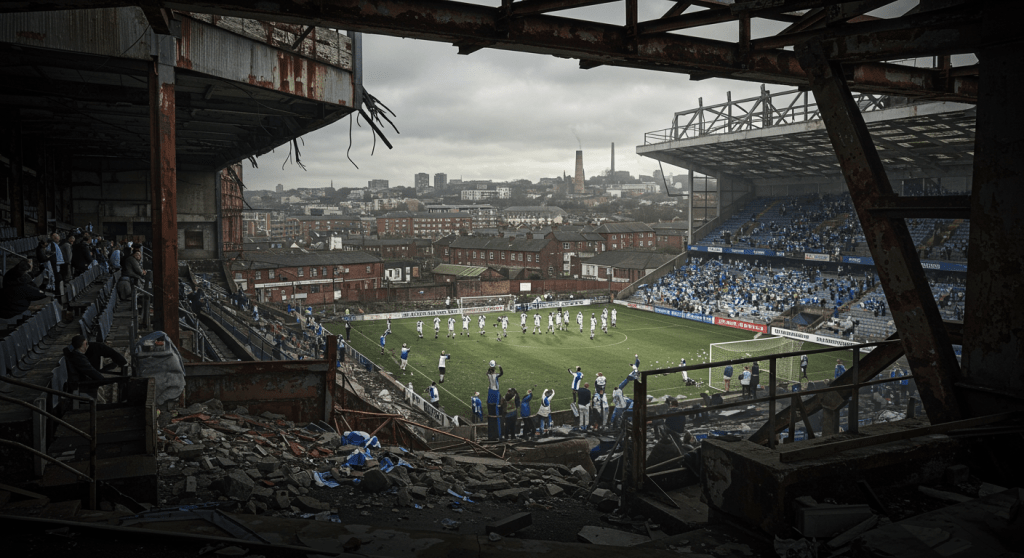
Sheffield has lost its steel, and now it threatens to lose its soul. Once upon a time, the word “Steel City” carried weight, an identity forged in fire, iron, and graft. Now the furnaces are cold, the factories shuttered, and the football club that once stood as its noisy emblem is staggering toward the same fate. On Tuesday night, at Hillsborough, the collapse becomes theatre: Sheffield Wednesday host Leeds United in the Carabao Cup, but the game feels less like a derby and more like a funeral procession with a ball placed in the middle.
Unpleasant prior meetings
For the neutral, this fixture is still stamped as a “Yorkshire Derby.” For Leeds and Wednesday supporters, it has always been more personal, more toxic, more vicious. These clubs don’t just dislike each other — they revel in each other’s misery. Leeds haven’t lost to Wednesday in five games. Wednesday haven’t even scored against them since September 2023. History digs the knife deeper: Leeds’ infamous 6–1 mauling of Wednesday at Hillsborough in 1992; the notorious Kirkland assault game of 2012, where Dave Jones branded Leeds fans “vile animals” and the chanting spilled into grotesque mockery of tragedy and revenge. For decades, this derby has existed in a register of bitterness that few outside Yorkshire can fully grasp.
Wednesday’s distraught era
Yet this week’s meeting is coated in an uglier varnish. For Wednesday, the collapse is no longer just symbolic — it is lived reality. Dejphon Chansiri’s regime has become a grotesque farce. Wages unpaid for three straight months. Transfer embargoes slapped on. Players leaving for pennies, the squad stripped bare. The once-proud Owls reduced to a carcass of youth players, loanees, and men too stubborn to abandon ship. Even the goalkeeper situation is a comedy sketch gone wrong: Pierce Charles injured, Ethan Horvath drafted in on an emergency deal, only to hand Wrexham a goal with his first real action in blue and white.
The supporters have had enough. Under the banner of “Black and Gold until we’re sold,” they have organised, protested, and now escalated to the ultimate statement: boycott. Not just empty words but a tangible plan — don’t turn up, don’t feed the regime, donate your ticket money to a children’s hospital instead. It is the most damning indictment: a fanbase so sick of its owner that it prefers to give its money away than watch its club play Leeds United, of all teams, at Hillsborough. Imagine that. A Yorkshire Derby with an empty home end, the cathedral silenced not by defeat but by despair.
Even some Leeds voices have urged solidarity. Strange bedfellows, the enemy showing a rare moment of humanity. Because deep down, even the most venomous rival knows the truth: football clubs are fragile things, and when one goes, it scars everyone. Leeds fans can mock Wednesday’s collapse, chant about rust and ruin, but they also know they once stood on their own financial cliff edge. “All clubs are precious, even those we hate,” one headline declared.
But don’t expect Leeds’ travelling army to go soft on Tuesday. Three thousand seven hundred away tickets sold in a blink, and the Whites will march into Hillsborough ready to fill every decibel the boycotting Owls leave behind. They will sing not just for themselves but for dominance, to remind their neighbours that while Leeds are back in the Premier League, Wednesday are staring down the abyss.
Because Leeds are indeed back. Promoted in the most dramatic of fashions last spring, Daniel Farke’s side clinched the Championship title with a last-minute goal from Manor Solomon, a script too perfect even for Hollywood. The opening weeks of their Premier League return have been a sharp blend of pride and pain — a gritty 1–0 over Everton, followed by a brutal 5–0 evisceration at Arsenal. Leeds have seen both ends of the reality stick, but the essential truth is this: they are back in the big time, and Tuesday is not their destiny but a distraction.
Farke eats owls for breakfast
Farke has history here. Ten games against Wednesday, seven wins, unbeaten in the last four. His teams don’t just beat them; they make a habit of it. Even if he rotates — and he surely will, with Newcastle looming at the weekend — the imbalance is absurd. Leeds can throw fringe internationals, new signings like Sebastiaan Bornauw, and fresh-faced talent onto the Hillsborough pitch. Wednesday will throw Barry Bannan, who at 35 still runs like his lungs are forged of stubbornness, and Bailey Cadamarteri, a homegrown spark forced into the role of saviour before his career has truly begun.
Rusting steel: Sheffield falters beyond hillsborough
The gulf is more than sporting. It is financial, cultural, existential. Leeds, flawed but afloat, are building toward something. Wednesday, collapsing, are fighting just to stay alive. If this fixture once felt like a battle of equals — steel town vs industrial giant, Hillsborough roar vs Elland Road fury — now it feels like theatre staged by cruel gods. One city boasting a Premier League club, the other staring bankruptcy in the face. One marching into a cup tie with rotation as luxury, the other patching together a squad with duct tape and hope.
And hovering above all of it is Sheffield itself, the city in decay. Liberty Steel’s collapse has put 1,500 jobs at risk. Insolvency courts have taken control. The government is paying wages while scrambling for a buyer. For locals, the refrain is weary: we’ve lost shipbuilding, cotton, wool, coal, and now steel itself. What is left? The identity of a city, once fire and hammer, is reduced to rust and redundancy notices. The parallels with Wednesday are almost too on the nose. The Owls, once a byword for grit and pride, now mirror the city’s fragility. When Leeds fans descend on Tuesday, they will not miss the chance to rub salt into the wound: “You’ve lost your steel, next you’ll lose your club.” It is cruel, but it is also true.
Energy drinks in Yorkshire
The Carabao Cup rarely matters in August, dismissed as a sideshow, a nuisance. Yet this tie crackles with symbolism. For Leeds, a chance to flex depth, to keep momentum, to pretend for one night that domestic cups might still mean something. For Wednesday, it is a crucifixion. The derby arrives at the exact moment supporters are withdrawing their consent, at the precise hour their city is collapsing under economic despair. Hillsborough doesn’t feel like a fortress anymore — it feels like a crumbling monument, a place where history is preserved but the present is hollow.
There will still be football, of course. There will still be Bannan’s pirouettes, Cadamarteri’s restless runs, Leeds’ inevitable waves of pace and control. Someone will score, someone will celebrate, someone will trudge off beaten. But the meaning of Tuesday night cannot be found in tactical minutiae or expected goals charts. It is written in the silence of empty seats, in the anger of banners outside the stadium, in the mocking chants of away fans who know their neighbours are bleeding out. It is written in the headlines of a city watching its last industries collapse. It is written in the irony of a derby once called the biggest outside the Premier League being reduced to a grim sideshow.
So what is left? A rusted city, a broken club, and a derby still dripping with venom but drained of vitality. The Owls can hoot all they like — the sound is drowned out by the groan of collapse. On Tuesday, Hillsborough won’t just host football. It will echo Sheffield’s decline, a Yorkshire derby staged not as a celebration of rivalry but as a requiem.
 doragon sports