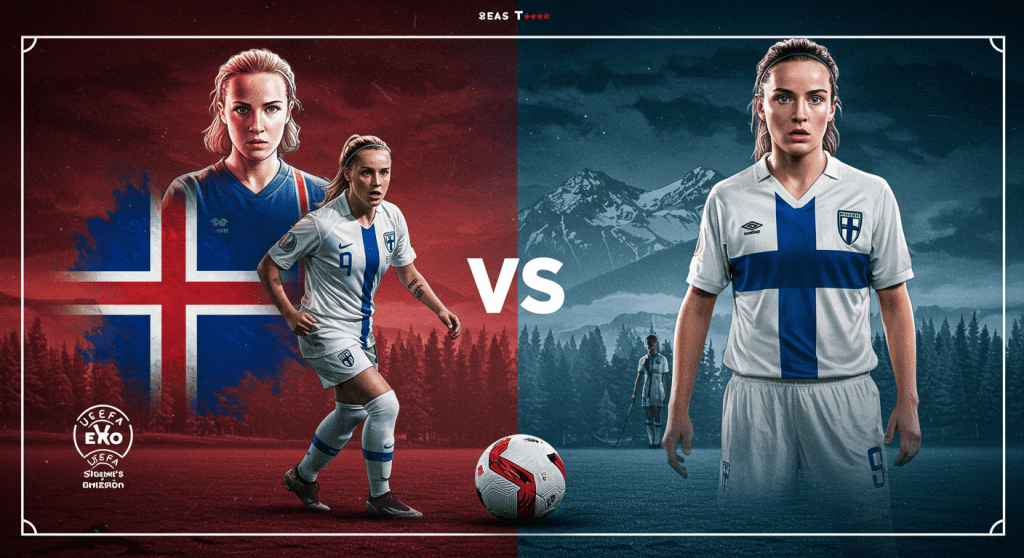
A contest steeped in shared heritage yet defined by distinct national identities is set to unfold as Iceland and Finland prepare to lock horns in a pivotal UEFA Women’s Euro 2025 Group A encounter.
This “Nordic derby,” transplanted to the neutral and picturesque terrain of Thun, Switzerland, promises a fascinating clash of footballing philosophies and deeply ingrained cultural narratives.
The Alpine setting, though distant from their homelands, may evoke a sense of rugged grandeur that resonates with both the Icelandic connection to dramatic, volcanic landscapes and the Finnish affinity for vast forests and unwavering resilience. This environment could serve as a subtle, almost poetic backdrop to the tenacity expected on the pitch.
The crucial details for this highly anticipated fixture are:
- Date: Wednesday, 02 July 2025
- Time: 5:00 PM UK (18:00 CET / 16:00 UTC)
- Venue: Stockhorn Arena, Thun, Switzerland
- Competition: UEFA Women’s Euro 2025, Group A
As an opening match in Group A,the stakes are incredibly high. This game is more than a regional rivalry; it’s a critical opportunity for both Iceland and Finland to set a positive tone for their tournament campaigns.
Adding a layer of intrigue to this encounter is the recent history between the two sides. Their last meeting, a friendly on 14th July 2023, saw Finland emerge victorious with a 2-1 scoreline. This result lingers in the backdrop, potentially fueling Iceland’s desire for redemption or bolstering Finland’s belief that they can once again overcome their Nordic rivals.
Going to the game? Check out our Stadium Guide!
If you’re attending this game, we have a stadium guide that offers a comprehensive matchday experience!
The Road to Thun: Contrasting Paths, Shared Ambition
The journeys of Iceland and Finland to the UEFA Women’s Euro 2025 finals in Switzerland have been markedly different, yet both arrive with a shared ambition to make a significant impact on the tournament, especially after both nations missed out on the 2023 FIFA Women’s World Cup.
This mutual absence from the global stage could serve as a powerful undercurrent, driving both teams to prove their mettle in Europe’s premier international competition and making their head-to-head clash particularly intense.
Iceland’s Qualification Journey & Recent Form:
Iceland, known as Stelpurnar Okkar (Our Girls), secured their place at Euro 2025 through a direct qualification route, finishing as runners-up in Group A. Their campaign was highlighted by an impressive 3-0 home victory against traditional European powerhouse Germany, a result that underscored their capability to compete with and defeat elite opposition. This direct passage, avoiding the anxieties of play-off football, speaks to their consistency and quality during the qualification phase.
However, their recent form leading into major tournaments has shown a pattern of resilience mixed with a need for greater decisiveness. At UEFA Women’s Euro 2022, they drew all three of their group matches against Belgium, Italy, and France. More recently, their UEFA Women’s Nations League campaign in early 2025 saw them secure draws against Switzerland (0-0 away, 3-3 home) and Norway (0-0 home), alongside a narrow 3-2 away defeat to France. Friendly results in late 2024 included losses to the USA and Canada, and a 2-0 defeat to Denmark.
This sequence suggests a team that is exceptionally difficult to break down, defensively robust, and capable of holding its own against strong sides.
Yet, the recurring theme is the challenge of converting these hard-fought draws into victories, pointing to a need to develop a more “clinical edge” in attack to progress deep into tournaments. Their non-qualification for the 2023 World Cup will undoubtedly serve as a strong motivator to make a statement at these Euros.
Finland’s Qualification Journey & Recent Form:
In contrast to Iceland’s direct route, Finland, the Helmarit (Boreal Owls), navigated the more perilous path of the play-offs to secure their Euro 2025 spot. Their journey involved a comprehensive 6-0 aggregate victory over Montenegro (1-0 away, 5-0 home) followed by a tense and ultimately triumphant 2-0 aggregate win against a strong Scotland side (0-0 away, 2-0 home). Successfully managing these high-stakes, must-win encounters demonstrates a significant degree of mental fortitude and tactical execution under pressure, which could stand them in good stead for the tournament environment.
Finland’s recent form indicates a team building positive momentum. They won their UEFA Women’s Nations League Group B2, earning promotion. Results in early 2025 included a narrow 1-0 away loss to Serbia, a 1-0 away victory against Hungary, a 0-0 draw with Belarus (played in Italy), and a convincing 3-0 home win over Hungary. These performances, coupled with their play-off success, suggest a team growing in confidence and effectiveness. Like their upcoming opponents, the disappointment of not qualifying for the 2023 FIFA Women’s World Cup will be a powerful driving force behind their Euro 2025 aspirations.
The differing qualification paths offer an interesting dynamic: Iceland’s impressive consistency versus Finland’s battle-hardened resilience. Both teams, however, share the common goal of leveraging their Euro 2025 appearance to reassert their status on the European stage.
Iceland – Stelpurnar Okkar (Our Girls): Echoes of Sagas, Spirit of the Volcano
The Icelandic women’s national team, affectionately known as Stelpurnar Okkar (“Our Girls”), carries the hopes of a nation renowned for its dramatic landscapes and resilient spirit. This moniker reflects a deep connection between the team and its supporters, embodying national pride and a sense of collective ownership.
Manager Profile: Þorsteinn Halldórsson
At the helm since early 2021, Þorsteinn Halldórsson has guided Iceland with a steady hand. His extensive background in Icelandic club football, notably securing three league titles with Breidablik between 2014 and 2020, provided a strong foundation for his national team role.
Halldórsson’s Iceland is characterized by its resilience and defensive organization, a trait clearly demonstrated during UEFA Women’s Euro 2022 where they drew all three group stage matches against formidable opponents like France, Belgium, and Italy.
His coaching philosophy appears to center on playing to the team’s inherent strengths, fostering unity and a coherent tactical approach.
While the team has shown consistent progression, a frequently noted area for development is the need for a more “clinical edge” in converting opportunities into goals.
Tactically, Iceland is anticipated to line up in a 4-3-3 formation, a system that allows for defensive stability while offering avenues for dynamic attacking play, particularly through the flanks.
Key Players & Strengths:
Iceland boasts a core of highly talented individuals playing at top European clubs:
- Glódís Perla Viggósdóttir (Defender, Captain – Bayern Munich): The undisputed leader at the back, Viggósdóttir is a world-class central defender. Her strengths lie in her exceptional game-reading ability, aerial dominance (standing at 1.73m), vocal organization of the defense, and impressive composure and skill in distributing the ball from the back. Her captaincy of a powerhouse like Bayern Munich speaks volumes about her leadership qualities.
- Sveindís Jane Jónsdóttir (Forward – Angel City): A dynamic and powerful attacking force, the 23-year-old Jónsdóttir is pivotal to Iceland’s offensive strategy. Known for her blistering pace, strength, and ability to penetrate defenses, she made an immediate impact on her international debut, scoring twice. A unique and potent weapon in her arsenal is her exceptionally long throw-ins, which often create dangerous set-piece situations.
- Dagný Brynjarsdóttir (Midfielder – West Ham United): An experienced and influential midfielder, Brynjarsdóttir holds the distinction of being Iceland’s record goalscorer in Euro final tournaments.
- Sara Björk Gunnarsdóttir (Midfielder): With the most Euro final tournament appearances for Iceland, Gunnarsdóttir brings a wealth of experience and tactical astuteness. Her presence is vital for maintaining composure and guiding the team through the pressures of tournament football.
- Karólína Lea Vilhjálmsdóttir (Midfielder/Forward – Bayer Leverkusen): A versatile and creative attacking player, Vilhjálmsdóttir often features in Iceland’s front three, contributing significantly to their offensive movements and goal-scoring opportunities.
- Cecilía Rúnarsdóttir (Goalkeeper – Bayern Munich): A promising young goalkeeper developing at one of Europe’s top clubs, highlighting Iceland’s talent pipeline.
Playing Style Analysis:
Iceland’s approach is built on a foundation of defensive solidity, a hallmark of Halldórsson’s tenure.6 This resonates with a historical Icelandic defensive tradition exemplified by figures like Katrín Jónsdóttir, renowned for her disciplined and intelligent defending. The team is expected to be organised, compact, and difficult to break down.16 Beyond structure, a key characteristic is their immense physicality and “fighting spirit,” often described in national discourse as “Icelandic madness,” where they frequently outdo opponents in sheer competitiveness and willpower. Offensively, they often rely on quick transitions, leveraging the speed and power of players like Jónsdóttir on the wings. Set-pieces, particularly Jónsdóttir’s long throws, represent a distinct and dangerous attacking avenue. The combination of this defensive resilience and specific attacking threats suggests a team that may not always dominate possession but is adept at frustrating opponents and capitalizing on key moments or individual brilliance.
The Viking Echo: Resilience, Warrior Women, and National Spirit
The tenacity of Stelpurnar Okkar is deeply interwoven with Iceland’s cultural fabric. The famed “Viking spirit” is more than a catchy phrase; it reflects a national character shaped by survival in a challenging environment and a history steeped in resilience. This spirit finds echoes in the Icelandic Sagas, which are replete with tales of strong, independent, and often formidable female figures. Characters like Auður Djúpauðga, a powerful settler and leader who sailed the open seas, and warrior women like Brynhildr, alongside influential figures from Norse mythology such as the Valkyries (choosers of the slain and symbols of battlefield prowess) and Freyja (a goddess associated with war and sovereignty), all symbolize agency, strength, and an indomitable will. These narratives of powerful women, historically and mythologically, may contribute to a team environment where female athletes feel particularly empowered and valued.
Furthermore, Iceland’s strong national sentiment and its status as a global leader in gender equality create a supportive backdrop for women’s football. While the women’s team has historically operated in the shadow of the men’s national team’s international successes, their consistent qualification for major European tournaments is a source of immense national pride for a country with a population of around 350,000. This “small nation, big heart” ethos fuels their competitive drive, allowing them to consistently punch above their weight on the international stage. The reliance on a core group of world-class players from this small talent pool, however, means that the fitness and form of these key individuals are exceptionally critical to the team’s overall success.
Finland – The Helmarit (Boreal Owls): Guided by Sisu, Inspired by Kalevala
The Finnish women’s national team, known as the Helmarit (“The Boreal Owls”), approaches Euro 2025 with a spirit forged in determination and rooted in a rich cultural heritage. Their nickname itself offers insight into their identity, with the Boreal Owl symbolizing courage, determination, community spirit, wisdom, and keen vision.
Manager Profile: Marko Saloranta
Marko Saloranta’s association with Finnish women’s football is long and deep, spanning over fifteen years in various capacities within the national setup. He has coached youth national teams (U16, U17), served as an assistant for the senior side at multiple Euros (2009, 2013, 2022), and had interim spells as head coach before his permanent appointment in 2023. This extensive experience, which also includes three league titles with club side Honka Espoo, has endowed him with a profound understanding of the Finnish player pool and a coaching philosophy likely built on long-term development and team cohesion. His recent success in guiding Finland through the demanding Euro 2025 play-offs, notably overcoming a strong Scotland team, highlights his tactical acumen and ability to prepare his squad for high-pressure encounters.
Key Players & Strengths:
Finland’s squad blends experienced stalwarts with emerging talents:
- Tinja-Riikka Korpela (Goalkeeper, Captain – Servette): The team’s captain, Korpela, is an experienced and commanding presence in goal, vital for organising the defence and providing on-field leadership.
- Emma Koivisto (Defender/Midfielder – AC Milan): A highly versatile and seasoned international with over 100 caps, Koivisto’s experience in top European leagues (England’s WSL, Sweden’s Damallsvenskan, Italy’s Serie A) is invaluable.7 Her adaptability allows her to contribute effectively in both defensive and midfield roles.
- Linda Sällström (Forward – Vittsjö GIK): As Finland’s all-time leading goalscorer, Sällström remains their primary attacking threat. Her ability to find the net consistently, including scoring in Euro 2022 and being a joint top scorer for Finland in the Euro 2025 qualifiers will be crucial.
- Olga Ahtinen (Midfielder – Tottenham Hotspur): A key figure in the Finnish midfield, Ahtinen is known for her work rate, ability to control tempo, and effectiveness in linking defensive play with attacking moves.
- Natalia Kuikka (Defender – Chicago Red Stars): An important and experienced defender, Kuikka brings solidity and international experience from the NWSL to the Finnish backline.
- Eveliina Summanen (Midfielder – Tottenham Hotspur): Partnering Ahtinen in midfield at club level, Summanen is recognized for her tenacity, all-around contribution, and high-level experience in the WSL.
Playing Style Analysis:
The Helmarit are expected to exhibit traits common to Scandinavian football, such as strong defensive organization. The legacy of composed and intelligent Finnish defenders like Anna Westerlund, known for her discipline and anticipation, may well inform their current defensive philosophy. Central to their approach will be the Finnish characteristic of Sisu – an unwavering determination and resilience, particularly when facing adversity. The team possesses an experienced core, with players like Korpela, Koivisto, Kuikka, and Sällström providing stability and leadership across the pitch. While teamwork is paramount, Linda Sällström’s goal-scoring prowess will be a focal point of their attacking strategy.
A Battle Etched in Nordic Ice: Head-to-Head History
The rivalry between Iceland and Finland on the women’s international stage is a long-standing one, characterized by competitive encounters that reflect their shared Nordic tenacity. An examination of their past meetings reveals a closely contested history, making their upcoming Euro 2025 clash all the more intriguing.
Based on available records, the teams have met multiple times across various competitions, including European Championship qualifiers and international friendlies. The overall head-to-head record is quite balanced, indicating that neither side has enjoyed prolonged periods of dominance over the other. This equilibrium suggests that matches between Iceland and Finland are typically hard-fought and unpredictable.
Recent Encounters:
The most recent fixture between the two nations took place on 14th July 2023, an international friendly where Finland secured a 2-1 victory over Iceland. This result will undoubtedly be fresh in the minds of both squads, potentially giving Finland a slight psychological edge, or conversely, providing Iceland with added motivation for revenge.
Prior to that, they met in two friendlies in June 2019. The first, on June 13, 2019, ended in a 0-0 draw, while the second, on June 17, 2019, saw Iceland defeat Finland 2-0. These results from 2019 show Iceland having the better of that particular pair of encounters.
Memorable Matches from the Archives:
Looking further back, Iceland achieved a notable 3-0 victory over Finland in the Algarve Cup on 12th March 2008.
Conversely, in the qualifying stages for the 1984 UEFA Women’s Championship, Finland recorded two victories over Iceland: 2-0 in Kópavogur on August 21, 1983, and 3-0 in Porvoo on August 27, 1983. These historical results demonstrate that both teams have had their moments of superiority in this Nordic derby.
The fact that many of their recent encounters have been friendlies is a critical consideration. The intensity and tactical approaches in a high-stakes Euro 2025 group stage match are likely to differ significantly from those in preparatory games. Tournament football brings with it a unique pressure that can alter team dynamics and individual performances.
Icelandic Identity & Football: The Saga Spirit and Norse Echoes
Iceland’s Stelpurnar Okkar often play with a spirit that seems to echo the resilience and fortitude of their ancestors. The Icelandic Sagas, epic prose histories chronicling the lives of early Norse settlers, are filled with themes of justice, honor, and survival against the odds. These narratives frequently feature strong, agentive female characters – warrior women, influential matriarchs like Auður Djúpauðga who led expeditions, and figures like Brynhildr, a shieldmaiden of great renown. This historical and literary tradition of formidable women may subtly contribute to the “Viking fighting spirit” often attributed to Icelandic teams, a spirit that values courage and an indomitable will.
Norse mythology further enriches this symbolic landscape. Figures like the Valkyries, choosers of the slain who ride into battle, embody a fierce warrior ethos and a connection to destiny – a potent symbol for a team known for its fight. Freyja, a multifaceted goddess associated with love, beauty, war, and sovereignty, who herself chooses fallen warriors for her hall, Fólkvangr, represents a complex strength that is both formidable and strategic. Even Skuld, one of the Norns who weave the fate of mortals and gods, can symbolise an unwavering belief in one’s path and the resilience to face destiny head-on. For a small nation like Iceland, with a population of around 350,000, sporting achievements carry immense national pride, and the team’s performances are often seen as a reflection of this resilient national character, punching above their weight on the international stage The “Icelandic madness” seen in their competitive spirit is a testament to this deep-seated cultural identity
Shared Nordic Values in Football:
While their specific cultural narratives differ, both Iceland and Finland are part of a broader Scandinavian football culture that has historically fostered strong women’s football programs. This includes an emphasis on robust youth development systems, high participation rates, well-organized club structures, and a societal environment that, particularly in the Nordic region, was an early adopter of promoting women in sport.
The contrasting primary mythical and cultural touchstones – Icelandic sagas and Norse gods often highlighting individual heroism, fate, and a direct warrior ethos, versus the Finnish Kalevala and Sisu emphasizing collective perseverance, creation against the odds, and stoic endurance – might subtly influence their fundamental psychological approaches. Iceland could draw strength from narratives of heroic destiny, while Finland might lean on a collective, unwavering belief in their process and enduring spirit.
Match Outlook: Key Battles, Tactical Chess, and Nordic Pride on the Line
As Iceland and Finland prepare to meet at the Stockhorn Arena, this Group A opener at UEFA Women’s Euro 2025 promises a tactically engaging contest, fueled by Nordic pride and the high stakes of a major tournament. Both teams, having missed the 2023 World Cup, will be eager to make a strong statement.
Key On-Field Battles:
Several individual duels could significantly influence the outcome:
- Sveindís Jane Jónsdóttir (Iceland FW) vs. Finland’s Central Defence: Jónsdóttir’s explosive pace and power will be a stern test for Finland’s central defenders, likely including the experienced Natalia Kuikka. Emma Koivisto’s defensive acumen might also be called upon to help contain this threat.
- Linda Sällström (Finland FW) vs. Glódís Perla Viggósdóttir (Iceland DF): A classic striker versus defender battle. Sällström’s intelligent movement and finishing ability against the commanding presence, aerial strength, and game-reading skills of Iceland’s captain Viggósdóttir will be a fascinating contest.
- The Midfield Duel: The battle for midfield supremacy will be critical. Iceland’s experienced duo of Dagný Brynjarsdóttir and Sara Björk Gunnarsdóttir will look to impose their control against Finland’s industrious midfield, likely featuring Olga Ahtinen and Eveliina Summanen. The team that can gain ascendancy in this area will be better positioned to dictate play.
This Nordic derby is anticipated to be a tightly contested affair, true to the resilient nature of both teams.
Considering these factors, Finland might have a slight advantage if the game remains close in the latter stages. Their ingrained Sisu and recent experience in decisive qualifiers could prove pivotal. Set-pieces could also play a crucial role; Iceland’s threat from Jónsdóttir’s long throws 17 will test Finland’s defensive organization, while the Helmarit will look to capitalize on their own dead-ball situations, perhaps where their “Owl-like” tactical preparation comes to the fore.
Concluding Thoughts:
This encounter is more than just the opening match of Group A; it’s a battle for regional bragging rights, a test of contrasting yet equally potent national spirits, and a crucial step on the path to Euro 2025 glory. Whether it’s the echoes of Viking sagas spurring on Iceland or the deep well of Sisu and Kalevala-inspired wisdom guiding Finland, the Stockhorn Arena is set to witness a compelling chapter in Nordic football history. The team that can best channel its unique cultural strength while executing its tactical plan with precision will likely emerge victorious.
 doragon sports